
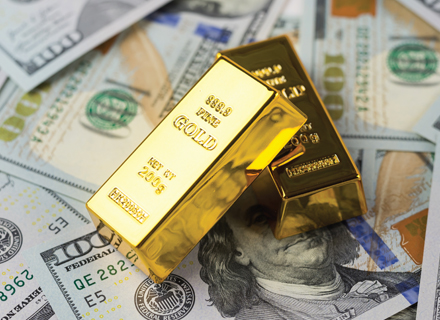

Gold is experiencing a renaissance. After years of steady interest, the precious metal’s value has skyrocketed, rising over 40% in the past year alone and recently shattering all-time price records. In late April 2025, gold breached $3,500 per troy ounce, eclipsing its 1980 peak even after adjusting for inflation.
There’s a palpable mix of excitement and trepidation on the horizon, as investors pile into an asset they view as a haven amidst today’s turmoil. But with gold fever sweeping the markets, many are asking the following: What’s driving this boom, and could it all come crashing down?
A “perfect storm” of economic anxiety, geopolitical conflict, and shifts in monetary policy has burnished the yellow metal’s appeal. Fears of recession and inflation have grown, exacerbated by unpredictable policy moves, such as abrupt changes in US trade strategy, which rattled markets and weakened confidence in paper assets. Wars (whether trade or actual military conflicts) have further spooked investors and fuelled demand for the timeless safety of gold. In this climate of uncertainty, gold’s lustre as a store of value shines brightly once again.
Yet history teaches that what goes up can also come down. Previous gold booms, notably those in 1980 and 2011, were followed by painful corrections. So, is today’s rush for gold a prudent hedge or the makings of a bubble?
International Finance will examine the drivers of the current gold price boom, explore why gold is traditionally seen as a haven, consider the risks of investing amid the hype, weigh expert opinions on a potential bubble burst, and discuss strategies for navigating uncertainty in these volatile times.
Drivers behind gold’s record boom
Gold’s recent rally has been stunning in its speed and scale, and several key forces are behind it. Economic jitters and monetary policy shifts have played a leading role. Over the past year, investors have grown nervous about the global economy’s health.
In the United States, the world’s largest economy, flashing signs of a late-stage cycle include slowing growth, a softening labour market, and rising fears of an impending recession. Inflation, which spiked after the pandemic, remains a concern as well.
Gold thrives in such conditions because it is viewed as a hedge against inflation and currency weakness. Unlike cash, gold’s value cannot be eroded by central banks printing more money or by a surge in consumer prices.
Indeed, analysts point out that the cost of gold “tends to spike in times of high inflation and economic and geopolitical uncertainty.” As inflation fears rise, so does demand for the yellow metal, which is used to preserve purchasing power.
At the same time, monetary policy itself has boosted gold. After aggressively raising interest rates to combat inflation in 2022 and 2023, major central banks adopted a more dovish stance in 2024 and 2025. For example, the United States Federal Reserve halted its rate hikes and even began hinting at (or enacting) rate cuts as economic momentum faltered. Lower interest rates make non-yielding assets like gold more attractive than bonds or savings accounts, reducing the “opportunity cost” of holding gold.
It is no surprise, then, that gold’s price jumped in March 2025 immediately after the Fed signalled a pause, surging above $3,050/oz following a decision to hold rates steady. Expectations of global rate cuts have been a major tailwind.
“We reiterate our long gold recommendation due to the gradual boost from lower global interest rates, structurally higher central bank demand, and gold’s hedging benefits against geopolitical, financial, and recessionary risks,” Goldman Sachs noted.
With the prospect of easier money on the horizon, investors are preemptively moving into gold as a safeguard against any policy-driven currency debasement.
Geopolitical turmoil and uncertainty form the second key pillar of gold’s boom. In recent years, the world has witnessed a series of destabilising events, and gold often shines when confidence in governments or international stability wavers. One major factor has been the escalation of trade conflicts.
Under President Donald Trump, the United States unleashed waves of tariffs and trade threats, sparking a trade war that unsettled global supply chains and alliances. By early 2025, an aggressive new round of American tariffs on many of its main trading partners had investors on edge.
The recent surge in gold prices has closely mirrored the spike in global policy uncertainty, driven in part by fears of substantial tariffs and their potential inflationary consequences, as one analysis observed. Markets interpreted Trump’s erratic trade moves and even direct attacks on Federal Reserve independence as destabilising forces.
For instance, when President Trump lambasted Fed Chair Jerome Powell as a “major loser” on social media and demanded immediate rate cuts, it undermined confidence and sent shockwaves through financial markets. Stocks tumbled, the dollar’s value slipped, and gold promptly hit a fresh record high in the aftermath. This episode vividly demonstrated how political and policy drama can boost gold. When investors fear that policymakers might mismanage the economy or upend the status quo, many seek refuge in a tangible asset whose value is not at the mercy of any government’s decisions.
Beyond trade disputes, traditional geopolitical risks have also driven a flight to safety. Ongoing wars and international tensions, such as the conflict in Ukraine and flare-ups in the Middle East, have unnerved investors and spurred demand for gold, which is often viewed as crisis insurance.
Historical data show that gold’s price tends to rise during episodes of heightened geopolitical risk or military conflict, periods when stocks and even government bonds might fall. In such extreme moments of uncertainty (for example, the days after the 9/11 attacks or the outset of the COVID-19 pandemic), gold has proven its mettle by preserving value and rising in tandem with other havens like the American dollar. Today’s climate, marked by diplomatic rifts and security concerns, is a textbook case of investors hedging against worst-case scenarios.
Crucially, central banks around the world have themselves become major drivers of the gold rush, a relatively new dynamic that cannot be overlooked. Over the past few years, central banks, especially in emerging markets, have been voracious purchasers of gold, bolstering their reserves.
They have collectively bought more than 1,000 tonnes of gold each year since 2022, more than double the average annual purchases in the prior decade. In 2022, when Western nations froze Russia’s dollar reserves in response to the Ukraine invasion, many other central bankers had an epiphany.
“Reserve managers…realised, maybe my reserves aren’t safe either. What if I buy gold and hold it in my own vaults?” explained Daan Struyven, a commodities strategist at Goldman Sachs.
In other words, countries like China, India, Turkey, and Poland (all among the leading gold buyers) are hoarding gold to reduce reliance on the US dollar and the global dollar-centric financial system. The fear is that dollar assets can be “weaponised,” meaning turned into tools of sanction or pressure in times of geopolitical strife.
Gold, by contrast, is sovereign. Holding gold gives these countries an asset that no foreign government can seize or block, a form of financial security amid rising East-West tensions. This structural shift in central bank behaviour has added a steady, price-supporting demand for gold that many analysts say is “unlikely to reverse in the near term,” even if the pace moderates. In short, central banks are effectively building a golden buffer against geopolitical and economic shocks, and that trend has helped propel the market upward.
Finally, market sentiment and investor behaviour have amplified gold’s climb. Success begets success in financial markets, and the sight of gold repeatedly breaking records has triggered a classic case of FOMO, or fear of missing out. From small retail investors to large institutions, many are now scrambling to “get a piece of the golden pie,” as one bullion dealer observed.
Exchange-Traded Funds (ETFs) focused on gold have seen surging inflows, as they offer an easy way for people to buy into the rally without handling physical bars or coins. These investment vehicles have magnified demand. Large funds buying gold on behalf of investors further push up the price, which in turn attracts even more buyers in a virtuous (or vicious) cycle.
“Even a small move out of the big stock market or bond market means a big percentage increase in the much smaller gold market,” Struyven notes.
That is, the gold market is tiny relative to stocks or bonds, so it doesn’t take a huge reallocation of global capital towards gold to make its price jump dramatically. With market volatility elsewhere (stocks and bonds both had rocky periods recently), a modest shift in portfolios toward gold has an outsized effect on its valuation.
Additionally, some investors are seeking insurance against a scenario of stagflation, meaning simultaneous economic stagnation and high inflation, which is a nightmare for most assets but historically a favourable backdrop for gold.
As one commentary succinctly put it, with the risk of stagflation unsettling markets, many are “seeking refuge from both recession and inflation threats” in gold. In sum, a blend of fear and momentum has gripped the gold market, drawn ever more buyers, and fuelled the boom.
Corrections and pitfalls
With gold glittering at record highs and headlines touting its surge, it’s easy to get caught up in the excitement. However, investing in gold during a boom carries its own set of risks and potential pitfalls. For one, the possibility of a sharp price correction or even a bursting bubble looms large whenever any asset rises this far, this fast.
History provides a sobering precedent. The last time gold saw a mania comparable to today’s was in the late 1970s. Spooked by oil shocks and stagflation, investors drove gold to then-record heights in January 1980. But the euphoria didn’t last, as prices crashed violently thereafter. In 1980, gold plunged from a peak of $850/oz (about $2,684 in today’s dollars) to nearly half that value within just three months.
By mid-1981, it had decreased a staggering 65% from its peak. More recently, after gold reached another peak of around $1,900/oz in 2011, amid post-financial crisis turmoil and Eurozone fears, it also experienced a significant decline. Within four months, prices were 18% lower, and the slide continued for two years until gold was roughly 35% below its 2011 high. Investors who bought near those peaks and assumed gold “could only go up” nursed painful losses for years.
Could today’s rally meet a similar fate? It is certainly a risk to consider. Gold may feel solid and timeless, but its market price is volatile and driven by fickle sentiment as much as fundamentals.
A key danger is that many new investors are piling in due to hype or fear of missing out, rather than careful analysis. When an asset becomes a popular talking point at dinner tables and on social media, as gold has now in some circles, it often means a lot of momentum-driven money is at play.
These latecomer investors can quickly exit at the first sign of bad news, accelerating a downturn. Analysts caution that a bout of good news, such as easing geopolitical tensions or stronger economic data that reduces uncertainty, could prick the balloon. For example, one strategist noted that gold prices briefly fell 1.4% following news of a US-China tariff agreement that de-escalated trade tensions, highlighting the price’s sensitivity to shifts in the outlook. If we were to witness several positive developments, such as a lasting peace in a conflict or a strong global growth rebound, the very factors that drove gold prices up could reverse, potentially causing a significant decline in value.
Another risk factor is gold’s lack of yield or cash flow. Unlike a stock that pays dividends or a bond that yields interest, gold provides no regular income to its holder. Investors rely solely on price appreciation to earn a return.
In a booming gold market, that may not seem to matter, since the asset is climbing 40% in a year. But if the price momentum stalls or reverses, gold holders don’t have any interest or dividends to cushion their total returns. Furthermore, if interest rates were to rise again (for instance, if central banks tighten policy to fight inflation), gold could lose favour.
Higher interest rates increase the appeal of interest-bearing assets relative to zero-yield gold. This dynamic was one reason gold languished through much of the 1980s and 1990s when central banks under Paul Volcker and successors kept real interest rates high to rein in inflation. Indeed, an investor who bought gold in 1990 had to wait about 14 years before the price recovered to that level in real terms.
During such long flat stretches, holding gold can mean a significant opportunity cost. Money tied up in gold is money not invested in stocks, bonds, or other assets that might be growing or paying income. As The Independent noted in a recent analysis, these “missed opportunities” are a real drawback of over-allocating to gold. In other words, if you go all-in on gold and it does nothing (or declines) for a decade, you might regret not having put at least some of that money into assets that were flourishing during that time.
Investors must also consider practical challenges and costs associated with gold. Buying physical gold means dealing with storage, insurance, and security, which can be costly and inconvenient. While many people now opt for gold ETFs or other financial instruments to sidestep these issues, those come with their own fees and, in some cases, tax considerations.
Additionally, gold markets can be influenced by factors beyond the average investor’s control, such as central bank actions or fluctuations in jewellery demand in key markets like India and China. These factors can introduce volatility. And if the market turns, gold’s liquidity can also dry up; in a panic sell-off, finding buyers at the last high price is not a given.
All these points boil down to a simple warning that, even during a boom, investing in gold is not a one-way bet. The metal’s famed stability refers to its long-term retention of value, not short-term price stability.
As Susannah Streeter, head of money and markets at Hargreaves Lansdown, aptly put it, “Short-term speculating can backfire,” and those lured by gold’s record run should be careful not to put all their eggs in one (golden) basket.
Gold deserves respect as a haven, but chasing it at peak prices without regard for the downside risks is a recipe that could leave an investor feeling, in hindsight, that all that glittered was not gold.
The big question on everyone’s mind is: How long can this gold boom last? Opinions among experts are divided on whether the market is nearing a peak or just catching its breath before climbing further. Some observers indeed worry that gold has entered bubble territory and that a significant correction is inevitable.
Jon Mills, an industry expert at Morningstar, grabbed headlines recently by predicting that the price of gold could plunge to around $1,820/ oz in the next few years. Such a drop would cut gold’s value nearly in half from its recent highs, a dramatic reversal.
Mills argues that today’s high prices will eventually encourage greater supply, as miners increase production and more individuals sell or recycle old gold. At the same time, some of the short-term demand drivers are likely to diminish. In his scenario, supply and demand would rebalance. A greater flow of gold into the market, plus waning buying by central banks and investors once the current fears subside, could cause the price to retreat significantly.
It is worth noting that since making that bearish call, even Mills acknowledged reality has shifted a bit. Mining costs have risen, and inflation has stayed stubborn, leading him to revise his downside target upward slightly.
The core of the cautionary outlook is that if today’s “perfect storm” of drivers fades, gold could surrender much of its gains. Investors would do well to remember that no asset is immune to economic gravity. Caution, diversification, and a clear-eyed view of one’s goals are essential. Gold can be a prudent part of an uncertainty strategy, but it is not a guarantee against loss or a substitute for a balanced approach.
Ultimately, gold endures as a glittering reflection of our shared hopes and fears. Its boom today signals deep-seated worries about tomorrow. Whether or not the bubble bursts, the true value of gold will likely endure, but the journey could be volatile.
By understanding the forces at play and by hedging bets wisely, investors and the public can avoid turning a haven into fool’s gold. In these unpredictable times, that may be the most important investment advice to heed.