
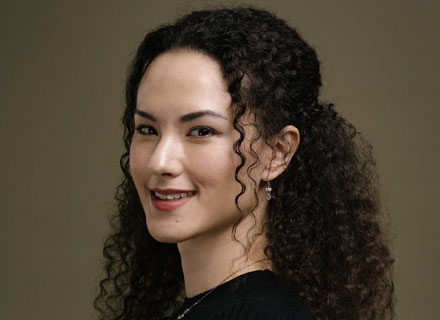

Jay Graber, the CEO of Bluesky, appeared at her SXSW keynote address in March sporting a shirt that seemed to honour Mark Zuckerberg. Similar to the shirt Zuckerberg had designed and worn the previous year, it was an oversized black t-shirt with Latin block text.
In reference to a well-known quote about Julius Caesar and his unyielding desire for power, Zuckerberg’s t-shirt said, “Aut Zuck aut nihil,” or “Zuck or nothing.” In contrast, the phrase “Mundus sine Caesaribus”—”a world without Caesars”—was printed on Graber’s shirt. The shirt served as a scathing indictment of Zuckerberg’s centralised vision.
In contrast to Zuckerberg’s centralised approach to building Meta, Graber aims to manage and develop Bluesky, a dominant social media platform that went live in early 2024, she tells TIME. She claims these digital firms have established virtual kingdoms where their CEOs present themselves as self-made kings.
In the hyper-centralised world of social media, where internet giants like Elon Musk and Mark Zuckerberg make decisions on their own regarding privacy, censorship, and data harvesting for artificial intelligence, this message is becoming more and more relevant. While Bluesky’s daily usage increased by 500%, X lost 115,000 users the day after the election as consumers sought a haven from right-wing trolls, sponsored posts, and disinformation bots. However, X’s daily active user count in the United States was still ten times higher than that of Bluesky. Among the 35 million users of Bluesky today are Alexandra Ocasio-Cortez, George Takei, and Stephen King. It’s the world’s biggest decentralised social network by far.
Beyond its sizable liberal fan base, Bluesky still has a way to go before becoming profitable and widely used. However, Graber asserts that her goal is not to overtake Musk or Zuckerberg as the dominant figure on social media. She declares, “We oppose centralised authority prescribing the rules for everybody else. We would rather not establish a future in which I am a more benevolent emperor. We envision a society in which monarchs are completely unnecessary.”
Bluesky’s interface visually resembles Twitter, with an endless scroll of text posts that are no longer than 300 characters. New users can quickly engage in discussions by using “starter packs,” which are user-generated collections of accounts centred around common interests. Topics such as memes, pop culture, politics, and sports are especially popular among users.
The primary distinction between Twitter and Bluesky is that the latter’s open-source protocol enables users to personalise their content feeds and algorithms. Like Reddit, Bluesky has seen the emergence of close-knit communities that have established censorship guidelines and communication methods. Additionally, because of Bluesky’s architecture, users can move their posts and follows to another platform as long as it uses the same protocol.
It wasn’t Graber who came up with Bluesky. In 2019, Jack Dorsey, a co-founder of Twitter, funded a small group of academics and announced Bluesky as a decentralised version of Twitter. Graber, who had formerly worked on bitcoin projects and had a long-standing interest in decentralised technology, offered to lead the company in 2021. Graber was living in a large communal home with other entrepreneurs during the lockdown in San Francisco.
According to Rose Wang, Graber’s former roommate and current COO of Bluesky, the company’s growth was influenced by the particulars of COVID-19. “How do you get people to feel safe together in this time? There were a lot of community challenges. I believe that our perspectives on creating communities online are greatly influenced by Jay’s and my experiences creating communities offline,” she said.
As per PitchBook, female-led companies in Silicon Valley remain rare, securing only 6% of venture capital deals. Graber says that her and Wang’s identities have shaped their approach to leadership. “As women with extensive online experience,” she explains, “we’ve made moderation a top priority—because we believe it’s essential to building a healthy social platform.”
Elon Musk paid $44 billion for Twitter in 2022. He initially argued in favour of making its algorithm open-source, which could be derived from Bluesky’s technology and research, but he swiftly stopped supporting Bluesky instead. After searching elsewhere, Graber and her team eventually raised $8 million and then $15 million in investment rounds. They also decided to turn Bluesky into a public benefit corporation, which means that they must work for the public and social good in addition to making money.
Demand surged in 2023 as Bluesky prepared to launch its invite-only system, with many potential users pleading with them to remove the platform’s limitations. However, Graber decided to keep Bluesky small until the decentralised tools were developed because they weren’t yet ready.
Currently, Graber oversees more than 100 content moderator contractors and 24 staff members who strive to eliminate harmful posts such as aggressive threats and child sexual abuse information. Dorsey was upset with Bluesky’s content moderation strategy and quit the board last spring, claiming that Bluesky was centralising and that its moderating tools were becoming overly intrusive.
To determine what people see and what they don’t, Graber contends that users should largely design their own moderation systems. She explains, “You have this open right to leave—where you can build your own thing if you disagree with the services, moderation actions, or design choices.”
According to Rudy Fraser, a technologist who started the feed, popular feeds on Bluesky include Science and Blacksky, for Black community building, with 370,000 monthly active users. “Some of the feeds are centred around people who are discovering shared affinity in gender or their identities. I want to create an open network so that communities and individuals who feel excluded from the current social media platforms and power structures can create their own spaces,” Graber noted.
Bluesky continues to lean far to the left politically, and conservatives have complained about being harassed or censored on the site. Additionally, Bluesky’s user growth has slowed considerably since its post-election surge. Furthermore, its 35 million users are insignificant compared to the hundreds of millions on X and Meta’s Threads, not to mention the billions on Instagram and TikTok.
Graber acknowledges that the platform has experienced several ups and downs, but remains unconcerned about the slow growth. To avoid the mistakes of previous social media platforms that prioritised growth over user experience, she feels comfortable taking her time. “Social networks can degrade the main experience of the feed because they have become too accustomed to believing that users are trapped because of the network effects. This monetisation model is likely to reach some natural limits where people grow weary of it, so it won’t last forever,” she explained.
Graber and Wang must now come up with a new revenue strategy that goes beyond using user data to build AI models or running constant advertisements. Graber says she is considering monetising Bluesky’s marketplaces through custom tools or subscription models, despite not having specific plans in place.
Graber and Wang are more than happy to let independent business owners create other platforms on top of Bluesky’s AT protocol, which are likewise open-sourced and compatible with one another, as Bluesky scuttles toward monetisation. Remember how standard email protocols served as the foundation for Gmail, Yahoo, and other inboxes. These new initiatives include Sky-light, a TikTok clone supported by Mark Cuban, and Flashes, an Instagram substitute that has received over 100,000 downloads.
The duo won’t stop anyone from constructing a Bluesky clone on top of the infrastructure. According to Wang, “Greensky can appear the following morning if Bluesky, the server, shuts down overnight. We are frequently asked, ‘How can we trust you?’ Don’t trust us, is our response. Have faith in the infrastructure.”
Only good days ahead
In April 2025, Bluesky rolled out a new verification system, taking the competition with X to the next level. The social platform formerly relied on an unconventional self-verification system, where users could “authenticate” themselves by including custom domains in their web handles. Now it’s adopting a more proactive and traditional verification strategy, with the Bluesky team reportedly identifying notable accounts and bestowing blue check marks.
“It’ll be a rolling process as the feature stabilises, and then we’ll launch a public form that people can use to request verification,” Graber said, adding that the highest-priority accounts right now are government officials, news organisations, journalists, and celebrities. A 2024 study from the MIT Technology Review reveals that Bluesky has grown, and so has the uptick in impersonators posing as public figures. To meet growing demand for ways to confirm that accounts are legit, some Bluesky power users have taken it upon themselves to create their own verification systems. As the app continues to attract celebrity users (former US President Barack Obama joined the platform earlier this spring), a more formal verification process will help reassure public figures that Bluesky is a safe digital hangout space.
In addition to this traditional, top-down verification approach, Bluesky offers “trusted verifier” status to a select group of vetted organisations. These organisations will be given a scalloped blue check mark on their Bluesky accounts. The initial batch of publications selected as trusted verifiers includes The New York Times and WIRED, with more in the works. This same system was initially followed by Twitter, Facebook, and Instagram, where the rule was: you had to actually be famous and verifiable in the public eye.
While users cannot request verification directly, more importantly, Bluesky will not “sell” verification checkmarks like X and now Instagram and Facebook.