

As the UAE’s wealth management sector flourishes amid its rise as a global financial hub, The Continental Group has been empowering clients with customised strategies, innovative solutions, and long-term financial guidance to build, protect, and preserve their wealth across generations.
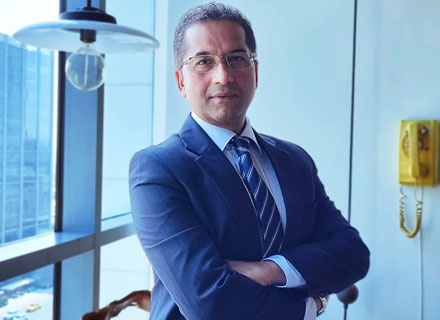
At the forefront of this client-centric approach is the firm’s Senior Vice President – Sales, Kapil Sharma, who brings over two decades of experience in financial advisory and wealth management to help clients achieve financial security and long-term prosperity. He specialises in personal protection, retirement strategies, estate planning, and cross-border wealth solutions.
Kapil’s expertise spans Business and Investment Solutions, including corporate insurance, portfolio bonds, property investments, and structured products, as well as Specialised Financial Solutions such as inheritance tax planning, group pension schemes, and UK pension transfers. He focuses on empowering individuals, families, and businesses to grow their wealth strategically, efficiently, and with lasting confidence.
In an exclusive interview with International Finance, Kapil Sharma, Senior VP – Sales at The Continental Group, shares his client-centric approach to wealth management, emphasising tailored strategies, risk management, sustainable investing, and technology-driven insights to balance short-term goals with long-term wealth preservation and legacy planning.
Can you walk me through your overall approach to wealth management and how you tailor it to meet individual financial goals?
My approach to wealth management is rooted in a deep understanding of each client’s unique financial landscape. I believe that wealth management is not merely about managing assets, but also managing aspirations. Every client’s journey is distinct, shaped by their life goals, values, and circumstances. My first step is always to listen and understand their priorities, tolerance for risk, and long-term vision, including their current provisions to meet their future financial goals.
Once this foundation is built, I design a tailored wealth strategy that aligns with both short-term liquidity needs and long-term capital preservation. I integrate traditional investment principles with modern financial analytics, ensuring that portfolios are both resilient and adaptable to changing market dynamics. The ultimate goal is to create enduring value, helping clients not just grow wealth, but preserve and transfer it across generations.
What is your process for evaluating a client’s current financial situation and understanding their long-term goals?
Evaluation begins with a comprehensive financial discovery session. I assess the client’s income sources, liabilities, existing investments, tax exposures and estate structures. This forms the baseline for the analysis. From there, I conduct a detailed goal-setting exercise to understand not just what clients want to achieve, but why those goals matter to them—whether it’s financial independence, legacy creation, or philanthropic impact.
This combination of quantitative assessment and qualitative understanding allows me to translate life goals into measurable financial milestones. Regular reviews and recalibrations ensure that our strategy evolves alongside changes in life circumstances, regulatory environments, and market conditions.
How do you determine the appropriate asset allocation and investment strategy for clients with varying risk tolerances?
Asset allocation is the cornerstone of a sound investment strategy. I use a structured, data-driven approach supported by risk-profiling tools that quantify a client’s capacity and willingness to take risk. Beyond metrics, I focus on emotional risk tolerance, which is their reaction to volatility or downturns.
Based on this insight, portfolios are diversified across asset classes, geographies and sectors. For conservative investors, I emphasise capital preservation through fixed income and defensive equities with dividend-paying instruments. For growth-oriented clients, I adopt a more dynamic approach incorporating thematic investments, alternative assets and tactical opportunities. Each allocation is designed to balance return potential with downside protection.
How do you stay updated on market trends, economic changes, and new investment opportunities that could affect a client’s portfolio?
Remaining ahead of market developments is central to delivering informed advice in the current world. I maintain a disciplined routine of reviewing global economic reports, monetary policy updates, and geopolitical trends, while also attending international investment forums to gain forward-looking insights.
My approach is built on staying informed, interpreting data in context, and translating insights into strategic action. Continuous learning and adaptability remain central to my practice because the ability to anticipate, rather than react, defines true advisory excellence.
What strategies do you use to manage the potential risks in a client’s portfolio, particularly in times of market volatility or economic downturns?
Risk management is an integral part of every portfolio design. I employ a multi-layered approach, starting with strategic diversification and periodic stress testing.
During periods of volatility, I focus on maintaining liquidity and avoiding emotional decision-making. My philosophy is to prepare clients for uncertainty, not react to it. I believe disciplined rebalancing and prudent cash allocation often prove more effective than drastic market timing. Protecting capital in downturns ensures clients remain positioned to capture recovery when markets stabilise.
How do you balance short-term financial goals like saving for a house or funding education with long-term goals like retirement or legacy planning?
Balancing multiple objectives requires a layered financial architecture. I segment wealth into distinct “buckets” based on time horizons such as short-, medium- and long-term. Each segment has a defined liquidity profile and risk exposure.
For short-term goals, I prioritise stability and accessibility through low-volatility instruments. Long-term objectives, such as retirement and legacy planning, are aligned with growth assets that compound value over time. This approach ensures that short-term needs are met without compromising the long-term compounding journey.
What is your approach to tax planning, and how do you ensure that a client’s portfolio is tax-efficient throughout different stages of life?
Tax efficiency is a silent driver of wealth accumulation. My approach integrates tax planning within every investment decision rather than treating it as a separate exercise. My emphasis is on designing structures that minimise liabilities through asset location strategies, optimised withdrawals, and efficient succession planning.
As clients progress through different life stages, I reassess the tax implications of changing income patterns, investment holdings, and estate considerations. A well-structured, tax-efficient portfolio enhances returns and also provides flexibility in wealth transfer and retirement planning.
How do you incorporate sustainable or socially responsible investing (SRI) strategies into a client’s portfolio?
Sustainable investing has become an imperative. Many clients, particularly in the GCC and Middle East, are increasingly conscious of aligning their wealth with purpose. I integrate ESG (Environmental, Social, and Governance) principles into portfolio construction by identifying financial plans and solutions that demonstrate strong ethical and sustainability practices. Responsible investing is, in my view, the future of wealth management.
What is your philosophy on balancing growth versus preservation of wealth, and how do you adjust that balance as clients age or change financial goals?
Wealth management is a dynamic process that evolves alongside life stages. In the accumulation phase, I prioritise growth through calculated exposure to equities and alternative investments. As clients move into preservation and distribution phases, the focus gradually shifts toward capital protection and income generation.
The balance between growth and preservation is continuously reviewed through life events such as retirement, inheritance, or business exits. Flexibility is key. Recalibrating strategies ensures that portfolios remain aligned with evolving objectives and risk profiles.
How do you handle market downturns or financial crises, and what steps do you take to protect clients’ assets during uncertain times?
In times of crisis, clarity and communication are paramount. My first step is to reassure clients through transparent discussions that explain market realities, and then reaffirm the long-term strategy. Panic-driven decisions can be more damaging than volatility itself.
I emphasise diversification, liquidity buffers, and quality holdings that can weather downturns. During crises, opportunities often emerge, and disciplined investors who stay the course are best positioned to benefit from recoveries. My role is to help clients navigate uncertainty with confidence and resilience.
What tools or technology do you use to analyse and manage client portfolios, and how do you ensure transparency in tracking performance?
At Continental, technology plays a key part in enhancing the teams’ and advisors’ capabilities to serve our clients efficiently and accurately. We use advanced portfolio management tools combined with real-time analytics, performance reporting, and risk metrics to enable clients with insight and tools that provide clear visibility into asset allocation, returns, and benchmarks at any given moment. Technology has elevated the client-advisor relationship from transactional to collaborative. We combine digital insights with human judgement to ensure that decisions remain both data-driven and personalised.
What advice would you give someone just starting out with wealth management to ensure long-term financial success?
Start early, stay disciplined, and think long term. The most powerful element in wealth creation is time, and consistency magnifies its effect. New investors should focus on building a diversified foundation, understanding their risk appetite, and avoiding impulsive decisions driven by short-term market movements.
Equally important is seeking professional guidance early on. A well-structured plan, reviewed regularly, can turn financial goals into tangible achievements. Wealth management should not be skewed to chasing returns. It’s about building security, legacy, and peace of mind over a lifetime.