
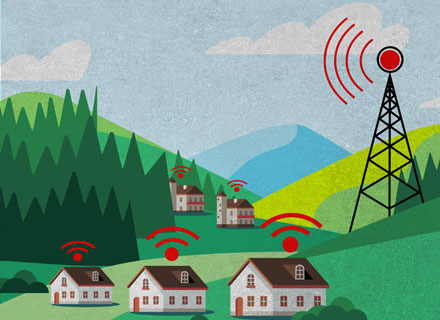

Fixed Wireless Access (FWA) is emerging as a breakthrough solution to extend high-speed broadband beyond the reach of cables and fibres. It uses 4G/5G mobile radio networks to deliver internet to homes and businesses via a dedicated outdoor or indoor receiver, without the need for wires to be run to every house.
With an estimated one-third of the world’s population (about 2.6 billion people) still offline, predominantly in rural and low-income areas, FWA offers a fast, cost-effective way to reach the “last mile.” Unlike plugging a smartphone into a router, FWA uses specialised customer-premises equipment, along with spectrum licenses, to provide stable, high-speed links.
Its portability and lower construction costs make it ideal for areas where laying fibre is prohibitively expensive or slow.
In short, FWA brings fibre-like speeds to underserved areas in weeks or months, rather than years, helping to close the digital divide while opening new business opportunities for investors.
What is fixed wireless access?
Fixed Wireless Access is a broadband service designed for homes and businesses, delivered via a cellular network. As Ericsson explains, “FWA is a wireless connection that provides broadband access to a specific location, such as a home or enterprise premises. It enables high-speed internet via radio signal, without the need for physical cables.”
It typically involves a small antenna (customer premises equipment or CPE) mounted on the outside (or inside) of a building, which communicates with a nearby 4G/5G base station. While FWA can run on existing 4G LTE networks, 5G FWA offers much greater capacity. Because 5G supports much higher speeds and lower latency, it can deliver performance comparable to fibre optics, making it a true alternative even in cities.
FWA differs from personal hotspots or “tethering” in that the receiver is stationary and dedicated, which allows for unlimited data plans and guaranteed performance. In a way, FWA treats each home like a 5G customer, but fixed so that operators can offer symmetrical, high-capacity links similar to wired broadband.
As one telecom strategist put it, fixed wireless has moved from a niche solution to a “primary growth driver” for broadband expansion. The technology works best when homes stay in roughly the same location (no driving off with the router) and ideally have some line of sight to the cell tower. However, new equipment and the use of spectrum are extending the range and overcoming obstacles, widening FWA’s reach.
FWA and the digital divide
Worldwide, connectivity gaps are stark. In high-income countries, roughly 93% of people are online, but in low-income countries, only about 27% have internet access. Rural areas lag even further. Globally, 83% of urban dwellers are online versus only 48% in rural communities. In fact, of the 2.6 billion people still offline in 2024, 1.8 billion live in rural areas. This digital divide is not just statistics; it translates into missed opportunities in education, healthcare, commerce, and more. Providing affordable broadband to underserved populations could be transformative for emerging economies.
In this context, FWA is being embraced as a key bridging technology. Its low infrastructure cost, with no need to dig trenches for cable, can cut deployment expenses by roughly half in hard-to-wire areas.
Deploying FWA involves installing towers and dishes, which is much faster than stringing fibre across mountains or forests. Samsung’s network experts note that FWA “can reach the last mile” and is often “easy and fast to deploy,” making it ideal for unserved markets.
The cost savings also tend to be passed on to customers; for example, rural home internet plans over 4G/5G are often cheaper than legacy DSL or fibre services, aiding adoption in price-sensitive communities.
In remote regions of the United States and elsewhere, towers like this one are being equipped with 5G radios to serve fixed wireless customers. For instance, UScellular, in partnership with Ericsson, launched 5G millimetre-wave FWA service targeting rural and suburban homes.
In April 2022, the company began offering home internet speeds of several hundred Mbps in ten cities. Within months, nearly 180,000 households were able to access the service. Upgrading antenna technology has expanded its FWA coverage area by roughly 40 times, delivering speeds of up to 300 Mbps in areas previously too remote for cable.
Similar efforts are underway at other US carriers; a recent Accenture/ CTIA study finds that 5G FWA could economically serve 8.4 million rural US households, which is nearly half of all rural homes, with high-speed broadband. In the US, billions of dollars in federal subsidies are also being directed toward new FWA-friendly deployments, recognising it as a fast path to connect the hardest-to-reach communities.
Across the globe, governments and telecom companies are promoting FWA as a digital inclusion tool. In Bangladesh, for instance, regulators recently authorised mobile carriers to offer fixed wireless broadband to homes and offices. Under the new 5G guidelines, operators can now use their wireless spectrum to extend coverage into rural villages and urban edge areas where wired infrastructure is sparse.
One local newspaper noted that this move will “extend broadband coverage efficiently, especially in areas with limited wired infrastructure.” In India, Reliance Jio is already deploying FWA on its nationwide 5G network; Jio’s 5G “AirFiber” plans are reaching remote districts and fuelling explosive growth.
A June 2025 report notes that Jio’s FWA subscriber base has ballooned to 6.88 million, slightly surpassing the 6.85 million fixed-wireless users of US-based T-Mobile, making Jio poised to become the world’s largest FWA provider. In many parts of Sub-Saharan Africa, wireless broadband is often the only realistic option. Tarana Wireless, for example, is working with Microsoft’s Airband initiative to deploy “next-generation FWA” in several African countries.
In some regions of Africa, fewer than 30% of people have reliable internet today. Such efforts, using FWA radios capable of handling non-line-of-sight signals and interference, could rapidly improve connectivity for schools, clinics, and homes, even in rugged terrain.
In Latin America and the Caribbean, both governments and multilateral banks recognise significant opportunities. Currently, over 240 million people in Latin America lack internet access, which represents about one-third of the population.
Analysts from Ericsson note that many countries are beginning 5G rollouts with FWA use cases in mind because “FWA is ideal for places that are difficult to access with traditional fixed broadband.”
The Inter-American Development Bank even estimates that closing the region’s digital gap could boost GDP by up to 7.7% and create over 15 million jobs, which is a significant boost to economic growth, gains to which rapidly expanding broadband (whether wired or wireless) would contribute. In practice, some Latin operators have trialled 5G FWA in rural Peru and Brazil, and big carriers like Claro (America Movil) have signalled interest in using 5G home internet to reach unserved areas.
Overall, the message is clear: the areas hardest to wire tend to be exactly where digital connectivity is needed most for development, and FWA offers a practical way to bring broadband to those communities. By delivering multi-hundred-megabit service over the air, FWA can connect remote schools, telemedicine outposts, and low-income neighbourhoods that have fallen off the fibre map. It is already reshaping market dynamics.
For example, in 2023, over 90% of new broadband subscribers at Tier-1 carriers in the US came via FWA rather than fibre or cable. Operators everywhere are taking note. Even smaller regional ISPs and rural cooperatives see fixed wireless as a growth engine, and hardware vendors report that virtually every operator is now planning or deploying FWA networks.
Investment and market trends
FWA is also a bright spot for investors and equipment makers. The global market for fixed wireless broadband is booming. A recent industry forecast values the FWA market at about $36.5 billion in 2024, with projected growth to roughly $127.6 billion by 2032, which reflects a 17% CAGR. This rapid growth is primarily fueled by the need for connectivity in rural and underserved areas. The report notes that “growing demand for broadband in underserved and rural areas is driving market growth.”
Unsurprisingly, most of the early deployments have been in North America, which currently holds the highest share of the FWA market, but Asia-Pacific is expected to grow the fastest, thanks to initiatives in India, China, and Southeast Asia.
Major industry players are positioning themselves accordingly. Traditional telecom giants like Verizon, T-Mobile, AT&T (all in the US) and equipment vendors like Nokia and Ericsson are highlighted as top FWA players.
Indeed, each of the “big three” US wireless carriers has already launched 4G/5G home internet products and is investing in FWA-capable radio sites. On the vendor side, Nokia and Ericsson have boosted their FWA product lines in recent years. Nokia’s 5G AirScale and Lightspan products, and Ericsson’s FWA CPE and small-cell portfolios, are being sold into markets worldwide.
Even traditionally mobile-focused equipment makers are touting FWA. For example, Samsung has made statements about how its 5G radios can be used to cost-effectively extend broadband under US government subsidy programmes.
There is also a surge of private investment and partnerships in this space. United States-based startup Tarana Wireless, which makes so-called “next-generation FWA” gear optimised for NLoS rural use, has attracted over $400 million in R&D and capital to date.
In 2023, Tarana raised an additional $50 million from Digital Alpha, a digital infrastructure investor, to scale its deployments. Digital Alpha’s thesis is centred on funding wireless internet service providers that rely on FWA, recognising that this technology can “fundamentally change network performance and operator economics” for rural ISPs. Tarana’s C1 (Gigabit 1) platform is now used by hundreds of small ISPs in 21 countries, and its success stories have piqued investor interest.
Despite its promise, FWA also faces challenges. Many regions still lack sufficient mid-band 5G frequencies or the regulatory approvals for using them in fixed services. Without mid-band spectrum, operators may rely on crowded sub-6GHz or limited mmWave bands, affecting coverage or penetration.
FWA can claim to offer fibre-like speeds, but real-world throughput may vary based on distance, interference, and whether customers share a cell. Some early fixed wireless plans experienced speed fluctuations or data caps that limited user experience. Emerging “next-gen” FWA systems aim to reduce these issues, but rollout and operator expertise are still catching up with the technology hype.
Finally, bridging the digital divide is not just a technology problem but also involves local education and support. In some regions, even when high-speed internet is available, adoption is low due to affordability, digital literacy, or competing priorities. Effective FWA initiatives often pair network buildout with programmes for subsidised service, community training, or partnerships with schools and clinics.