
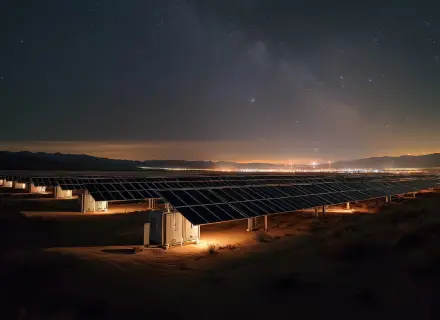

United States-based clean energy start-up “Overview Energy” hit the headlines on December 10, as the venture emerged with a plan to use the world’s solar panels as nighttime collectors of power beamed down from space.
The start-up aims to utilise large solar arrays in geosynchronous orbit, approximately 22,000 miles above Earth, where satellites synchronise with the planet’s rotation to harvest sunlight. The breakthrough technology will then use infrared lasers to transmit that power to utility-scale solar farms on Earth, allowing these facilities to send power to the grid nearly around the clock.
Building Up The Concept Called Space Solar Energy
The concept of “Space Solar Energy” is taking shape quite nicely in the United States and will likely lead the next-generation clean energy research and development efforts. Among the players taking the lead in the research and development-related efforts in this arena, we have Overview Energy.
As the start-up plan revealed its use of the world’s solar panels as nighttime collectors of power beaming down from space, it also raised USD 20 million, and part of that has now gone toward an airborne demonstration of the start-up’s power-beaming technology. A light aircraft, in November 2025, transmitted power using a laser to a ground receiver over a distance of five kilometres (three miles).
However, Overview Energy will be up against competitors like renewable energy player Aetherflux, which is also pursuing a laser-based approach. Then there are ventures like Emrod (pioneering commercially viable long-range wireless power transfer technology), Orbital Composites (a venture redefining additive manufacturing with advanced composites and robotic automation), and Virtus Solis (which has reportedly designed the world’s first space-based solar power energy generation system) that are developing their versions of microwave-based power transmission, which sends energy wirelessly using a different portion of the electromagnetic spectrum than Aetherflux and Overview.
Betting Big On Microwaves
Microwaves are less sensitive to clouds and humidity than infrared lasers, while the latter can’t transmit in cloudy weather since the suspended water droplets would absorb much of the energy. However, since microwave-based systems can’t reuse existing solar farms, they would have to build their own ground stations.
Also, the ground receivers need to be smaller in shape so that they can keep the costs down. In that case, the energy beams need to be tighter and more powerful to make sure they get caught by the receivers efficiently, without causing collateral damage to birds and aircraft.
While renewable industry players are working to address these challenges, Overview Energy has pitched the reuse of solar farms to mitigate some of those concerns. However, the real deal will be to convince people that energy beams from space are safe and won’t stray off target.
Also, the start-up will have to ensure its laser system is very efficient to prevent a situation where solar energy is converted to infrared light and back again.
The start-up is targeting a 2028 timeline to launch a satellite into low Earth orbit, far below the 36,000 kilometres (22,000 miles) at which it finally intends to operate. The satellite will start sending megawatts’ worth of power from geosynchronous orbit from 2030 onwards.
The innovation will also be facing two more rivals: cheaper grid-scale batteries, which are rewriting the United States’ energy storage rulebook, and nuclear fusion in the long run.
What prevented “space solar energy” from elevating from the concept stage to the commercial one were factors like expensive launches, fragile hardware, and, most importantly, the fact that the technology to beam power safely to Earth wasn’t ready.
However, with the rise of the private space industry, launch costs have dropped more than tenfold, and annual launches have grown massively as well. Mass manufacturing of satellites is now routine. High-efficiency photovoltaics and high-power, high-efficiency lasers have become inexpensive, reliable, and commercially available.
The start-up has set a standard for its action plan of sending megawatts’ worth of power from geosynchronous orbit: transmission must be completely safe for people, wildlife, aircraft, and other satellites, while the whole process should cost less than USD 1 billion, which will make it competitive with its industry rivals.
The start-up also plans to use significantly less land than traditional solar plants with battery storage. The solution has a distributed design, eliminating any single point of failure.
Taking A Pragmatic Path
Overview Energy’s satellites will operate at an altitude of approximately 36,000 kilometres (about 22,000 miles) in geosynchronous orbit, collecting sunlight continuously and transmitting it as low-intensity, invisible infrared light.
Since Overview Energy will be using existing solar projects as its infrared beam receivers, requirements such as new land, construction, and years-long waits for interconnection will be eliminated. The start-up’s satellites will be the first moving power plants, directing energy across regions in seconds and across continents in minutes.
This will lead to a situation where solar projects will be generating revenue during 65%-75% of operational hours, without making their assets sit idle. Utilities will be bypassing congested corridors and drawing on infinite energy reserves above the atmosphere. Households will see lower electricity costs, as satellites will be blunting the peaks that drive price spikes.
Off-takers like data centres will have access to massive energy capacity, which will help them come online in days instead of years.
The business is currently busy solving problems such as sourcing cost-efficient materials, precise tracking, and deployable architecture. The whole operational architecture is being tested and validated from lab to aircraft to orbit. Each phase is demonstrating the same core technology that will operate in space, focusing on real-world constraints, while helping the start-up inch toward its cost targets.
Airborne Demo Bringing The Concept To Reality
In November 2025, the start-up achieved a world first in power beaming, as it transmitted power from a moving aeroplane to solar panels on the ground, covering a distance of more than 5,000 metres in the process.
Overview Energy’s team installed laser and optical systems on a Cessna Caravan and flew at an altitude of over 5,000 m (16,500 ft). On the ground, it installed a receiver of standard solar panels, the same kind used in utility-scale projects or homes.
As the aircraft flew overhead, the system identified the receiver, locked onto it, and delivered power through an eye-safe beam. The panels convert that light into electricity in the same way they convert sunlight.
The whole experiment validated the performance of Overview Energy’s core technical pieces that will realise the concept of “Space Solar Energy.” The proof-of-concept phase has also been completed with the airborne technology demonstration. It will now be followed by a pilot low Earth orbit (LEO) mission in 2028 that will demonstrate the full system’s performance in space. The final step will be the Overview Energy’s geosynchronous orbit (GEO) satellites taking over the proceedings in 2029–2030, where they will see the sun 99% of the time.