
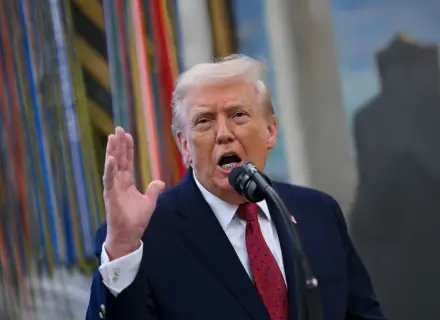

It’s a dangerous time for markets around the world, with the United States President Donald Trump moving away from market takeovers to imperial expansion. After the detention of Venezuelan President Nicholas Maduro, Trump has set his eyes on Greenland, and is willing to acquire the territory through purchase or military action. He has imposed sweeping sanctions on European allies who are supporting Denmark’s right to retain Greenland.
Trump has also made immigration tough, and the shooting of a woman in Minneapolis by ICE (Immigration and Customs Enforcement) agents has the whole nation on edge.
Amidst such developments, Suzanne Clark, the CEO of the US Chamber of Defence, urged corporate leaders to courageously defend free-market principles against expanding government intervention. Speaking in a dimmed ballroom, Clark emphasised that America must maintain its openness to global commerce, the exchange of talent, innovative ideas, and international trade partnerships.
While Clark avoided directly naming President Donald Trump or his specific policies, her remarks represented a subtle critique of the administration’s unprecedented interference in corporate affairs. The Republican has broken new ground in executive involvement with private business operations, taking positions in technology companies, dictating corporate equity arrangements, implementing sweeping tariffs, and pursuing immigration restrictions that the Chamber opposes.
Clark’s comments reflect a broader pattern emerging among American business leaders, including measured, careful criticism that stops short of confrontation. This cautious approach marks a significant shift from Donald Trump’s first presidential term, when executives were more willing to publicly break with the administration over controversial issues, including the president’s response to the 2017 white nationalist rally in Charlottesville, Virginia.
Selective Corporate Criticism
Several high-profile CEOs have recently voiced concerns about specific administration policies, though their objections remain narrowly focused on areas directly affecting their business interests. ExxonMobil CEO Darren Woods and JPMorgan Chase CEO Jamie Dimon both made headlines with tempered criticisms, but limited their remarks to Venezuela’s oil sector and Federal Reserve independence, respectively.
The muted nature of these responses has drawn criticism from governance experts and political observers. Richard Painter, a University of Minnesota law professor who served as chief ethics counsel under President George W. Bush, characterised the business community’s reaction as disappointingly weak.
He pointed to concerning developments, including immigration enforcement actions affecting US citizens in Minneapolis and Trump’s consideration of claiming Greenland, which could potentially isolate American companies from European markets.
Painter noted the stark contrast between the current administration’s authoritarian tendencies and Bush’s commitment to free-market economics. He emphasised that business leaders need to take a stronger stance against governmental coercion, regardless of whether it targets street protesters or corporate executives who resist presidential pressure.
Mark Levine, New York City’s Comptroller, overseeing substantial public pension fund investments in major US corporations, echoed these concerns. He characterised CEO responses as merely “baby steps,” with executives speaking up only when Trump’s actions directly threaten their bottom lines. Levine warned that capitalism cannot function properly if presidents with autocratic inclinations dictate corporate behaviour across American industry.
The Chamber’s Defence
Responding to criticism, a Chamber spokesperson referenced Clark’s media briefing, where she stated the organisation’s opposition to government intervention in business regardless of partisan source. Clark suggested that CEOs have been engaging in “quiet work” behind the scenes to promote sound public policy, avoiding what she termed a “rush to outrage.”
This approach aligns with the Chamber’s strategic positioning. In August 2025, the organisation’s chief policy officer, Neil Bradley, indicated that the group intended to respond to Trump in a nonpartisan manner to preserve broader support for free-market principles.
Presidential Pushback And Economic Perceptions
The public’s perception of Trump’s economic success contradicts his claims. He presently has a 36% approval rating on economic issues, which is lower than his 41% approval rating overall. Despite Trump’s claims that his policies have produced explosive growth, soaring productivity, booming investment, rising earnings, and conquered inflation, this mismatch still exists.
When CEOs have dared to question his approach, Trump has responded swiftly and sharply. After Woods expressed scepticism about Venezuela as an investment destination, calling it “uninvestable,” Trump threatened to exclude Exxon from future deals in the country, criticising the company for “playing too cute.” Similarly, when Dimon defended Federal Reserve Chair Jerome Powell’s independence following a criminal investigation into Powell’s conduct, Trump dismissed the CEO’s concerns outright.
Pfizer CEO Albert Bourla also voiced frustration over Health Secretary Robert F. Kennedy Jr.’s efforts to roll back childhood vaccine recommendations, calling the moves scientifically baseless. However, representatives from Exxon, JPMorgan, and Pfizer all declined to provide additional comments for this story.
A Climate Of Uncertainty
The dread that permeates business boardrooms is highlighted by recent surveys. According to the Conference Board’s most recent study, uncertainty will be the biggest risk factor for American CEOs in 2026. Chief economist Dana Peterson pointed out that executives are aware that the lobbying environment has drastically changed, even if the study did not specifically address Trump.
According to Gary Clyde Hufbauer, a senior scholar at the Peterson Institute for International Economics, CEOs might be carefully calibrating their public remarks to prevent reprisals while positioning their businesses to profit from Trump’s aims and policies. He cautioned, though, that this laissez-faire strategy might backfire and lead to even more stringent regulations after Trump leaves office.
Executives may see the current interventionist policies as transient anomalies, according to Hufbauer. However, he warned that since state capitalism appeals to both progressive Democrats and some MAGA Republicans, investors and business executives may be dangerously complacent about long-term defence of free-market values.
The conflict between corporate America and the Trump administration raises important issues regarding the balance between private industry and governmental authority, as business executives must balance safeguarding their own interests with upholding more general economic liberties.