
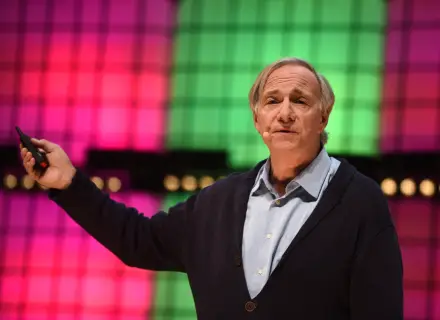

According to Ray Dalio, the billionaire founder and former CEO of Bridgewater Associates, one of the largest global hedge funds with USD 162 billion in assets under management, the one principle an investor should focus on now is diversification. He also mentioned that the United States will be able to hedge against uncertainty in a highly leveraged market by investing in gold.
“Diversification is very important, particularly in times of current uncertainty, to make tactical decisions that could help you beat the markets. We emphasise diversity. Based on that, a well-diversified portfolio will have somewhere between 10%-15% in gold. It is an alternative currency that is uncorrelated with other assets, because when you have a crisis, it tends to go up a lot and the others go down a lot,” Ray Dalio said while attending the launch of the Abu Dhabi Financial Week (ADFW) 2025.
In July 2025, he divested his final share in Bridgewater Associates, the hedge fund he started 50 years ago. The hedge fund veteran further stated that investors need to reevaluate what a neutral portfolio is and avoid becoming too heavy on traditional debt and asset classes, diversifying appropriately.
“The world is abundant in debt. When you are holding money, you are holding a debt instrument. And one man’s debt is another man’s asset. So, when you are holding it as an asset and a store of wealth, there is a problem,” Ray Dalio said.
Taking note of the rising geopolitical tensions, the hedge fund veteran remarked, “It’s important to know whose money you’re holding.”
He pointed out that countries like China, Japan, and Russia placed their reserves in US assets, mostly bonds, which ultimately didn’t work out well for them.
“For these reasons, people should consider what a neutral portfolio looks like and should not be so biased toward traditional debt and asset classes,” he added, while noting that even though American tariffs may bring in revenue for the world’s largest economy, the country is spending even more to service its debt.
Dalio compared the credit and capital markets to the human circulatory system, as he concluded, “Credit works like nutrients. If it’s directed into investments and activities that generate income, the system stays healthy. But when it’s not, debt servicing builds up like plaque, squeezing out other spending. That’s what we’re seeing happen now.”