

In October 2025, Washington-based Stoke Space raised USD 510 million in a funding round led by entrepreneur Thomas Tull’s US Innovative Technology Fund. The start-up will use the newly acquired funds to accelerate the development of its Nova reusable launch vehicles.
As space is set to become the new battlefield for defence missions and commercial exploration (including space tourism), governments and private companies around the world are steadily increasing their research, development, and infrastructure-related spending.
Staying true to this trend, the fundraiser saw additional backing from Washington Harbour Partners and General Innovation Capital Partners, along with existing investors, including 776, Breakthrough Energy, Glade Brook Capital, and Toyota Ventures.
Commenting on the news, Michael Ashley Schulman, partner at Running Point Capital Advisors, told Reuters, “Investors, especially those who may have missed out on SpaceX, are still very much in the mood for moonshots despite gravity, interest rates, and valuations. Stoke is building as if it expects… a future where sending cargo to orbit becomes as routine as shipping boxes through UPS or FedEx.”
Stoke Space has made headlines in 2025, as earlier in the year, the venture was awarded a “National Security Space Launch” contract by the United States Space Force, joining the likes of Elon Musk’s SpaceX, Jeff Bezos’ Blue Origin, Rocket Lab USA, United Launch Alliance, and others, with the common goal of strengthening Washington’s space launch capabilities.
Making The Space Sector Green Again
There is a growing demand for medium-lift launch capacity for defence, with the Donald Trump administration backing the Golden Dome missile defence system, in which space-based assets—whether offensive or defensive—will play a huge role in the early detection and neutralisation of enemy warheads. In line with Washington’s requirements, Stoke Space is developing the fully reusable Nova Rocket for frequent, low-cost space launches. However, the start-up aims to implement its plan in an eco-friendly manner.
“Our 168,000-square-foot headquarters is home to our vertically integrated design and manufacturing operations. Leveraging next-generation tools and methods, Stoke’s rocket engines, structures, and avionics are built in days, not months or years. And with our test facility just a three-hour drive away, we test and iterate with unprecedented speed,” the start-up commented.
Since its inception in 2019, Stoke Space has been setting new benchmarks for sustainability over the last seven years, reducing atmospheric impact by 98% compared to the 21st century’s most prolific rockets. The company’s long-term vision is to foster a booming space economy that not only propels human ambition but does so with an unwavering commitment to environmental stewardship, making the space economy both sustainable and scalable.
Central to Stoke’s mission of making the space industry sustainable and scalable are the start-up’s high-efficiency engines, which significantly reduce harmful emissions, thereby creating the lowest environmental impact of any existing rocket. According to the American Geophysical Union, the current crop of rockets relies on solid rocket boosters or kerosene-based engines, both of which release harmful emissions into the upper atmosphere.
While kerosene engines account for 70% of all rocket-driven global warming impacts, emitting black carbon soot (fine particles resulting from the incomplete combustion of fossil fuels, biofuels, and biomass) that traps heat 500 times more effectively than aviation emissions, solid rockets account for 28% of rocket-based warming and release ozone-depleting chemicals like chlorine and aluminium oxide.
To steer the space sector in a greener direction, Stoke’s breakthrough product has been its Nova Rocket, powered by liquid natural gas/liquid oxygen in the first stage and liquid hydrogen/liquid oxygen in the second stage, combining to form one of the world’s most efficient fully reusable rockets. These clean fuels are known for eliminating black carbon emissions, the single most damaging factor in today’s orbital launches, while also reducing rocket-driven global warming by 98%.
Knowing Nova In Detail
Talking about its flagship product, the start-up stated, “Nova’s fully reusable design changes the fundamentals of cost, availability, and reliability of launch. Full reusability means production costs are amortised across launches, and flight frequency isn’t limited by production rates. And with 100% reusability, every mission uses flight-proven hardware.”
The 100% reusable model also enables return shipments from space to Earth, unlocking new mission types and business opportunities. Not only does the rapidly reusable model make economic sense for today’s emerging market, but it is also the only approach to sustainably scaling the industry. Stoke Space’s reusable upper stage features a liquid, regeneratively cooled metallic re-entry heat shield with an integrated modular liquid hydrogen/liquid oxygen (LH2/LOX) rocket engine. It’s robust, resilient to damage, and operates with passive failure modes.
Designed for minimal refurbishment between flights, the second stage unlocks rapid turnaround and offers direct access to GTO (Geostationary Transfer Orbit), TLI (Trans-Lunar Injection), and other high-energy orbits, unlimited engine restarts, and return from orbit to the launch site: precision-powered vertical landings.
Stage one, known as full-flow staged combustion (FFSC) and powered by liquefied natural gas/liquid oxygen (LNG/LOX), is the pinnacle of rocket engine cycles, providing high performance and efficiency while stressing the engine less than other, simpler engine cycles. FFSC has the highest ceiling for performance, efficiency, long life, and rapid reusability.
Stage two is the expander cycle with an integrated heat shield. Powered by liquid hydrogen/liquid oxygen (LH2/LOX) fuel, which offers 30% higher efficiency and five times better cooling than conventional hydrocarbon fuels. With highest-in-class performance and unlimited restarts, the start-up’s stage two engine enables missions directly to high-energy orbits. The nozzle accommodates deep throttle operation even in the presence of atmospheric pressure and serves as an actively cooled metallic heat shield during atmospheric re-entry.
“Our dynamic approach to design, testing, and production enables us to deliver high-quality, efficient, and fully reusable rockets at an unmatched pace. We build in long life and rapid reusability from the start, using steel rather than carbon composite to give Nova’s tanks exceptional thermal properties, strength, and ductility. Steel tanks are better able to endure the multiple cycles of pressurisation, high and low-temperature cycles, and mechanical stresses of rapid reusability,” the start-up stated.
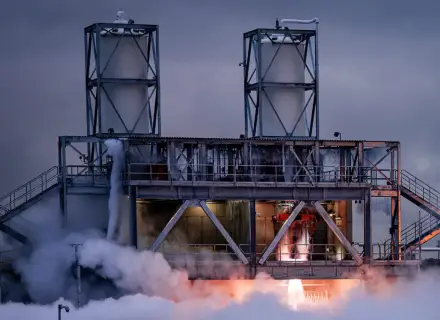
Central to Stoke Space’s R&D efforts is the start-up’s private test facility in Moses Lake, Washington, just a three-hour drive from the company’s vertically integrated design, development, and manufacturing facility, enabling the company to test, learn, iterate, and test again faster than its industry peers.
“Our state-of-the-art vertical test stand for our stage one engine is designed to qualify our full-flow staged combustion engines at full thrust and full duration—in the orientation in which they’ll launch. Our Moses Lake test facility has an ever-expanding selection of test cells for testing structures, pumps, combustion devices, engines, and more,” the start-up noted.