
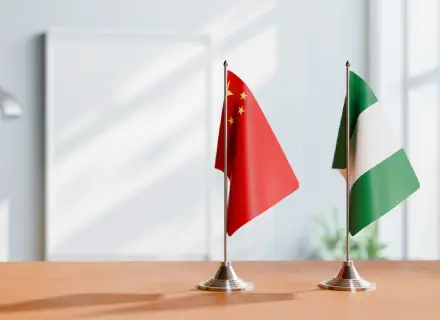

China and Nigeria formalised diplomatic relations on February 10, 1971, a decade after Nigeria gained independence. Initially driven by Cold War-era geopolitics, their relationship remained modest until the early 2000s, when Nigeria emerged as China’s key oil supplier.
By 2006, bilateral trade reached USD 3 billion, up from USD 384 million in 1998. In the same year, Chinese President Hu Jintao visited Nigeria, securing several oil-drilling licenses and pledging USD 4 billion for oil and infrastructure projects, including a USD 1 billion loan for modernising railways.
These early years exhibited notable imbalances: Chinese exports comprised nearly 80 % of Nigeria’s imports, stifling local industries (textiles, in particular) and resulting in factory closures and mass layoffs.
Still, this relationship laid the groundwork for large-scale infrastructure investments funded through export-import transactions and loans, often carried out under China’s Belt and Road Initiative (BRI) umbrella.
Scaling Up With Strategic Focus
There are three major developments in recent times. They include the Levi Corridor Road, Kano Kaduna railway and the Lagos-Kano Standard-Gauge Railway.
In May 2025, Nigeria’s federal executive council approved a USD 652 million loan from China’s Exim Bank for a critical road linking Lekki Deep Sea Port with the Dangote Refinery and southern states. This corridor is meant to streamline logistics, boost trade flows, and connect major economic hubs.
In January 2025, China Development Bank released a USD 254.76 million instalment to support the 203 km Kano–Kaduna rail project, which is part of the broader Lagos–Kano railway and integral to boosting passenger travel and security in Nigeria’s north.
Since the Abuja–Kaduna segment began in 2016, China has steadily funded and constructed additional segments through CCECC, reviving a rail network that was nearly defunct by the 2000s. Efforts continue on Lagos–Ibadan, Kaduna–Kano, and coastal rail segments valued collectively at billions of dollars.
There are also energy and industrial infrastructure developments. In late 2024, Nigeria inked a USD 1.2 billion deal with China’s CNCEC to refurbish a gas-processing plant critical to its aluminium sector, demonstrating deeper industrial collaboration.
Recently, some 36 Nigerian governors signed an MoU with Chinese partners to address the African country’s energy crisis through renewables. Concurrently, Nigeria also explored nuclear cooperation with China in small modular reactors.
China is also trying to build a comprehensive strategic partnership in Africa. In January 2025, Nigerian Foreign Minister Tuggar hosted China’s Wang Yi, elevating bilateral ties to a comprehensive strategic level. They committed to collaboration on clean energy, defence, infrastructure, a possible currency swap expansion, and support for Nigeria’s “Panda bonds” to raise infrastructure capital. In June 2025, China announced it would eliminate tariffs on exports from its 53 diplomatic partners in Africa, including middle-income nations like Nigeria. This aims to balance trade (where China maintains a USD 62 billion surplus) by easing access for African-manufactured goods.
Sector-Wide Analysis
Robust funding for roads and rail (such as the Lekki corridor and Kano–Kaduna line) is transforming Nigeria’s logistics backbone. These projects reduce transportation costs, enhance distribution networks, and increase competitiveness for Nigerian goods; they also create immediate construction jobs and stimulate regional economic activity.
Energy infrastructure enhancements, in fossil fuels and renewables, directly influence Nigeria’s energy security and industrial productivity. The gas plant rehabilitation supports downstream manufacturing (notably aluminium), while renewable energy projects aim to diversify energy sources beyond traditional fossil fuels and enhance rural electrification.
Duty-free access to the Chinese market marks a significant milestone. Countries like Nigeria, Kenya, Egypt, and Morocco (boasting burgeoning manufacturing sectors) stand to gain from tariff elimination. Successful execution could stem the flow of value-added goods to China, rebalance trade, and nurture local manufacturing.
The currency-swap agreement with China and Panda bond mechanisms diversify Nigeria’s capital sources and reduce dependency on Western debt. They also provide buffers against naira volatility and dampen exchange rate pressures, which is critical given Nigeria’s high inflation and currency struggles.
Strategic Considerations And Potential Risks
Nigeria’s debt to China has surpassed USD 5 billion, making China its largest bilateral creditor. While concessional loans fuel growth, they also increase debt-service obligations and potential disputes over repayment terms, especially if projects underperform.
Despite new initiatives, the historical dominance of Chinese imports poses a challenge. Domestic industries (particularly textiles and light manufacturing) have been undone by an influx of cheap imports. Tariff removal is a necessary but not sufficient step; domestic industrial policies must evolve to build real capacities.
Chinese investment’s historically top-down nature risks sidelining community voices, transparency, and labour standards. Future success depends on embedding oversight, environmental diligence, and fair labour practices.
Emerging as West Africa’s logistics nucleus, Nigeria (with deeper Chinese engineering and funding) can serve as a gateway for trade to neighbours. Its ports, railways, and roads could benefit broader regional integration.
Nigeria’s strategy exemplifies a recalibration of relations with China, aligning with African calls for “greater agency” in external partnerships. By demanding better terms, trade access, and project alignment with domestic goals, Nigeria sets a template for other nations.
If the elimination of Chinese tariffs holds, Nigeria’s manufacturing ambitions (especially in agriculture, minerals processing, and light goods) may gain footholds. Complementary policies like subsidies, export incentives, and standards enforcement will be essential for capitalising on new market access.
China remains Africa’s top bilateral trade partner, with USD 282 billion in trade in 2023. Despite complaints over debt traps and slowing GDP in China, Nigerian and African leaders view China as a stable source of development finance. The ongoing partnership challenges Western dominance and offers African states alternative development pathways.
Success means transforming infrastructure into thriving manufacturing sectors, leveraging trade access, and using new financial tools to drive inclusive growth. Failure risks deepening dependency, worsening debt burdens, and allowing policy missteps to marginalise local industries.
Africa and the world are watching. If Nigeria leverages these tools to deliver jobs, reduce poverty, and fuel regional value chains, it could spark a model for Pan-African growth. But it will take strategic governance, local capacity-building, and bold policy reform to turn billions in infrastructure into sustainable, equitable development.