
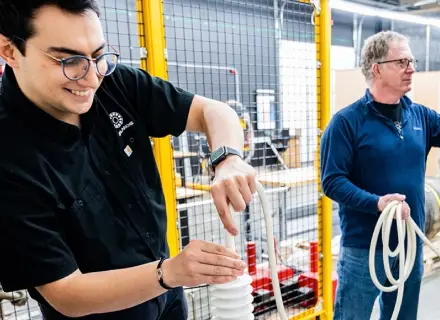

Seattle-based Avalanche has been in the news for developing enormously energy-dense compact fusion machines for clean power generation. The start-up’s small design allows the venture to iterate designs in days, apart from building tons of hardware onsite, and, most importantly, applying game-changing fusion energy to applications from lunar surface power to transportation to the deep sea.
Avalanche recently caught attention for operating its desktop fusion machine for hours on end while maintaining 300,000 volts, a figure the start-up predicts will allow it to build a reactor capable of generating more energy than it consumes, the “holy grail” for any fusion company.
Whereas other fusion companies need powerful magnets to generate energy, Avalanche’s design uses intense electrical currents to draw fast-moving ions into tight orbits around an electrode. As the density and speed of the ions rise, they begin to collide and fuse, releasing energy in the process.
What Avalanche Is Up To
The Seattle-based start-up, while developing enormously energy-dense compact fusion machines for clean power generation, is focusing on keeping the products’ designs small, as in the words of the venture, “Our small design allows us to iterate designs in days, build tons of hardware onsite, and apply game-changing fusion energy to applications from lunar surface power to transportation to the deep sea.”
According to Robin Langtry, Avalanche’s co-founder and CEO, his company specialises in building small reactors, targeting anywhere from five kilowatts to several hundred kilowatts. The density of that voltage, six million volts per metre, will also become important in the coming days, as with the help of such breakthrough technology, Avalanche expects it will be able to generate a large number of neutrons at low cost, which can be used to make radioisotopes and evaluate materials for use in fusion reactors.
The company recently got a USD 10 million contract from Washington State to build “FusionWERX,” a testing facility where other fusion companies and researchers can book time to study their own fusion technologies. The grant money comes from proceeds from the state’s carbon marketplace. At the facility, fusion companies and researchers will be able to test their hardware and retain full ownership of their IPs.
“FusionWERX will serve as a first-of-its-kind commercial-scale testing facility for advanced fusion technologies, offering access to private companies, universities, national laboratories, and public-private consortia working to accelerate the path to commercial fusion power,” Avalanche stated.
Langtry also sees the sales of radioisotopes and rentals of the FusionWERX facility making Avalanche profitable in 2028, as the start-up eyes generating USD 30-50 million worth of revenue by 2029. As per reports, the venture is looking to raise a Series B round.
Fusion Approach
Avalanche’s “Fusion Approach” revolves around high-speed ions electrostatically confined in processing elliptical orbits around a negatively charged cathode, through three stages: Ion Injection, Ion Capture, and Ion Densification. Fusion here refers to the generation of energy through the process of nuclear fusion. At its core, fusion power aims to replicate and harness the same powerful physics that drives the sun and the stars. Throughout the fusion process, light elements such as hydrogen are forced together under extreme heat and pressure to form heavier elements, releasing an immense amount of energy; four million times more energy than an equal mass of coal.
“Research and development in fusion power, advancements in fusion technologies, high-voltage power systems, computing, and magnets are accelerating, bringing us closer to practical fusion energy systems. While fusion power may not be realised immediately, it holds the promise of transforming our energy landscape, delivering an abundant and sustainable source of power for a cleaner, more prosperous future,” the start-up stated.
Avalanche’s Big Bet
A fusion reaction does not release greenhouse gases. And unlike nuclear fission, fusion does not produce long-lived radioactive waste. In the event of any unforeseen disruptions, the fusion reaction naturally ceases, minimising potential hazards. To power fusion, five different fuels exist and are practically limitless in supply. Depending on the power needed, some fuels are more easily accessible.
Fusion releases roughly four million times more energy than an equal mass of burning coal, and four times more than nuclear fission. By reducing dependence on finite fossil fuel reserves, fusion provides nations with greater energy independence. Fusion also meets the rising global energy demand without depleting natural resources or causing irreparable harm to the planet.
“Fusion energy generation requires the merging or combining of light atoms, such as hydrogen, to form heavier elements, while fission energy generation is the process of splitting or fragmenting heavy elements into lighter ones. How is fusion cleaner than fission? Fusion reactions do not produce long-lived radioactive waste materials as a byproduct. In contrast, fission reactions generate radioactive waste that requires careful management and long-term disposal due to the long half-lives of certain fission products. How is fusion safer than fission? Fusion energy devices require exceptionally difficult conditions to continue the fusion process. In contrast, fission reactors require precise control mechanisms to prevent uncontrolled chain reactions that generate too much energy, possibly leading to accidents. Any disruptions to fusion conditions, on the other hand, result in the natural cessation of the reaction,” Avalanche commented.
The Orbitron
Avalanche is developing a 1–100kWe compact fusion machine called “The Orbitron,” ultra-small and ultra-lightweight in its category, where high-speed ions get electrostatically confined in processing elliptical orbits around a negatively charged cathode. The unique physics of the Orbitron allows for its compact size, which is a key enabler for rapid development, scaling, and a wide variety of applications.
“The Orbitron design is small enough to sit on a desk, making it a game changer for a wide variety of applications, from lunar surface power to transportation and micro-grids. The Orbitron’s small scale reduces hardware, labour, and lead time to build, test, learn, and iterate. We can iterate on reactor components in days, allowing us to learn fast, at orders of magnitude cheaper than alternative fusion approaches. Our small-scale Orbitron design lends itself to high-speed production line manufacturing techniques, dramatically lowering the cost of fusion power with economies of scale,” the start-up stated.
The Orbitron can be packaged as a single cell from 5kW to 100s of kW capacity, grouped as needed to get to megawatt-scale clean energy solutions. The reactor design also avoids the expense and complexity of high-powered magnets or lasers. Talking about the reactor design, it is capable of fusing fuels like proton-boron-11, which practically eliminates internal neutron radiation, resulting in longer life and lower shielding requirements for a lighter power pack.
“The fusion core is the very high vacuum chamber that confines the fusion plasma. The coaxial chamber is surrounded by a magnetic bottle, specifically tuned to trap high-energy electrons. The central electrode pulls high-energy ions into orbits. The deep vacuum keeps them confined in orbits for long periods. The fuel injectors ionise fusion fuels, such as Deuterium and Tritium, and accelerate the ions as a beam into the fusion core. The fuel injector systems contain the fusion fuel storage, controlled release, ionisation, focus, and acceleration systems required to feed a high-energy beam of fusion fuel ions into the fusion core,” Avalanche continued.
Once energy is released from the fusion reaction within the fusion core, high-energy particles will bombard the inner walls of the chamber, heating it. Avalanche’s first phase of energy extraction will be for a Deuterium-Tritium system, which will release neutrons. The heat generated from neutron bombardment will be converted to electrical energy with a thermal cycle, utilising turbines.
Image Credits: Avalanche