
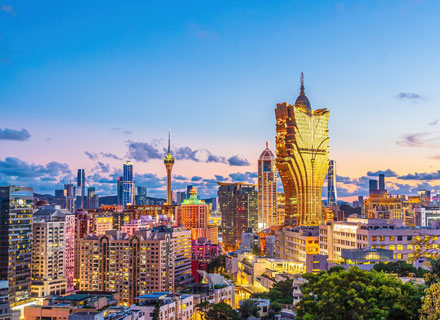

Macao’s skyline is evolving, with modern financial institutions (like the ICBC building in the centre) now prominent. The city’s bond market is becoming a cornerstone of its economic expansion.
Historically known for its casinos, Macao is accelerating economic diversification by turning to modern finance, particularly its fast-growing bond market, as a strategic pillar of growth. Over the past few years, isolated financial initiatives have coalesced into a robust bond market that connects Macao with international capital flows.
Strategic expansion
Macao’s government prioritised “modern finance” in 2020 to address an unbalanced industrial structure overly reliant on gaming. By 2022, it formalised a diversification blueprint known as the “one plus four” strategy.
Under this plan, the “one” refers to Macao’s traditional integrated tourism and leisure industry, while the “four” denotes four new pillars: healthcare, modern financial services, high technology, and a cluster of industries spanning conventions, exhibitions, trade, culture, and sports. This policy shift signalled that finance, and specifically the bond market, would play a central role in Macao’s next chapter.
Today, the financial sector, led by banking and insurance, alongside bonds, funds, and other services, has grown into Macao’s second-largest industry. The city’s bond market journey began only in 2018, yet progress has been swift. By 2021, Macao had established a Central Securities Depository (CSD) system to facilitate bond trading and custody.
In recent years, the government has improved issuance mechanisms, expanded financial infrastructure, updated regulations, and strengthened collaboration with Mainland China and Hong Kong, all to support the bond market’s growth.
This groundwork has attracted major bond issuers. The Ministry of Finance of China, the Guangdong provincial government, and leading banks and corporations have floated bonds in Macao.
Notably, bonds in Macao are issued in multiple currencies: Chinese yuan, US dollars, Hong Kong dollars, and the local Macanese pataca. By 2024, the total value of publicly offered and listed bonds in Macao reached about $100 billion, a remarkable feat for a market that barely existed a few years ago.
The bond boom
As a leading commercial bank in the territory and the chair of the Securities and Funds Industry Association of Macao, ICBC (Macau) plays multiple roles in bond deals.
It serves as an issuer, an institutional investor, an underwriter, a clearing and settlement bank, an agent bank, and a trustee administrator, covering the entire bond market value chain. The bank also provides one-stop services for bonds from issuance to trading.
Over the past few years, ICBC (Macau) has spearheaded many of Macao’s key bond transactions. It has issued over $1 billion in bonds annually for four consecutive years, making it the most active and diversified bond issuer among local players. The bank has also pioneered various innovative offshore bond products, often with colourful nicknames.
These include “Kung Fu bonds,” “Dim Sum bonds,” “Lotus bonds,” “Pearl bonds,” and “Yulan bonds,” among others. Each term refers to a specific category of offshore bond tailored to different investor markets or currencies. By creating this multi-market, multi-product portfolio, ICBC (Macau) has helped put Macao on the map for global bond investors. Leveraging the advantage of its full banking license, the bank actively invests across various bond markets, further linking Macao’s capital market with the world.
Macao’s bond market evolution
As one of Macao’s leading banks, ICBC (Macau) has positioned itself at the heart of the bond market’s development, in line with the government’s push to diversify the city’s casino-heavy economy through modern finance.
The bank’s deep involvement is helping transform Macao from a one-industry town into a budding financial hub, with the total value of listed bonds in the city surging to around $100 billion by 2024.
ICBC (Macau)’s Macao headquartered building serves the entire bond market value chain, from issuance and underwriting to clearing and investment. As a major local institution, ICBC (Macau) is the chair of Macao’s Securities and Funds Industry Association, and it plays multiple roles across the bond market value chain.
The bank wears many hats. It acts as a bond issuer, an institutional investor buying bonds, an underwriter helping other entities issue debt, performs technical functions like clearing and settlement, and serves as an agency bank and trustee administrator for bond offerings.
This all-in-one participation has made ICBC (Macau) one of the bond market’s most pivotal players. Over the past few years, the bank has spearheaded many of Macao’s landmark bond deals and consistently led in issuance volume.
Since 2020, ICBC (Macau) has issued bonds in the local market for four consecutive years, raising more than MOP 8 billion (around $1 billion). That track record makes it the most active and diversified bond issuer among Macao’s banks.
In January 2025, for example, ICBC (Macau) launched a $250 million three-year bond as part of its global medium-term note programme. The notable deal was listed on Macao’s exchange (MOX) and was among the first to benefit from a new Hong Kong–Macao bond clearing link that opened the market to a wider pool of investors. ICBC (Macau) is steadily boosting the market’s scale and liquidity by issuing sizable bonds and attracting outside investors.
Beyond volume, ICBC (Macau) has also been a leader in innovation within the bond sector. It has pioneered a range of niche bond products with catchy nicknames that underscore Macao’s international connectivity. These include offshore renminbi bonds known as “Dim Sum bonds” (a term for RMB-denominated bonds issued outside Mainland China) and Macao’s very own “Lotus bonds,” the local label for RMB bonds issued in the territory.
The bank’s underwriting portfolio spans multiple markets and currencies, from “Kung Fu bonds” (international bonds by Chinese issuers) to “Pearl” and “Yulan” bonds, indicating a breadth of expertise in both Chinese and global bond markets. By bringing such products to Macao, ICBC (Macau) has expanded the city’s bond offerings beyond vanilla debt, giving issuers and investors more options and tying Macao’s market into regional trends.
All of this reinforces Macao’s ambitions to become a modern financial centre. ICBC (Macau)’s comprehensive involvement in the bond ecosystem has been instrumental in turning the government’s vision of economic diversification into reality. Each role the bank plays, whether helping a local firm issue its first bond, investing in a public infrastructure bond, or streamlining cross-border settlement, builds confidence in Macao’s financial infrastructure.
The bank’s support for innovative bonds, like green and “Belt and Road” themed issues, also signals that Macao can be a platform for financing projects far beyond its shores. In short, ICBC (Macau) is not only driving deals, it is helping to anchor Macao as a credible finance hub in the Greater Bay Area and beyond.
Unique advantages fuelling growth
Geographically, Macao serves as a strategic gateway between mainland China, Portuguese-speaking countries, and markets involved in China’s Belt and Road Initiative. The city enjoys free-port status and an independent customs regime, while being an integral part of the Guangdong-Hong Kong-Macao Greater Bay Area (GBA). In the context of China’s continued opening-up, this position gives Macao a prominent edge as a regional financial hub connecting East and West.
Equally important is Macao’s business-friendly financial environment. The city boasts abundant fiscal reserves and private wealth, and adheres to internationally recognised standards of confidentiality in finance. Tax rates are competitive, lower than those in many global financial centres, which attracts businesses and investors.
Macao’s financial regulators maintain an open, pragmatic stance that supports innovation while ensuring stability. Thanks to these factors, the banking sector in Macao is highly internationalised; by the end of 2024, international assets made up 83.4% of total banking assets in the territory. In other words, a large share of Macao’s banking business connects to overseas capital, reflecting the city’s global reach.
Supportive policy from the broader region also plays a key role. Macao is one of four core cities in the Greater Bay Area, a dynamic economic zone in southern China with a combined GDP of around $1.8 trillion. Being part of this region means Macao can tap into a vast market and diverse financial service needs nearby, which helps propel the growth of its nascent finance sector.
Furthermore, Macao’s deepening integration with its mainland neighbour, Hengqin (an island in Guangdong province), provides extra room and resources for development. A special Guangdong-Macao cooperation zone in Hengqin allows Macao’s financial industry to leverage Hengqin’s land, infrastructure, and client base while using Macao’s own global connections. As of the end of 2024, fund companies in this Hengqin cooperation zone managed around $600 billion in assets, highlighting the scale of opportunities being unlocked by regional integration.
Having successfully established a bond market “from zero to existence,” Macao is now looking to go “from existence to excellence,” as officials put it. The roadmap involves further opening and innovating to enhance the market’s competitiveness and cement Macao’s status as a modern finance hub. Key initiatives shaping Macao’s bond market future include making the market more liquid.
This means developing a more active secondary market for bonds and providing supporting services like better pricing (valuation), trading platforms, and funding options for investors. Embracing financial technology is part of this effort, as is introducing new investment products to keep the market dynamic. Strengthening these areas will enable investors to enter and exit positions more freely, which attracts greater participation.
Macao aims to broaden its international reach by deepening ties with mainland China and Portuguese-speaking countries. Given the city’s cultural and historical links, it’s uniquely positioned to bridge these markets. Officials are promoting cross-border collaboration, resource sharing, and complementary partnerships with institutions in these regions.
By integrating Macao’s strengths (such as its open market and bilingual heritage) with the vast resources of its partners, the goal is to create synergies that increase cross-border investment and financing. This would boost the scale and appeal of Macao’s bond market at home and abroad.
Macao is aligning its financial growth with global sustainability trends and fintech developments. The focus is on attracting green and sustainable bond issuers and investors, aligning with worldwide environmental finance initiatives.
Macao’s rapid progress in developing its bond market shows real determination to move beyond its reliance on casinos. The city has built a solid base for modern finance in just a few years, which is impressive. Macao could become a true financial hub if it continues to innovate, attract global investors, and strengthen ties with neighbouring regions. Its focus on sustainability and technology suggests a smart, forward-looking approach to long-term economic growth.