
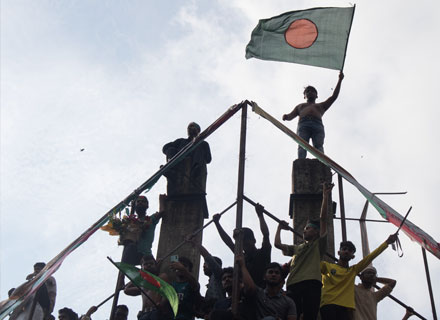

Over the past year, Bangladesh has undergone a profound transformation following the ousting of Prime Minister Sheikh Hasina in the student-led uprising of July-August 2024. The abrupt end of Hasina’s 15-year rule, amid public fury over corruption and autocracy, ushered in an interim government led by Nobel laureate Muhammad Yunus.
Twelve months later, the country is navigating a fragile path toward democratic restoration, grappling with economic stabilisation and sweeping reforms at home, even as it recalibrates delicate relationships abroad.
International Finance examines how the “July Revolution” and its aftermath have reshaped Bangladesh’s political landscape, economy, and foreign policy one year later, highlighting the key reforms, challenges, and international dynamics.
Fallout of the student-led revolution
The immediate trigger for Hasina’s downfall was a wave of student protests ignited by a controversial affirmative action quota in public sector jobs.
In 2024, Bangladesh’s Supreme Court reinstated a policy reserving 30% of government jobs for the descendants of 1971 independence war veterans. This move outraged young graduates, who demanded merit-based hiring in a country already plagued by youth unemployment.
Long-simmering mass grievances over scarce jobs, economic inequality, and perceived cronyism under Hasina’s Awami League government boiled over. Protesters saw the quota as emblematic of a system that rewarded the ruling party’s loyalists at the expense of ordinary citizens, following years of alleged high-level corruption and authoritarian drift in Hasina’s administration.
What began as campus demonstrations escalated into nationwide unrest by mid-July 2024, met by a heavy-handed crackdown. Security forces used live fire and mass arrests in an attempt to quell the uprising, resulting in significant bloodshed. Rights groups like Amnesty International blamed Hasina’s government for using excessive force, which caused the deaths of students, journalists, and bystanders.
In total, over a thousand people were killed in the weeks of chaos that paralysed Dhaka and other cities. The violence only fuelled public outrage. By early August 2024, tens of thousands of demonstrators were marching on the Prime Minister’s residence, defacing images of Hasina and demanding her resignation. Facing insurmountable pressure, Hasina finally resigned on August 5, 2024, and fled the country under military escort with her family, seeking refuge in India.
Sheikh Hasina’s abrupt exit precipitated a constitutional crisis. With the elected government’s collapse, an interim administration was hastily assembled to fill the power vacuum. On August 8, 2024, Muhammad Yunus, the famed microfinance pioneer and the country’s only Nobel Peace Prize winner, was sworn in as Chief Adviser by the figurehead President.
This caretaker government, consisting of technocrats and respected civil society figures, was tasked with restoring order and guiding Bangladesh back to democracy. Yunus vowed to hold credible elections, reform the political system, and deliver justice for those killed during the protests. The student revolution, known colloquially as the “July Revolution,” had upended Bangladesh’s dynastic politics overnight, dismantling the long-entrenched Awami League rule. However, the challenges of governing a polarised nation in the aftermath proved daunting, and the initial euphoria of change soon gave way to the messy reality of transition.
The interim government
As interim leader, Muhammad Yunus set an ambitious agenda to stabilise Bangladesh’s democracy and economy. Yunus, internationally lauded for his anti-poverty work with Grameen Bank, had instant credibility and strong backing from Western donors and the United Nations.
Domestically, however, his unelected government faced “massive expectations to restore democracy and prosperity” without any popular mandate or political party base. To build trust, Yunus brought in several experienced technocrats for key positions. For example, he appointed former IMF economist Ahsan H Mansur as the new governor of Bangladesh Bank to spearhead financial reforms. He also reconstituted the Anti-Corruption Commission with respected figures, signalling a break from past regimes accused of shielding the powerful.
In its early months, the interim government focused on halting violence and initiating institutional reforms. Notably, enforced disappearances and extrajudicial killings, which were the hallmarks of the previous government’s repression, ceased under the Yunus administration.
Yunus opened dialogues with opposition parties to discuss overhauling the constitution, judiciary, and law enforcement before any vote. Some proposed political reforms included imposing term limits for prime ministers, creating a two-chamber parliament, and appointing an empowered Chief Justice independent of the executive. These ideas aimed to prevent a return to one-party dominance and to strengthen checks and balances after years of democratic backsliding.
To assess the scale of economic damage and corruption left behind, Yunus’ cabinet commissioned a 12-member committee to produce a “white paper” on Bangladesh’s finances. The findings, released in late 2024, were staggering. During Hasina’s tenure, an estimated C$326 billion had been syphoned out of Bangladesh through illicit financial outflows, averaging C$22 billion per year.
The report identified 10 banks as technically bankrupt, exposed inflated costs in public infrastructure projects, and estimated that up to 40% of the government’s annual development budget had been embezzled by insiders. These revelations highlighted the institutional rot and graft that the new government inherited, strengthening Yunus’ resolve to “root out corruption and recover Bangladesh’s stolen wealth.”
Armed with this diagnosis, the interim authorities pursued urgent remedial measures. Bangladesh Bank’s leadership, under Mansur, moved swiftly to address a looming banking crisis. The bank was raising interest rates to tame surging inflation, dissolving and replacing the boards of 11 troubled banks, and launching efforts to recover non-performing loans and repatriate money illicitly sent abroad.
Anti-corruption prosecutors opened high-profile investigations into politically connected tycoons who benefited under Hasina’s patronage. By year’s end, the government had attached or frozen assets worth over Tk 1.75 trillion belonging to about a dozen influential business groups suspected of large-scale loan fraud and money laundering. Such moves marked the start of a clean-up of Bangladesh’s financial system, though they also risked unsettling some domestic business interests.
Financial stabilisation efforts
One year after the uprising, economic stabilisation remains a central preoccupation of the Yunus administration. When they took office, Bangladesh’s economy was fragile, rocked by unrest, burdened with debt and deficits. Although the country had enjoyed robust GDP growth averaging 6–7% for much of Hasina’s tenure, deep structural weaknesses became increasingly evident by 2024.
Youth unemployment was alarmingly high, with 83% of all unemployed individuals being under 30 years old. Inflation was in double digits. The political turmoil in mid-2024 delivered an immediate economic shock as factory output, exports, and investor confidence all plummeted amid strikes, curfews, and internet blackouts.
The vital garment industry, accounting for 85% of export earnings, reported over C$547 million in lost orders and production disruptions in the weeks following the revolution. By some estimates, 2.1 million jobs were lost between July and December 2024 as businesses downsized or shut down, with women, especially garment workers, bearing over 85% of those job losses.
The interim government negotiated emergency support from international lenders to prevent a financial meltdown. Bangladesh was already under a $6.4 billion IMF loan programme, and in December 2024, Yunus requested additional IMF financing to shore up dwindling foreign exchange reserves. The IMF and World Bank imposed strict conditions. Bangladesh had to restore fiscal discipline, raise revenues, reform its exchange rate policy, and restructure its ailing banking sector.
Meeting these benchmarks was arduous, but Dhaka made notable progress by mid-2025. The central bank’s monetary tightening helped cool inflation from 11.7% in July 2024 to around 9.0% by May 2025. The government also took politically delicate steps like adopting a unified, market-driven exchange rate and cutting public spending.
In fact, the national budget unveiled for FY2025–26 was slightly smaller than the previous year’s, marking the first time in Bangladesh’s history that an annual budget shrank year-on-year. This unprecedented belt-tightening, tax administration reforms, including abolishing the old National Board of Revenue to create two new revenue authorities, satisfied the IMF’s requirements.
In return, by mid-2025, the IMF released about C$1.76 billion in delayed programme funds, while the World Bank and other donors also unlocked fresh financing for Bangladesh. These inflows stabilised the forex reserves and reassured markets that Bangladesh would avert a balance-of-payments crisis.
Some crucial economic indicators have started to improve. Export earnings rebounded strongly in late 2024 and early 2025. Also, between July 2024 and May 2025, merchandise exports were up by C$5.4 billion compared to the same period a year prior, with ready-made garment exports growing about 10% despite the turmoil.
This export resilience, aided by the more competitive exchange rate, helped Bangladesh maintain a current account balance. Nevertheless, serious weaknesses persist. The GDP growth rate is projected to slow to only 3.3% in the 2024–25 fiscal year, down from over 6% in previous years, reflecting depressed investment and consumer confidence.
Private sector credit growth remains sluggish due to banks’ bad loan burdens. Unemployment and underemployment are still acute, as millions of young people entering the workforce each year are not finding adequate work, raising the risk of further social discontent.
Critics note that while the interim government stabilised macroeconomic fundamentals, it has yet to enact deeper structural reforms to spur new industries or significantly boost job creation. For example, despite Yunus’ past advocacy for higher garment worker wages, his government has not yet raised the minimum wage or unveiled major stimulus for employment generation.
The economic recovery remains fragile and heavily contingent on political stability and continued policy discipline. Any resurgence of unrest or loss of reform momentum could easily set back the gains of the past year, economists warn.
Roadmap to political stabilisation
Following the revolution, Bangladesh finds itself in a fluid and fragmented landscape. The old Awami League-led order has been dismantled, and Hasina’s party was formally banned in May 2025. Several of its top leaders now face prosecution, but the contours of the new order are still taking shape.
In the vacuum left by the Awami League, new and resurgent forces are vying for influence. The student activists who spearheaded the uprising have coalesced into a new political party, with the stated goal of breaking the dominance of the country’s two dynastic mainstream parties.
Meanwhile, the Islamist Jamaat-e-Islami, which had been banned from politics for over a decade, has re-entered the scene, allying itself with the youthful revolutionary movement. Jamaat’s return is highly polarising, as it is an Islamist party that once opposed Bangladesh’s independence in 1971. Its renewed strength is uncertain, but its leaders clearly see an opening to fill the void left by Hasina’s ouster.
Managing these factions and delivering on the promise of fresh elections has proven tricky for Yunus. Upon taking power, he dissolved the parliament in August 2024 and asserted that new national elections would be held once essential reforms were implemented.
Initially, the interim government indicated a vote could occur by April 2026, about 20 months after Hasina’s fall. Yunus has insisted that key governance changes must be enacted before a return to elected rule, ensuring that the next government inherits a fairer system. This includes constitutional amendments and strengthening independent institutions that were eroded under the previous regime.
However, consensus on the timeline and scope of reforms remains elusive. The BNP was the main opposition under Hasina and is now eager for a quick election, sensing an opportunity to finally gain power through the ballot box after boycotting the flawed 2024 polls.
BNP leaders argue that the interim government’s legitimacy will wane if it overstays or delays a democratic transition. By contrast, the Jamaat-e-Islami and many student revolutionaries favour giving Yunus’ administration more time to implement reforms thoroughly before holding a vote. This debate has become a flashpoint in Bangladeshi politics.
One analyst noted, “There’s a divide between those who want to see reforms through and give them more time, and those who feel it’s time to wrap things up and focus on elections.”
The disagreement even extends into state institutions. Bangladesh’s army chief reportedly urged holding elections by December 2025, several months earlier than Yunus’ schedule, a suggestion the interim civilian leadership resisted.
The post-revolution honeymoon has clearly ended, replaced by wrangling and mistrust among erstwhile allies. While all major parties profess support for democratic revival, each fears losing advantage. The student-led movement and Jamaat worry that a premature election could allow BNP stalwarts to replace one entrenched establishment with another. On the other hand, the BNP accuses the student leaders of being too close to the Yunus regime and using state institutions to advance their own agenda.
Yunus himself walks a tightrope as he must maintain neutrality and stability, even as segments of the population grow impatient for elected representation. His government’s crackdown on residual pockets of Awami League loyalists has drawn criticism from Hasina’s camp as political persecution, although many in Bangladesh see it as overdue accountability for an authoritarian regime.
At the same time, human rights issues have not disappeared as violence against religious minorities spiked amid the power shift, and community leaders complain the interim authorities have struggled to protect vulnerable groups from mob attacks and Islamist hardliners.
Human Rights Watch acknowledged that enforced disappearances and extrajudicial killings declined under Yunus but urged faster reforms to “create robust, independent institutions” that safeguard rights long-term. As Bangladesh edges toward an election, likely in 2025 or early 2026, the success of its political transition will hinge on balancing these tensions. Electoral laws are being revised to ensure a free and fair vote. For instance, discussions are underway about reconstituting the Election Commission and updating voter rolls with input from all parties.
Civil society is pushing for the deployment of neutral election observers and perhaps even the United Nations’ technical assistance to strengthen credibility. Yunus has hinted that he might step aside before the polls if a consensus political framework is achieved, to allow a fully neutral caretaker to oversee the voting.
While such a move might reassure critics who see him as overly partisan, it could also sow fresh uncertainty. The path to democracy remains unfinished, and time is running out. The interim government’s mandate ends once an elected administration takes office, making it imperative to implement reforms and conduct elections that earn broad legitimacy. Failure to do so risks reigniting street unrest—or worse, inviting military intervention, a scenario Bangladesh is determined to prevent.
Democracy’s defining test ahead
Politically, the clock is ticking for Yunus to deliver the promised new election and hand over power. Continued disagreements over the reform timetable or the rules of the election could spark renewed street agitation, and indeed, sporadic protests have already flared as various groups push their demands, some too volatile in nature.
Maintaining public trust is critical, and the interim government must be seen as an honest broker setting the stage for real democracy, rather than clinging to power or favouring one faction. Yunus’s suggestion that he may step down early, if necessary, reflects an acute awareness of public perception. Ultimately, the credibility of Bangladesh’s democratic transition will hinge on how the upcoming elections are managed, particularly their inclusivity, fairness, and broad acceptance. Only then can Bangladesh move beyond its legacy of flawed polls and entrenched one-party rule.
Internationally, the country will need to continue balancing competing interests. The infusion of Chinese funds is helpful, but overreliance on any single patron could compromise the nation’s strategic autonomy. Likewise, repairing ties with India, the regional hegemon, may be unavoidable for economic and security reasons in the long run. And while courting Western trade and aid, Bangladesh must address their concerns about labour rights and transparency to avoid punitive measures like tariffs or sanctions.
A South Asia analyst aptly noted, “Post-revolution honeymoons often don’t last long, and Bangladesh is no exception.”
The real work of building a stable, prosperous, and democratic Bangladesh is just beginning, and it will require steadfast commitment to reform and consensus-building well beyond this first year of dramatic change.
The coming months up to the planned 2025/26 election will be crucial. If the interim leadership succeeds in preserving stability, enacting vital institutional reforms, and delivering credible elections, Bangladesh could emerge from this period of upheaval with renewed strength and democratic resilience.
If not, the country risks sliding back into political uncertainty or conflict, squandering the hard-fought gains of the past year. A cautious optimism persists that Bangladesh’s darkest days of July 2024 have given way to a new dawn of possibility, albeit one that will demand patience and perseverance.