
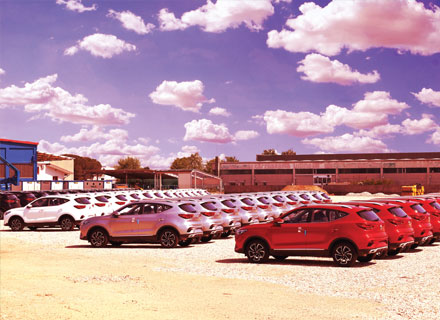

In September, crucial news emerged from the Chinese automobile sector. It was about the China Association of Automobile Manufacturers (CAAM) launching an anti-discrimination probe into the impact on the auto industry of US trade policy over chips. The investigation, which will witness heavy participation from Chinese automakers, comes just after Beijing initiated discrimination and dumping investigations into American chips.
Government policies and subsidies have effectively made China a leader in the global automotive industry and electric vehicles. Domestic automakers have met the production targets that the Communist government’s policy wanted to achieve, but a new headache has emerged.
The world’s second-largest economy’s auto industry is making more cars than the global market can absorb. The industry players are finding it increasingly difficult to make a profit.
China’s EV glut problem
Compared to the United States, Chinese electric vehicles start at less than $10,000, whereas the average price of an EV remains at $35,000.
Liuzhou, a Chinese city with a population of 21 million, has a showroom in a shopping mall offering special deals on new cars, including 50% off on locally made Audis and a seven-seater SUV for about $22,300, more than 60% below its sticker price. These cars are made by China’s FAW (First Automobile Works).
With so many cars in one place, these deals are possible. A company called Zcar, which informed Reuters about its business practice of buying in bulk from automakers and dealerships, is now offering customers the option of choosing from among 5,000 vehicles.
An industry survey released in August 2025 revealed that many manufacturers were struggling with excess inventory. As a result, they have been unable to generate additional revenue, leading dealers to lower prices. Some retailers have registered and insured unsold cars in bulk, a strategy that enables automakers to count these vehicles as sold and allows dealers to qualify for factory rebates and bonuses from manufacturers.
“Unwanted vehicles end up in the hands of grey-market traders like Zcar, which pop up in fire sales on TikTok-style social media sites. These cars are rebranded as used (even though the odometer says otherwise) and exported overseas, or some wind up in weedy car graveyards. According to many industry figures and analysts, these practices are signs of a market that is vastly oversupplied and at risk of a shakeout, as is seen in the Chinese property market and the solar industry,” Reuters reported.
China’s emphasis on boosting sales for job creation and growth comes at the cost of profitability and healthy competition. It makes local governments compete with each other for cheap land and subsidies for automakers. They make production and tax-revenue commitments, which fuel overcapacity across the country.
During an interaction with Reuters, Rupert Mitchell, an Australia-based macroeconomics commentator who previously worked at a Chinese EV startup, said, “When there is a directive from Beijing that this is a strategic industry, every provincial governor wants the car factory. They want to be in good shape with the party. Ultimately, what happens is that it makes the existing auto sector double down on investment.”
A review by Reuters of thousands of car-sales listings, hundreds of government documents, state-media reports, court filings, and consumer-complaint records, as well as interviews with over 20 industry players, including dealers, buyers, analysts and manufacturing executives, shows how oversupply is enfeebling China’s auto market even as the industry emerges as a world power.
Foreign rivals are lagging Chinese brands in delivering new models, but the same government policies that spurred explosive growth and innovation in automaking are causing lose-lose transactions throughout the domestic sales chain.
The industry and commerce ministries did not address these issues publicly, issues like pressures facing the sector, the potential for consolidation or the extent to which government policies promoted oversupply.
The experts state that these issues have wider implications for China’s economy. The country’s GDP accounts for around 10% of the auto industry and related services. Chinese policymakers have long waved off American and European concerns about overcapacity caused by cheap Chinese exports, but Chinese officials have pledged to cool price wars in electric vehicles and solar panels in recent months.
According to consultancy Gasgoo Automotive Research Institute, Chinese automakers have the ability to make twice the 27.5 million cars they produced in 2024. The issue is particularly severe in gasoline cars, where demand collapsed as Beijing promoted EVs, while the number of EV factories mushroomed as companies and local authorities jumped in.
Another consultancy, AlixPartners, estimates that only 15 of the 129 electric vehicle and hybrid brands in China will be financially sustainable by 2030. This price war is now in its third year. Allowing that to happen would mean allowing many automakers to fail, an outcome that some analysts say would risk mass layoffs and falling consumer spending, an outcome many Chinese officials have resisted.
Yuhan Zhang, principal economist at The Conference Board’s China Centre, said, “That leaves automakers and local governments locked in a downward spiral. They feed and reinforce one another, trapping the market in a vicious cycle.”
This is not only a problem for Chinese automakers. Foreign brands are losing market share, with Chinese car sales going to foreign brands in the first seven months of this year at 31%, down from 62% in 2020, according to the China Association of Automobile Manufacturers (CAAM).
European governments are concerned that affordable Chinese-made cars will undermine their domestic automotive industries. In contrast, the United States has effectively banned Chinese cars due to national security risks and allegations of unfair competition.
Attracting EV manufacturers
The origins of this market date back to the 1990s in Beijing, when national policymakers aimed to position China at the forefront of significant technological changes, particularly in the auto industry. This shift occurred as people began transitioning from internal combustion engines to electric vehicles.
In 2009, it bought out a programme to promote automakers who are producing electric vehicles and consumers purchasing these cars, by bringing billions of dollars in subsidies. As a result, the EVs had not caught on by 2017.
That year, government officials drafted a car-making policy blueprint, a 13,000-character document known as the “Medium-and Long-Term Development Plan for the Automotive Industry,” which laid out a target of 35 million vehicles produced annually by 2025, twice the American annual sales record.
Chinese authorities, who had been trying to rein in an overheated property sector, started to discourage excess investment. The automaking blueprint became an expedient second economic pillar for local governments that had relied on land sales and real-estate tax revenue.
The 2017 plan also fanned a rush by local authorities to court electric vehicle makers. In 2024, China almost reached the goal, building over 31 million, according to the China Association of Automobile Manufacturers (CAAM).
The competition has set a playbook across China. The local governments offer incentives to automakers, and expect production and tax-revenue goals in return. Also, automakers have often prioritised meeting those goals over turning a profit, and over time, local governments have kept manufacturers that might have gone under in other markets afloat.
The right automaker can also be a massively profitable bet. The county government in Changfeng, Anhui province, lured BYD in 2021 with inexpensive land, and in return, the county, which was once the main producer of traditional flatbread, received a mega-factory from the EV maker.
Experts say they have calculated from property-sales filings published by the Chinese government that over five years, BYD bought 8.3 square kilometres of land in Changfeng at an average price 40% below the average price paid by other buyers.
In 2023, the year after BYD began production in Changfeng, the county’s economic growth outpaced the national rate by 9.1 percentage points. It was 5.6 percentage points higher in 2024.
The Chinese smartphone maker Xiaomi started acquiring land in Beijing’s Yizhuang district for an electric vehicle factory in 2022, buying more than 206 soccer fields’ worth at an average price 22% below what others paid for industrial land, land-sales filings show.
Beijing mandated that the plant have a minimum annual revenue of 47 billion yuan, or about $6.6 billion, at full production. Xiaomi followed an open bidding process and did not receive discounts or incentives for the land, and it was the only bidder, according to tender information posted by Beijing’s municipal government.
In China, the Guangzhou officials published a policy document in June 2025. However, it stated that the city would aim to develop up to three makers of “new energy vehicles,” including fully electric cars and hybrids, to each produce 500,000 vehicles a year, while awarding up to 500 million yuan (about $70 million) a year to each automaker that built new production lines and made 100,000 vehicles in three years.
At least six other local governments between 2023 and 2025 issued policies to encourage automakers to expand output, policy documents show. Earlier this year, Chinese authorities began to raise the alarm about auto price wars, saying competition was unsustainable. In July, President Xi Jinping chided provincial officials, asking why every province was rushing to invest in a small number of technologies, including electric vehicles and artificial intelligence.
Automakers’ impossible growth
Excess capacity driving aggressive sales targets isn’t limited to China. General Motors, Ford and Chrysler had too many factories making too many cars in the early 2000s, and shut down more than a dozen plants in the United States. Pressure to meet sales targets and gain market share is higher in China, industry analysts and former executives say.
In recent years, the industry has started referring to this kind of competition as involution, a concept that describes self-destructive competition that rewards irregular practices.
Liang Linhe, the chairman of Sany Heavy Truck, one of China’s largest truck makers, said vehicle manufacturers are compelled to keep selling and producing, even at a loss, because this generates cash flow, which is essential to survival.
“It’s like riding a bicycle: As long as you keep pedalling, you might feel exhausted, but the bike stays upright,” Linhe said.
As losses mount, many carmakers are pedalling faster, leading some analysts to talk about a shakeout. In early 2025, EV brand Neta shut down operations after its parent filed for bankruptcy.
In 2024, Chinese tech company Baidu and automaker Geely laid off workers and restructured their joint venture, Ji Yue Auto, which was facing fierce competition.
Still, some say that an abrupt shock is unlikely. Consolidation could take years, and local governments would likely support struggling automakers, limiting the impact.
Michael Pettis, senior fellow at Carnegie China, said, “The problem of excess capacity in China is a systemic problem.”
The chief executive and co-founder of Chinese electric vehicle startup Xpeng, He Xiaopeng, said in 2023 that each automaker would have to sell three million cars a year by 2030 to stay alive, and only eight would survive by then. Xpeng sold 190,000 cars in 2024. A handful of large players are reaching or close to those volumes, and are well placed to be the survivors in a cull.
Geely said it aims to achieve five million vehicle sales per year by 2027, more than double the 2.2 million it sold last year. It is still unknown whether that target still applies. BYD, the industry leader, has set aggressive targets for 2025, but has slowed its expansion.
Its quarterly profit fell for the first time in more than three years in August, and it has internally adjusted its original plan to sell 5.5 million vehicles to at least 4.6 million. Most industry players are selling a fraction of that.
In 2024, as state-owned automakers like Changan, Dongfeng and FAW lagged their private peers in the EV race, the national regulator of government-owned firms announced that it wanted the state companies to expand market share and production, rather than profitability.
The automakers and the regulator, the State-owned Assets Supervision and Administration Commission, have not made any official statement regarding this so far. Changan stated that it aimed to quadruple sales of new-energy vehicles by 2030.
Will the market die?
Reuters reported that an influx of new cars has made it more challenging for dealers to turn a profit. This assessment comes from Chen Keyun, a retired dealer in Jiangsu province, and is supported by four other dealers.
Chen said the problems, such as dealers selling new cars at a loss and offloading them to traders who sell them on as zero-mileage “used” cars, are rooted in China’s “production-oriented” industrial model.
“Automakers have ignored the true level of demand but kept expanding capacity and increasing sales targets, forcing dealers to take more inventory,” he said.
A survey by the China Automobile Dealers Association reported that only 30% of dealers are profitable in August. The dealer groups in Henan, Sichuan provinces and the Yangtze River Delta publicly raised these issues and problems in June.
“We urge automakers to formulate sales guidance policies that align with market realities. If the sales channels collapse, the market will die!” the Henan Automobile Industry Chamber of Commerce said in an open letter to unspecified automakers.
Chen also stated that larger dealerships overpurchase inventory to hit automakers’ sales targets and obtain factory rebates.
“If you have managed to sell 16 out of the 20 units targeted for the month, what will you do with the remaining four units on the very last day of the month?” said one dealer in Jiangsu.
He went on to say that selling those cars even at fire-sale prices would mean qualifying for a bonus of around 80,000 yuan, or $11,200, and put him close to break-even.
Lang Xuehong, a deputy secretary-general of the CADA industry group, said dealers were selling at up to 20% below their cost, a level never before seen. In July 2025, EV brands Neta and Zeekr inflated sales in recent years, with Neta doing so for more than 60,000 cars.
The automakers had cars insured before they were sold so that the vehicles could be booked formally toward monthly sales targets. Neta’s parent, Hozon, which is in bankruptcy administration, could not be reached for comment.
Zeekr told Reuters in July that the cars had been insured with mandatory traffic insurance to ensure their safety while on display, and that they were legally new when sold to buyers.
Neta and Zeekr represent a widespread padding of sales figures across the industry, much of it involving zero-mileage used cars that have been insured and booked as sold, according to dealers and analysts.
Dealers and traders then export those cars as used, often with the blessing of local governments, or market them domestically through grey markets, as four regional dealer groups accused car companies of doing in June.
A livestream sales
In a rooftop parking lot at a mall in Chengdu, Wang Lihong rides a scooter with a selfie stick, shooting video for social media while livestreaming for Zcar, a grey-market trader that flips brand-new vehicles that dealers couldn’t sell. Hosts like Wang stream on platforms like Douyin, China’s TikTok.
Wang, who has 1.25 million followers, said recently that Zcar was Sichuan province’s largest seller of zero-mileage ‘used’ cars, available in March, June, September and December, “when dealers rush to meet the quarter or annual sales targets set by the automakers for cash rebates.”
The marketing director for Zcar, Zhou Yan, said that because it sources some vehicles directly from automakers in bulk, it can sell at deep discounts. Zhou also said that Zcar had acquired more than 3,000 Malibus in China from SAIC-GM, the American automaker’s Chinese joint-venture entity, and was selling them for under $14,000 apiece, down from a sticker price of $24,000.
GM told Reuters that “authorised dealers are the only official channels for our vehicle sales”, and that Zcar “isn’t a dealer affiliated in any way” with SAIC-GM.
Zcar said its Cheshi subsidiary bought 3,428 Malibus for wholesale distribution to dealers. Zcar also said it sells “popular, attention-getting models to draw people into our stores” and often sells at a loss.
The Malibus have not been reported in any previous trade. Audi did not have an opinion on what Zcar is doing, but said it does not condone grey-market trade, which it considers detrimental to the long-term value of its vehicles.
China’s auto industry hit a record in 2024, producing over 31 million vehicles as NEV production surged past 12 million. But too much capacity and excess inventory are creating real risks. The rapid growth that was once praised now threatens long-term stability, as fierce competition and price cuts could undercut profits for many automakers. Without better coordination, China’s car boom could turn into a costly overhang for companies and the economy alike.