
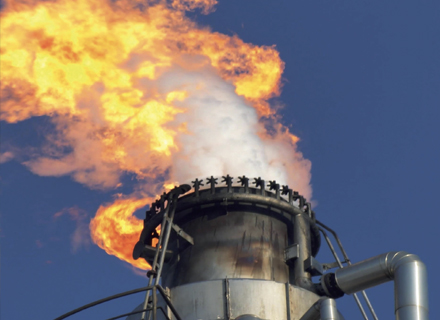

Gas flaring is the burning of natural gas that comes from oil extraction. This practice has been going on for more than 160 years. It happens for several reasons, including weak political will, poor regulation, and economic or market challenges. A valuable natural resource that could be conserved or put to better use, such as producing electricity, is wasted when it is flared and vented. For example, the 148 billion cubic metres of gas that are currently flared annually could power all of sub-Saharan Africa.
According to Rystad Energy research, flaring emissions from global upstream oil and gas production increased by 7% from 2022 to 2023. While upstream activities emitted about 1 gigatonne per year of carbon dioxide (CO2) in total, flaring contributed around 30% of those emissions in 2023, assuming 98% flaring efficiency on average.
“Flaring reduction is considered a low-hanging fruit for oil and gas companies trying to reduce their carbon footprint. However, this recent uptick underscores the challenges facing the industry, particularly in key producing countries such as Russia, Iran, and Iraq,” the study noted.
What causes gas to flare?
Despite being inefficient and harmful, flaring is still used today as a relatively safe way to dispose of the related gas from oil extraction. Using related gas frequently necessitates economically viable markets for businesses to invest in its capture, transportation, processing, and sale.
For safety reasons, flaring can be necessary. Oil and gas extraction and processing involve handling extremely high and variable pressures. An explosion could result from an abrupt or significant increase in pressure during crude oil extraction.
Although uncommon, oil and gas-related industrial mishaps can cause hazardous, catastrophic, and protracted fires that are challenging to contain and manage. By burning any extra gas, gas flaring enables operators to depressurise their machinery and control erratic and significant pressure fluctuations.
Technical and economic factors
Oil fields are frequently found in isolated, difficult-to-reach locations. In addition to being difficult to access, these locations might not consistently yield significant quantities of usable associated gas. This can make moving related gas to a processing and use location logistically and financially difficult.
If oil production sites are small and spread out over a wide area, the cost of capturing and using the accompanying gas is often considered too high, so the gas is usually flared. The local geology will occasionally permit the conservation of gas through re-injection back into the reservoir where its use is impractical. Nevertheless, even with recent technical advancements, this is not always possible.
Sometimes a nation’s rules and regulations may make it difficult or even prohibit businesses from commercialising associated gas, even when it is technically and economically possible to capture and use it. For instance, even when a business has obtained the rights to extract oil, it might not be able to use the gas produced during extraction. In other cases, regulations might not outline the commercial handling of related gas. As a result, there is legal uncertainty over the proper processing of related gas. Furthermore, laws that penalise businesses for flaring gas might not always succeed in stopping the practice, particularly if flaring and paying a fine is more profitable than capturing and selling the gas.
To stop frequent flaring and ensure that the related gas is put to good use, GFMR collaborates with governments to help develop appropriate laws and policies.
Effects on the environment
About 148 billion cubic metres of gas were burned in 2023 by thousands of gas flares at oil-producing facilities worldwide. Each cubic metre of associated gas flared produces roughly 2.6 kilogrammes of CO2 equivalent emissions (CO2e), or more than 350 million tons of CO2e annually, assuming a “typical” composition of associated gas, a flare combustion efficiency of 98%, and a Global Warming Potential for methane of 28.
According to the “Intergovernmental Panel on Climate Change,” the inefficiency of flare combustion produces methane emissions, a major cause of global warming that is especially potent in the short to medium term, since over 20 years methane is more than 80 times stronger than carbon dioxide as a warming gas.
The yearly CO2 equivalent emissions have risen by about 80 million tonnes as a result. Naturally, flaring is completely inefficient and far easier to prevent than many other kinds of greenhouse gas (GHG) emissions. Utilising the gas could be beneficial and might even replace more polluting fuels like coal and diesel, which produce more pollutants per unit of energy.
In addition to greenhouse gas emissions, gas flares can generate black carbon, also referred to as soot. Even though black carbon only stays in the atmosphere for a few days or weeks, it has a significant, if short-term, impact on the climate.
It is created when fossil fuels are not completely burned. In the Arctic, where black carbon deposits are thought to accelerate the melting of snow and ice, this is particularly concerning. According to research by the “European Geosciences Union,” gas flaring emissions could be responsible for almost 40% of the Arctic’s yearly black carbon deposits.
The health risks
Communities surrounding oil fields suffer greatly from gas flaring, the burning of excessive natural gas during oil extraction.
Among the several harmful pollutants the process generates are particulate matter (PM), nitrogen oxides (NOX), sulphur dioxide (SO2), benzene, black carbon, and volatile organic compounds (VOCs). Extended exposure to these toxins has been linked to cancer, pregnancy issues, respiratory disorders, cardiovascular problems, and other major medical conditions. Gas flaring’s health hazards disproportionately affect the elderly, children, and individuals with pre-existing medical conditions, among other vulnerable populations.
The aggravation of respiratory ailments is among the most immediate and obvious consequences of gas flaring. Large amounts of fine particulate matter (PM2.5), nitrogen oxides, and sulphur dioxide produced by burning natural gas all worsen air pollution and compromise lung health. Small enough to pass deep into the lungs and even into the bloodstream, PM2.5 particles cause inflammation, chronic bronchitis, and aggravation of illnesses, including asthma and chronic obstructive pulmonary disease (COPD).
Studies have linked high levels of PM2.5 to higher rates of emergency room visits and hospitalisations for respiratory problems in exposed communities. A 2021 study found that hospital admissions for respiratory-related diseases rose 0.73% for every 1% rise in flaring gas emissions. Additionally, nitrogen oxides can aggravate airways, lower lung capacity, and increase the risk of respiratory infections.
Furthermore, contaminants released during gas flaring greatly compromise cardiovascular health. Specifically, fine particulate matter has been associated with stroke, hypertension, and heart disease. These particles aggravate oxidative stress and systemic inflammation when inhaled, which can damage blood vessels and raise the risk of clot development. Long-term gas flaring-related air pollution exposure raises the risk of heart failure, arrhythmias, and heart attacks.
Sulphur dioxide, another pollutant produced during gas flaring, is known to have immediate cardiovascular effects, especially in those with pre-existing heart diseases. Studies have indicated that rises in SO2 levels correspond with increases in hospital admissions for heart attacks and strokes.
Additionally, benzene and other VOCs help form ground-level ozone, which has been linked to higher blood pressure and other cardiovascular symptoms.
Extended exposure to carcinogens, including benzene, toluene, ethylbenzene, and xylene (BTEX chemicals), increases the risk of cancer in communities near gas flaring sites. Particularly, benzene is a well-documented carcinogen directly linked to leukaemia and other blood diseases.
For instance, Basra, Iraq, where significant gas flaring occurs, has seen a sharp increase in cancer rates. The area recorded a 20% rise in cancer diagnoses between 2015 and 2018, a trend attributed to extended exposure to benzene and other harmful pollutants. Similarly, research conducted in the Niger Delta, one of the most severely impacted areas worldwide, has revealed increased leukaemia and other cancer rates in areas close to oil drilling facilities.
Another class of carcinogens generated during gas flaring, polycyclic aromatic hydrocarbons (PAHs), can attach to DNA and induce mutations, causing cancer. By either direct inhalation or skin absorption, these toxins raise the likelihood of lung, liver, and other organ malignancies.
Adverse birth outcomes are far more likely for pregnant women living near gas flaring sites. Studies have connected low birth weights, preterm births, and birth abnormalities to air pollution from flaring. Pollutants such as VOCs and fine particulate matter can cause placental inflammation, disrupting fetal development and raising the risk of pregnancy problems.
Pregnant women living within three miles of oil and gas flaring facilities had a 50% higher risk of delivering prematurely, according to a study in Texas, than those living further away. Furthermore, benzene exposure is linked to a higher risk of stillbirths, spontaneous abortions, and developmental abnormalities in children.
Beyond pregnancy problems, gas flaring pollutants can also affect reproductive health. Heavy metals and endocrine-disrupting agents released during flaring can interfere with hormone production, leading to irregular periods, lower fertility, and a higher risk of miscarriages.
New studies point to strong neurological and cognitive consequences from gas flaring-related air pollution. Children with neurodevelopmental disorders, including lower IQ levels, attention deficit hyperactivity disorder (ADHD), and autism spectrum disorders, have been linked to prolonged exposure to hazardous substances, including benzene, lead, and other heavy metals.
High levels of air pollution from flaring have been linked to cognitive decline, increased risk of neurological disorders, including Alzheimer’s and Parkinson’s, and higher rates of depression and anxiety among adults. Long-term cognitive and emotional problems can result from brain cell damage and impaired neurotransmitter activity caused by toxins.
Additionally, gas flaring emissions aggravate dermatological and ophthalmological problems. Skin irritation, rashes, and allergic reactions can result from sulphur oxides and other acidic pollutants. Fine particulates, such as black carbon, can severely irritate the eyes, induce redness, and increase susceptibility to infections. Prolonged exposure might worsen chronic skin disorders, including psoriasis and eczema.
Although gas flaring poses hazards to all exposed populations, some groups are more sensitive than others. Children’s lungs and immune systems are still developing; hence, they are more vulnerable to neurodevelopmental problems, asthma, and respiratory infections.
Elderly populations, especially those with prior heart or lung conditions, have a higher risk of hospitalisation and early death due to air pollution. Low-income neighbourhoods suffer most from gas flaring-related health issues, as they often lack access to sufficient healthcare and live near oil drilling sites.
Stricter regulations and enforcement of policies to reduce emissions are urgently needed due to the significant health risks associated with gas flaring. While oil firms could invest in greener methods to capture and use related gas rather than flaring it, governments must enforce strict air quality standards.
Reducing the impact of gas flaring on sensitive populations also depends on public health campaigns, medical monitoring of affected communities, and improved healthcare access. Moreover, international initiatives like the World Bank’s “Zero Routine Flaring by 2030” project must be reinforced to ensure that oil-producing countries commit to ending routine flaring. Inaction has severe health consequences, so immediate intervention is required to safeguard the well-being of millions of people globally.
The health hazards of gas flaring are severe and diverse, affecting respiratory, cardiovascular, reproductive, neurological, and dermatological health. Communities living near flaring sites suffer disproportionately, with higher rates of cancer, birth problems, and chronic illnesses. Scientific evidence is clear: gas flaring is a public health risk that requires prompt and sustained action from governments, businesses, and international agencies. Reducing flaring and transitioning to greener energy sources can significantly improve global public health and environmental sustainability.
Finding redressals
Oil producers have the option of using associated gas productively or re-injecting it. The cost of stopping all routine flaring could exceed $100 billion, and operators frequently face significant challenges in capturing, treating, storing, transporting, and commercialising related gas.
Reaching economies of scale is crucial to the conventional method of using flare gas, which involves gathering related gas and transferring it via pipeline. To be profitable, operators typically need to collect significant amounts of associated gas from multiple flare sites, preferably close together, and then build the infrastructure required to market the gas—for example, to produce electricity and expand energy access.
However, there are several approaches to addressing routine gas flaring. Governments can implement efficient laws and policies to promote and incentivise reductions in gas flaring in the interim.
The potential for associated gas use has also increased significantly in recent years due to advancements in small-scale gas utilisation technologies. Not all of these technologies are cost-effective, and many depend on fuel prices and end-product values.
Although costly to install, integrated compressed natural gas systems, truck-mounted liquefied natural gas plants, and small power generation units are often good alternatives to flaring.
Positively, the amount of associated gas flared has dropped by 11% since 1996, despite an approximate 28% rise in oil production. The growing decoupling of the historical link between oil production and gas flaring indicates progress in the oil industry.
Many oil field operators who flare associated gas are investing in ways to reduce flaring. Numerous companies have also committed to ending routine flaring.
The Zero Routine Flaring by 2030 (ZRF) initiative, launched in 2015 by the World Bank and the UN Secretary-General, commits governments and oil companies to ending routine flaring of gas in existing legacy flaring operations as soon as possible and no later than 2030.
Gas flaring represents a profound and ongoing environmental and public health challenge, squandering valuable natural resources while contributing significantly to greenhouse gas emissions, air pollution, and climate change. The practice imperils vulnerable populations, exacerbating respiratory, cardiovascular, neurological, reproductive, and dermatological health outcomes, particularly among children, the elderly, and low-income communities.
Although technical, economic, and regulatory obstacles complicate the full utilisation of associated gas, innovative solutions, policy interventions, and small-scale technologies demonstrate that substantial reductions are achievable. Global initiatives like the “Zero Routine Flaring by 2030” project highlight the path forward, highlighting the urgent need for coordinated action. Mitigating gas flaring is a critical step toward safeguarding human health and ensuring sustainable energy futures worldwide.