
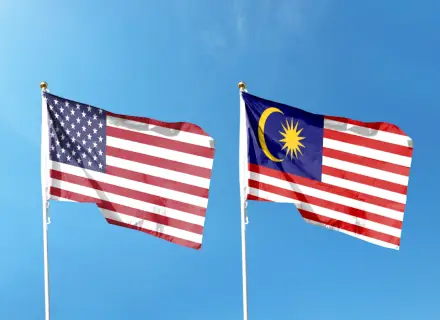

Malaysia is the first country to invalidate US trade agreements after a landmark February 2026 ruling by the Supreme Court of the world’s largest economy, which found President Donald Trump’s tariffs imposed under the International Emergency Economic Powers Act (IEEPA) to be unconstitutional.
Malaysia’s Investment, Trade, and Industry Minister Datuk Seri Johari Abdul Ghani stated that the US-Malaysia Agreement on Reciprocal Trade (ART) no longer holds any legality. He further claimed the deal was not suspended or paused, but terminated.
“It is not on hold. It is no longer there, it’s null and void,” Johari said, as reported by the New Straits Times. He further told reporters that if tariffs were imposed and legitimised based on a trade surplus, authorities should clearly specify the industry involved instead of implementing the mechanism on a blanket basis.
The ART was signed on the sidelines of the 47th ASEAN Summit in Kuala Lumpur in October 2025, with Donald Trump and Prime Minister Anwar Ibrahim as signatories. The agreement covered roughly 12% of Malaysia’s exports to the United States, offering improved market access for Malaysian exporters while making American products more competitive for Malaysian businesses. Under its terms, the world’s largest economy maintained a 19% reciprocal tariff on most Malaysian imports, with carve-outs for select goods.
The voiding of the deal comes at a particularly fraught moment. In March, the Trump administration launched a sweeping Section 301 trade investigation, authorised under the Trade Act of 1974, targeting 16 trading partners, including Malaysia.
Section 301 allows Washington to impose additional tariffs on countries found to be engaging in unfair trade practices. Johari identified Malaysia’s key vulnerable sectors as electrical and electronics, oil and gas, plantation commodities including palm oil, rubber gloves, and other rubber-based goods.
He stressed that Malaysian exporters must ensure compliance with labour and environmental standards to minimise exposure.
Domestically, the development has triggered a political response. Opposition coalition Perikatan Nasional has called for a special parliamentary session to address the collapse of the agreement, with secretary-general Takiyuddin Hassan warning of potential damage to export sectors and supply chains.
Donald Trump, for his part, has warned of significantly higher retaliatory tariffs against any nation attempting to exploit the Supreme Court ruling to unpick existing trade arrangements, a threat that hangs directly over Kuala Lumpur’s decision.