
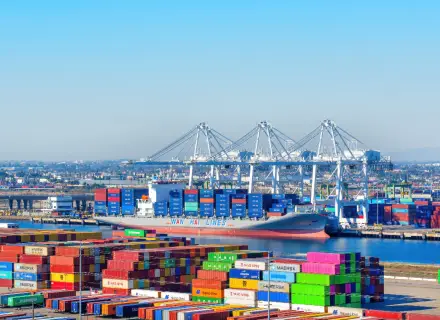

While the commitments made by China to buy more American agricultural products, as part of a trade bargain between Chinese President Xi Jinping and President Donald Trump, have yet to materialise, new data from the Port of Los Angeles shows the phenomenon has contributed to a decline in cargo volume to near a three-year low for the nation’s busiest port.
According to Gene Seroka, executive director for the Port of Los Angeles, total processed cargo volume at the facility in January was down by approximately 12% year over year, citing a decline in agricultural exports as among the major factors. He further told CNBC, “Exports to China look dismal,” suggesting that the shipping activity towards the world’s second-largest economy has dropped considerably across the United States’ major ports, with containerised exports down 26% in 2025. As per the data published by the port authorities, Los Angeles took a big hit on the crucial agricultural export of soybeans.
In early 2026, President Donald Trump announced China was considering purchasing an additional eight million metric tons of American soybeans (totalling 20 million) for the current season, following the October 2025 agreement to buy 12 million tons. Soybeans coming out of the Port of Los Angeles to China were down 80% last year, and despite the high-profile declaration from the Republican, no improvement was seen in either November or December after the initial discussions between the world’s two largest economies.
“It’s a really important part of the overall export strategy here. Argentina and Brazil have picked up a lot of the contracts for China on soybeans,” Seroka said, while adding that any increase in the American farm sector’s ability to export will take time.
“These are not transactional-type applications. These are agreements that are for the last three, six, and twelve months in duration. So, it’ll be yet another cycle before the US soybean exporter has a chance to bid and get into the game,” the senior official added.
“The Port of Los Angeles reported roughly 812,000 twenty-foot equivalent units (TEUs) for January, including imports, exports and empty containers. In January 2025, roughly 924,000 TEUs were reported, fuelled by front-loading of freight ahead of not only the major holiday period in Asia but the start of President Trump’s second-term tariffs. Breaking out the container count, January imports were 421,000 container units, down almost 13% from last year’s higher levels. On the export side, 104,000 container units were processed, a close to 8% drop year over year,” CNBC reported.
“Empty export containers that during times of high demand are sent back to Asia, a forward-looking indicator of Asia demand, came in at 286,000 TEUs, a 12.5% drop from last year,” the port authority stated.
According to Seroka, elevated 2025 numbers from a period when importers were scrambling to get cargo in ahead of Trump tariffs will continue to be a factor in comparisons throughout 2026.
“US trade policy remains largely uncertain, and I expect that to continue,” he concluded.