
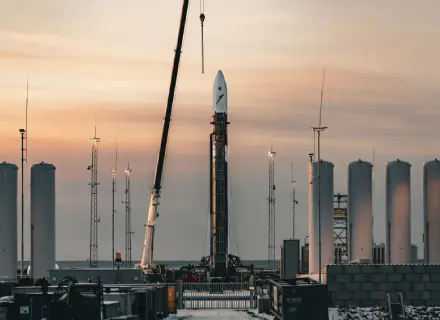

German space start-up Isar Aerospace, which specialises in satellite launch services, recently obtained 150 million euros (USD 173 million) in funding from an American investment company, Eldridge Industries. The funding, which was secured through an agreement for a convertible bond with Eldridge, will be used to expand the start-up’s launch service offerings.
The breakthrough comes after Isar Aerospace’s infamous first test launch, which failed in March 2025. During the incident, the venture’s Spectrum rocket crashed shortly after takeoff. Undeterred by the setback, the company is still pushing forward its efforts to strengthen Europe’s position in the aerospace sector, competing with firms such as Elon Musk’s SpaceX.
Established in 2018, Isar Aerospace wants to lower the entry barriers to space.
“By pushing the boundaries we are opening space as a platform for future technologies and competitiveness. As a launch service provider for small and medium-sized satellites, we create easy access to space for global customers. Offering the first fully privately funded European solution to meet the growing global demand, Isar Aerospace is driving commercial space across all continents,” the company said.
Isar Aerospace has a rich portfolio of investors, which consists of Airbus Ventures, Bayern Kapital, Porsche and Vito Ventures.
Engineering The Future Of Spaceflight
Isar Aerospace is engineering a launch vehicle to shape the future of spaceflight, by offering a flexible, sustainable and cost-effective access to space.
“Space will become a key platform for many industries worldwide using satellite-based technologies. From automotive to telecommunications, satellites advance technologies on Earth and bring new capabilities of IoT, data encryption, data storage and observation to life. These applications include smart farming, water resource and fertiliser optimisation and surveillance to tackle climate change,” it noted.
Isar Aerospace is also disrupting the commercial space sector through its high precision engineering and automated manufacturing methods.
“In less than one year, we have set up manufacturing capabilities for major rocket components, including our rocket engines. Driven by efficiency and high precision demands, our manufacturing process builds on a high degree of automation and the most advanced technologies like additive manufacturing and the use of carbon composite materials. We focus on a sustainable manufacturing process. Our in-house value creation enables maximum flexibility, unrivalled speed and highest autonomy to be at the forefront of the NewSpace industry,” the start-up informed.
Isar Aerospace has invested in things like new materials and technologies, such as additive manufacturing and carbon composites. Taking special care in structural development, the venture has made data-driven, high-performance designs the new normal. Process automation across manufacturing also enables high launch cadence and low cost while achieving premium quality. The most complex parts of the rocket engines are getting 3D printed from high-performance metals, enabling high design flexibility and part reduction with the shortest lead times.
The start-up’s space launch vehicle’s primary structure is made of single-part carbon composite, manufactured through an automated process. This lightweight material also offers the highest payload performance. Also, the non-toxic propellants offer very high density-specific impulse for high-performance, apart from allowing an optimised vehicle architecture. Isar Aerospace’s in-house developed systems are pyro-free, providing low shock for stage and payload fairing separation.
Meet The Two-Stage Orbital Launch Vehicle
Named “Spectrum,” the high-performance two-stage launch vehicle has specifically been tailored for small and medium satellites, with the ultimate goal of achieving mission success through high flexibility and lower risks by maintaining the highest quality standards.
“The Spectrum launch vehicle is fully designed and manufactured in-house. Since we own the design and development, we can respond to our client’s needs or requirement changes in the most flexible way. This means we can offer strong resilience through peerless autonomy,” Isar Aerospace remarked.
In the Low Earth Orbit (LEO) category, “Spectrum” will be able to deliver a payload up to 1.000kg, while for the Sun-Synchronous Orbit (SSO) category, the number will be 700kg. Isar Aerospace’s engineering method follows a purely data-driven approach, with design decisions being based upon system-level performance. Through this method, the start-up aims to achieve the highest cost efficiencies, allowing it to offer competitive prices to clients.
The start-up’s fully in-house designed and manufactured high-pressure turbopump-fed engines ensure superior deployment capabilities while keeping the vehicle small and easy to handle. Spectrum uses liquid oxygen and propane, offering high-performing, clean propulsion that minimises the environmental impact per launch. These propellants offer the highest density-specific impulse of all carbon-based fuels, triggering the orbital launch vehicle’s performance.
“In the last six years, we have designed, developed and built our launch vehicle Spectrum from scratch and completely in-house. After rigorous stage testing, the first test flight is now scheduled to lift off from Andoya Spaceport in Norway. The first test flight is the final integrated test of all systems. That is how we are approaching it: as a test. Our goal is to collect as much data and experience as possible. This allows us to analyse, learn, iterate and improve for the next flights,” the start-up stated before the first test launch that failed in March 2025.
During the mission, after ignition of its first stage and liftoff, the launch vehicle successfully cleared the launch pad. However, it got terminated at T+30 seconds and fell directly into the sea in a controlled manner. Despite the setback, the maiden test flight met its set goals like gathering a substantial amount of flight data and experience that will pave the way for future missions.
Marching Ahead
Isar Aerospace is preparing its launch vehicles #2 and #3 (Spectrum Series) for further test launches. Also, in its new headquarters near Munich, Germany, the start-up will be able to produce up to 40 Spectrum launch vehicles per year in the future. This approach will ensure maximum flexibility, independence and cost efficiency. Also, together with Norway’s Andoya Spaceport, the venture recently unveiled the first orbital launch site in Continental Europe.
The Norwegian Space Agency (NOSA) signed a contract with Isar Aerospace to launch its Arctic Ocean Surveillance (AOS) programme satellites. The Norwegian Civil Aviation Authority (NCAA) also became the first civil aviation authority in Europe to grant a Launch Operator License for a test flight of an orbital launch vehicle from Continental Europe.
Image Credits: Isar Aerospace