
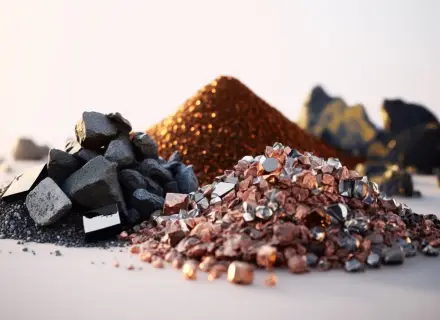

Let’s be honest. When was the last time you got excited about manganese or phosphate? Probably never. But here’s the thing: without these seemingly boring minerals, most of what we take for granted would vanish. No electric vehicles. No turbines. No phones. Honestly, even your food would take a hit.
They’re the invisible backbone of our daily lives. Quiet but essential. They’re behind your power, your data, your food, your travel. Yet, for some reason, we rarely stop to think about them.
And while our dependence on them grows by the minute, what are the systems to mine and move them forward? Sluggish. Awkward. Often broken. You’ve got roads that fade into dust, ports that choke under pressure, rail lines that barely exist. Meanwhile, the countries sitting on these resources? Still struggling to connect with the global economy they could help fuel.
It’s not just a supply chain issue. It’s a development crisis, too. According to a bunch of leading analysts (the serious number-crunchers), we need around USD 5.3 trillion in investments by 2030 just to keep up with the mineral demand driven by decarbonisation and digital growth. Yeah, trillion with a “t.” And no, money alone won’t fix this. Not even close.
You could stumble upon the world’s richest copper deposit tomorrow, but if there’s no road to get there, no power to run machines, no water to support the operation, it’s pretty much just shiny dirt. Enter Saudi Arabia. And no, it’s not just an oil story anymore.
They’re diving into mining big time. Updated laws, serious infrastructure investments, geological mapping—you name it. But the boldest move? Creating the Future Minerals Forum (FMF). Forget the stiff, boring conference stereotype. FMF feels more like a living organism than an event.
FMF pulls together ministers, mining bosses, development banks, and even communities who were once ignored. Its goal is surprisingly simple: move away from the old “dig it and ship it” approach and towards a model that builds real, lasting value.
Let’s zoom in. One of FMF’s standout ideas is cross-border mineral corridors. Sounds technical, but it’s powerful. These are shared road, rail, energy, and water routes that tie together several countries sitting on mineral wealth. Seven such corridors have been mapped so far, five in Africa, two in Latin America. Real places. Real resources. Real possibilities.
Take the Lobito Corridor. It’s a 1,300-kilometre railway that cuts through Angola and Zambia, reaching into Congo’s mineral-heavy heart. On a map, it’s a line. In real life, it’s hope, an example of what’s possible when strategy, politics, and investment sync up for once.
Still, there’s no magic wand. Infrastructure is just one side of the dice. The other? Sustainability, fairness, and local development. That part’s tougher.
FMF isn’t dodging that complexity. In fact, it’s going straight into it. They’re teaming up with the World Bank to rethink how mining projects are funded. The aim is to make investments less risky, attractive, and ethical.
Because let’s be real. In a lot of places, it’s not that there aren’t enough minerals. It’s that no one wants to take the risk to build around them. And then come the human questions, the ones that sting a bit.
What happens to villagers when a lithium plant shows up next door? Who trains the next generation of workers? Will electricity from a mining site ever reach homes nearby? Or are those communities just left behind again? These aren’t throwaway questions. They need answers. And slowly, FMF is helping us get there.
Whether it’s tackling water issues in South America’s lithium triangle or figuring out how Congo and Zambia can share power grids for copper mining, the Forum is focusing on the stuff that actually matters.
Of course, it’s easy to roll your eyes at high-level events. There’s no shortage of grand speeches that fizzle out. But something about FMF feels different. It’s grounded. Gritty. A bit chaotic, maybe, but in a way that feels alive.
Because this isn’t about clean press releases. It’s about messy cooperation, slow wins, and people figuring things out together. And maybe that’s what makes it human. These minerals? They’re not just economic assets. They’re a reflection of whether we’ve learnt to do things better. Whether we can go from short-term digging to long-term building. From taking to truly sharing.
The time to build is now. This is about more than rocks. It’s about rewriting who gets to benefit from them. It’s about giving countries, especially in Africa, Asia, and Latin America, not just a line in someone else’s story but a full chapter of their own.
If we get the infrastructure right, the policies aligned, and the funding smarter, we won’t just be unlocking minerals. We’ll be unlocking futures. And yeah, next time someone brings up cobalt or tin? Maybe don’t zone out. Maybe lean in. There’s a lot more riding on it than most of us realise.