

Qatar’s economy maintained steady growth in the third quarter of 2025, as the Gulf nation’s real GDP rose by 2.9% compared to the same period in 2024. This uptick was driven primarily by non-hydrocarbon activities, which expanded by 4.4%, stated the country’s National Planning Council (NPC).
As per the NPC data, real GDP estimates for Q3 2025 reached QAR 186.1 billion at constant prices, compared with QAR 180.9 billion in the third quarter of 2024.
“Non-hydrocarbon activities accounted for 65.5% of real GDP, with value added reaching QAR 121.9 billion in the third quarter of 2025, compared to QAR 116.8 billion in the same period of 2024. This represents a year-on-year increase of 4.4%, in line with the objectives of the Third National Development Strategy (NDS3) and Qatar National Vision 2030,” the report noted.
Within Qatar’s non-hydrocarbon economy, the fastest-growing activity on a year-on-year basis was construction (9.1%), followed by wholesale and retail trade and repair of vehicles (8.9%), and accommodation and food service activities (6.4%). The expansion reflected rising domestic demand, increased visitor activity, and the continued rollout of infrastructure and public-sector projects, with positive spillover effects across services and trade.
Secretary General of NPC, HE Dr. Abdulaziz bin Nasser bin Mubarak Al Khalifa, dubbed these numbers as trends reflecting “the resilience of the Qatari economy and the continuity of the path of economic diversification, as it achieves real growth driven by the strong performance of non-hydrocarbon activities.”
“This performance underscores the success of economic and development policies in enhancing the contribution of productive and service sectors, in line with the targets of the Third National Development Strategy and strengthens the national economy’s ability to achieve sustainable and balanced growth over the medium and long term,” the official stated.
Overall, NPC’s data noted 15 out of 17 economic activities recording positive real growth in the third quarter of 2025, demonstrating the resilience of the Gulf country’s overall economic base.
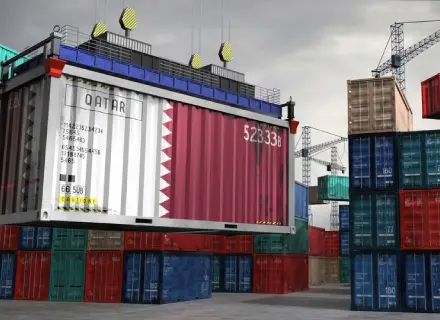
Talking about Qatar’s non-oil sectors turbocharging its GDP growth, the logistics sector emerged as another powerful driver, supported by rising trade volumes, expanding transshipment activity, and sustained investment in port infrastructure. Hamad Port, at the same time, played a central role in the Gulf country’s development ambitions by elevating the country’s position within regional and global supply chains.
The facility has transitioned from a national gateway into a multi-functional logistics platform, enabling higher-value activities such as re-exports, regional redistribution, and integrated logistics services. According to the 2024 Container Port Performance Index, jointly published by the World Bank and S&P Global, Hamad Port was ranked among the highest-performing container ports worldwide, while also holding the top position in the Gulf region, reflecting strong operational efficiency and advanced infrastructure.
As per Mwani Qatar, the authority controlling the Gulf nation’s seaports and shipping terminals, transshipment volumes accounted for nearly 50% of total container throughput between January and November 2025, signalling a significant shift in the port’s cargo profile.
According to logistics analysts, this growth reflects Qatar’s geographic position along major east–west shipping routes, combined with targeted investment in automation, digital platforms, and streamlined customs procedures. These measures also helped shipping lines reduce turnaround times and optimise operating costs, strengthening Doha’s appeal as a regional calling point.
“Hamad Port has shifted from being primarily a national gateway to a regional logistics platform. Its efficiency, connectivity, and capacity allow Qatar to capture higher-value activities such as transshipment and integrated logistics services,” logistics analyst Uwais Rahman told Logistics Middle East.
The expansion of port-led logistics activity has further improved non-hydrocarbon exports, along with sectors like manufacturing, construction, and e-commerce, while reinforcing supply chain resilience against external disruptions.