
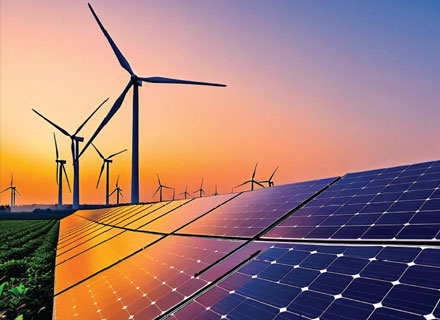

Green investing (Green Energy Investments, in other words) seeks to support business practices that have a favourable impact on the natural environment. Often grouped with socially responsible investing (SRI) or environmental, social, and governance (ESG) criteria, green investments focus on companies or projects that are committed to conserving natural resources, reducing pollution, or adopting other environmentally conscious business practices.
Thanks to the “Go Green” theme of the 21st-century global economy, investors are now eager to spend trillions on energy transition, but at the same time, too much money is piling into mature projects, with high-risk innovations struggling to attract backing. Will there be enough money in the world to save the planet? It is an urgent question that has a complicated answer.
Big-picture forecasters identify the enormous amounts required to fund a more environmentally friendly future, as well as the equally intimidating gaps in obtaining them. According to European financier Allianz, to meet the globally agreed-upon 2030 emissions targets, investment in the energy transition must more than double to $4.05 trillion annually. In a 2023 report, the Boston Consulting Group (BCG), a United States-based firm, projects a net-zero “capital gap” of $18 trillion.
The situation looks even more dire for 2025. With his promise to “drill, baby, drill” for oil and gas, United States President Donald Trump has reclaimed the presidency and will eliminate the generous green subsidies that his predecessor, Joe Biden, had advanced through the Inflation Reduction Act (IRA). High energy costs and farmer protests are undermining support for Europe’s ambitious transition agenda, while Canada is about to repeal its historic carbon tax.
In financial markets, the cost of capital-intensive energy infrastructure is continuing to rise due to persistently high interest rates. A return to reliance on fossil fuels is being prompted by the AI-driven surge in data centre construction, which is driving up electricity demand estimates.
According to Richard de los Reyes, a portfolio manager at T. Rowe Price’s New Era Fund, one of these data centres can consume as much electricity as a small city. The need for natural gas to meet demand is increasingly recognised.
Mismatched realities
However, practitioners in the financial trenches who are raising capital and structuring deals have a very different perspective. They are concerned about pursuing too few green investments with too much capital.
According to Alex Leung, head of infrastructure research and strategy at UBS Asset Management, “I continue to firmly believe that the megatrends of decarbonisation and digitalisation will revolutionise our way of life. However, these sectors are becoming increasingly crowded. The world of renewable energy is becoming more and more fragmented from a financial standpoint. How can both be true? Capital is plentiful, but it is largely concentrated in a small number of established green technologies, while more creative or untested industries have difficulty obtaining funding.”
On the one hand, investors can support well-established, reasonably priced technologies with the realistic hope of a consistent, multi-decade payout. Since economies of scale and a boom in Chinese equipment have driven the costs of solar and onshore wind power below those of fossil fuels, they have entered this category. Then there are technologies like offshore wind that have high costs and unknown risks, or technologies like carbon capture or green hydrogen that show promise but have not yet turned a profit. For these projects to become commercially viable, they still need government assistance or wealthy corporate backers.
Antoine Saint Olive, global head of infrastructure and energy finance at Natixis Capital and Investment Banking in Paris, said, “Everyone wants to be part of the energy transition on paper. But when you have a real deal on your desk, in many cases, you are talking about new technologies.”
As investors lament over crowded trades, this mismatch, between a surplus of capital for proven projects and a shortage for riskier innovations, helps explain why trillions are still required. The most important agreements arguably lie in the intersection of established and emerging technologies: rapidly evolving solar and wind energy storage systems and the modifications to grids required to transmit them. Without improved customer delivery, renewable energy investments will eventually reach a ceiling, and in certain locations, they may have already.
According to Rebecca Fitz, a partner at BCG and a founding member of the company’s Centre for Energy Impact, current grids can generally handle renewable energy until it accounts for 15% of their input. She said that there is “a bottleneck in power market design” in some regions of Europe where the percentage is higher than 50%.
Stef Beusmans, an associate partner at Sustainable Capital Group in Amsterdam, said, “Moving green energy from where it’s best produced—Spain and Portugal for solar, the Netherlands for wind—to where it’s needed is particularly challenging due to Europe’s patchwork of national grids and regulators. Europe finds it more difficult to really accelerate the deployment of clean energy due to different national support schemes.”
Energy finance at a crossroads
The venerable, obscure world of infrastructure finance, which accounts for roughly 4% of global capital, faces both opportunities and challenges as a result of the energy transition’s immense scope and complexity, according to UBS. In this area, plain vanilla deals are uncommon. Infrastructure investors must structure transactions individually and frequently bear the risk over an extended period of time, but bond underwriters and traders have access to rating agencies and liquid markets to help them manage risk.
According to Leung, “It could take up to a year to structure and close a deal. After that, active management is necessary for many infrastructure assets. This goes beyond simply cutting a coupon.”
As per Marta Perez, who leads the Americas infrastructure debt team at Allianz Capital Partners, green investments present a more complex scenario. She clarifies that established project finance models, originally devised for predictable long-term assets like traditional fossil fuel power plants, must undergo transformation to cater to the variability and often decentralised attributes of renewable energy systems.
Climate activists prioritise a variety of issues, such as building insulation and tree planting. However, electricity is the main issue for investors. According to BCG, approximately 90% of the $18 trillion net-zero capital gap is attributable to electric vehicles and other “end uses” of electricity.
Allianz reports that in 2023, “electrified transport” and renewable energy production each accounted for over $600 billion in global spending. Batteries and other energy-related components ranked fourth at $135 billion, while power grid upgrades came in third at $310 billion.
These figures will only rise due to the haste to construct AI data centres, which are huge energy users. According to UBS, the United States will generate an astounding 20% more electricity per year between 2023 and 2026. Leung claims that because the AI craze will require more power from fossil fuels, it will be “slightly negative for decarbonisation in the short term.”
However, AI also draws the world’s renowned tech companies further into the energy transition. Amazon, Microsoft, Alphabet (the parent company of Google), and other hyperscalers that run data centres are still “among the most committed to net-zero,” according to Leung, despite recent conciliation with Trump. They might have to pay more for clean power.
The AI-driven power surge is increasing the role of regulated utilities, which can raise rates to cover their costs. For energy-transition investments, this might offer one of the safest financing options. But public opposition to higher taxes, particularly those aimed at financing Big Tech’s energy appetite, might prove to be a significant barrier.
BCG claims that North American utilities will supply the remaining 35% of the anticipated increases in power demand from natural gas and 60% from renewable sources.
Infrastructure experts believe that Trump is one threat that may be overrated. The length of energy investments— much longer than a single presidential term—makes changes in policy less significant. As per UBS research, Trump will also have difficulty dismantling or repealing the IRA.
Leung and his associates point out that about 70% of the US renewable projects currently in development are in “red” states that supported Trump. In the House of Representatives, 18 Republicans have already signed a letter opposing repeal, which is more than enough to make a difference in the closely divided chamber. It is difficult to determine the exact impact of this resistance, though, because Trump has been avoiding Congress on a regular basis.
Despite being politically conservative, Texas leads the United States in solar and wind energy. More than 70% of Americans nationwide favour increased use of solar and wind power, according to Pew Research.
In the worst-case scenario, according to UBS, Trump will make changes to the IRA rather than abolish it, enabling Republican-led states to finish short-term renewable projects while still giving the President a political win.
China dominates green investing
The largest economy in the world, the US, does not lead the way in green investment. According to CarbonCredits.com, China holds that distinction, investing $818 billion in clean energy in 2024, more than the US, European Union (EU), and the United Kingdom combined. In 2024, the People’s Republic saw a 45.2% increase in solar capacity.
China is also far ahead in its nuclear power plant programme, which may lead to a resurgence in the US, if not Europe. Although nuclear power has other known hazards, it does not emit carbon. Since China is primarily funding its renewable energy advancements domestically, private capital from around the world is looking elsewhere. Europe is still dedicated to a surge in renewable energy to partially replace Russian natural gas imports, which Russian President Vladimir Putin stopped due to sanctions pertaining to Ukraine.
According to the European Investment Bank (EIB), the EU is still investing ten times as much in renewable energy as it is in fossil fuels, despite also placing bets on more liquefied natural gas. To reach the 2030 carbon reduction targets, the bloc’s overall energy-transition investment is predicted to continue increasing, having increased by a third in 2023 to $360 billion.
Other countries are joining in as well. With plans to triple by 2030, India’s renewable capacity jumped to almost half of the US level last year. In India, six significant solar developers have “attracted investments from diverse sources, including foreign institutional investors from North America, Europe, and the Middle East,” according to S&P Global.
Nearly 85% of the record 10.9 GW of power capacity added by Brazil in 2024 came from renewable sources. With an investment of $8.4 billion promised, Saudi Arabia is backing the biggest and most ambitious green hydrogen project in the world, close to Neom, the Kingdom’s “city of the future,” according to Neom.
The objective is to use electric current generated from renewable sources to split water molecules into their hydrogen and oxygen components, then store the hydrogen for use as fuel. Following closely behind, the United Arab Emirates (UAE), Saudi Arabia’s neighbour, is using its plentiful sunshine to power massive renewable energy projects.
Green energy draws investors
Big-ticket investors worldwide remain driven by environmental, social, and governance (ESG) principles, as indicated by Saint Olive of Natixis. Banks still wish to “greenify their balance sheets,” even though they contribute at least as much to infrastructure as institutional investors. Banks outside of the United States do, at least.
Saint Olive noted that banks and sponsors around the world still have ESG ambitions, and the change of a single country’s president will not make them fall apart.
The EIB estimated that private equity investments in green energy would reach $26 billion globally, up from almost nothing before the COVID-19 pandemic. The amount at stake could be many times that amount, given the private equity model’s practice of leveraging up equity holdings.
According to Fitz of BCG, as solar energy gains popularity and Texas lawmakers push legislation that favours fossil fuels, private equity firms in the US are paying special attention to onshore wind generation.
She said, “Private equity is paying more for wind assets. Going forward, they see wind as an essential component of the energy picture.”
One of the biggest obstacles still facing the world is financing the energy transition. When the US Department of Transportation completed the interstate highway system in 1991, it cost $129 billion, making it one of the largest infrastructure projects of the 20th century. The capital requirements for green power in a single year are a tiny portion of that. Utilising tried-and-true technology, the US highway system was funded by the federal government.
Aside from China, governments face significant pressure to transfer as much of the financial burden as possible to the private sector, given the social responsibilities of the 21st century. Saint Olive emphasises that many estimates of the renewable energy transition underestimate the significant costs involved in mining the metals required for constructing batteries, electrical grids, and turbines.
He argues that mining is a “fully merchant business” reliant on fluctuating prices that hinder fixed, infrastructure-style returns, and that it faces no favourable treatment from regulators or the public. He claims that many banks have a negative view of the mining industry from an ESG standpoint. They prefer to let others pay for it.
Nevertheless, despite the White House’s rhetoric, the global energy transition is not only continuing but also accelerating. However, investors in infrastructure are also accustomed to creating custom solutions for a project’s evolving environment.
For construction in the United States, you might have bank loans before looking to the capital markets. European plants could rely on power purchase agreements that last for ten years. Very long-term financing, such as construction plus 25 years, is available in the Middle East.
“Whether the transition will occur quickly enough to prevent ecological disaster is more important than whether it will occur at all. If governments and engineers can work together to produce profitable investments, private finance appears ready to play a role. More capital will come in if projects are generating 20% returns. Although it’s not always discussed, economic viability plays a significant role in the equation,” Leung noted.
Green energy investment is growing, but money flows mostly to proven technologies. Riskier innovations still struggle for funding. If governments and investors collaborate wisely, the world can accelerate the energy transition while keeping projects profitable and sustainable.