

Sudan is crumbling under the weight of hyperinflation. In the middle of a brutal civil war and a collapsing economy, ordinary Sudanese are being buried under numbers that defy belief. The IMF (International Monetary Fund) says inflation hit nearly 177% in 2024 and could still hover around 100% in 2025. Triple-digit inflation again, in a country already brought to its knees.
Approximately 30,000 people have died in the fighting, and, when accounting for starvation and disease, the total number of casualties exceeds 400,000. After Omar al-Bashir was overthrown in a coup in 2019 by the Sudan Armed Forces (SAF) and the Rapid Support Forces (RSF), some believed this could mark a new beginning for the nation. However, the formerly allied factions went back on their promises and began battling for power instead of working to restore civilian rule. This situation serves as a stark reminder of what can happen when political discourse breaks down, and a nation becomes fractured due to political and economic greed.
What the numbers really show
The IMF’s April 2025 World Economic Outlook places Sudan’s consumer price inflation at 100% for 2025 on average, a projection that reflects the scale and persistence of price pressures.
Complementing that, the IMF country page for Sudan shows consumer prices rising at triple digits, with real GDP projected to contract slightly in 2025, highlighting a stagflationary environment, which is a rare combination of high inflation, slow economic growth, and elevated unemployment, a squeeze that is both deep and sustained.
World Bank monitoring confirms continued macro fragility, with the May 2025 “Sudan Economic Update” describing entrenched supply constraints, administrative dislocation, and conflict-driven disruptions that keep inflation elevated and unstable.
A World Bank Macro Poverty Outlook note for Sudan indicates inflation decelerated to 78.4% year over year by July 2025, which is a notable moderation that still leaves households struggling as broad money growth, foreign exchange scarcity, and a persistent parallel premium feed through to prices.
When factories are looted, the farms burned, the roads severed, and banks shuttered or relocated under duress, price signals stop disciplining markets and start reflecting scarcity, fear, and speculation.
What fuels inflation?
How can anyone stabilise prices when the country is being torn apart by a civil war that began in April 2023 and has displaced millions, severed supply chains, and turned food, fuel, and cash into instruments of leverage?
United Nations updates since early 2025 have called Sudan the most devastating humanitarian and displacement crisis in the world.
The World Bank’s Sudan overview makes the connection explicit, describing how conflict has produced wide-ranging economic and social damage that constrains production, distorts logistics, and crushes livelihoods, which elevate price pressures and entrench volatility.
Moreover, standard economic analysis often misses the “shadow economy” of resource theft. In Sudan, this is not a small detail. It is the primary engine of the conflict. Official reports state that Sudan produced 64 tonnes of gold in 2024. This record amount should have injected billions into the banking system. It did not.
The reason is simple. Data indicates that between 50% and 80% of this gold is smuggled out of the country. Economic analysts estimate this results in a loss of up to $7 billion in annual revenue. This massive sum bypasses the government entirely. Instead of backing the currency, the wealth flows directly to armed factions like the RSF, who control key mines in Darfur.
Investigations reveal that over 90% of this gold eventually lands in the United Arab Emirates. The proceeds then return to Sudan in the form of weapons rather than food or medicine. This creates a self-sustaining “Gold-for-Guns” loop. The inflation crisis will never end while the nation’s most valuable asset is used to purchase the very bullets destroying it.
Currency collapse and the price spiral
Currencies are stories about credibility, and Sudan’s story has been a slow-motion implosion that turned precipitous as the war intensified.
Radio Dabanga reported that the US dollar surpassed 2,100 Sudanese pounds on the parallel market by July 2024. This violent depreciation quickly translated to increased prices for imported goods and basic necessities linked to import cost structures.
Further reporting captured the widening spread between official and parallel rates, with banks quoting markedly below street prices as the market premium crystallised into a daily tax on transacting outside privileged channels.
The World Bank’s 2025 update documents an official rate around 2,019 pounds per US dollar by March against a parallel rate near 2,679, quantifying an approximate 21% premium that distorts price discovery, encourages hoarding, and penalises the poorest who cannot arbitrage.
By June 2025, Xinhua described a further slide with the dollar trading at 2,760 on the parallel market and the official rate at 2,100, which is an exchange rate anatomy that maps directly onto continued price instability.
None of this is abstract because every currency gap creates space for speculation, counterfeiting, and rent extraction that show up as empty wallets and thinner meals for ordinary households.
Sudan executed a dramatic exchange rate adjustment in February 2021, moving the official rate from 55 to 375 pounds per dollar as part of a push to unify rates and restore competitiveness, a necessary step that proved insufficient in the face of political upheaval and then all-out conflict.
Any talk of new exchange rate reforms without parallel moves on security, revenue, and banking resilience will founder on the same rocks because credibility is earned through results that people can see on shelves and in markets.
That is why the IMF’s WEO snapshots matter less as forecasts to memorise and more as calls to restore the basic preconditions for price stability, starting with security, access, and institutional capacity.
Human cost of inflation
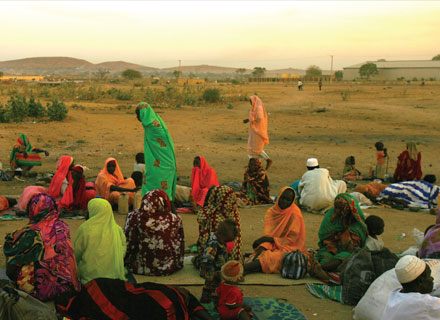
The numbers tell a story of collapse, but behind them are people, millions of them. According to UN assessments in 2025, tens of millions of Sudanese now depend on aid just to survive. Entire families are on the move, fleeing violence and hunger, while basic services such as water, health, and electricity fall around them.
The World Bank says poverty is surging and the economy has shrunk again, year after year. Latest data suggests that 26 million (around half the population) are starving, and the nation has more people living in famine than the rest of the world combined. There is also a 40% drop in income, and food inflation has tripled. People have no money for food, medicine, or fuel.
Even if inflation slows a little by mid-2025, it is still devastating. Prices are still high. And because food, housing, and transport make up most of what people spend on, it is the poorest who bear the most.
Humanitarian groups like ACAPS have been sounding the alarm for months. Food prices are spiking far above their multi-year averages. For example, the price of grains like Sorghum and millets in 2024 is 500% higher, which is six times, than in 2023. And it seems to be getting worse.
Markets are fractured. Imports are stuck. Traders are being taxed by armed groups at every checkpoint. Sudanese traders are being taxed or asked for protection money by both the Sudanese Armed Forces (SAF) and the Rapid Support Forces (RSF), as well as civil authorities and local militia. The cost of transit for goods itself is appalling. For a single truck to make a return trip in South Sudan, the cost of taxes and bribes to all competing parties is about a whopping $3,000. There are reports that supply trucks pass through almost 100 checkpoints controlled by rival factions on a one-way trip.
It is a human catastrophe that shows, in real time, what happens when war, misrule, and neglect destroy not only a country’s currency but its capacity to care for its people. The displacement map is also a price map because each wave of movement shifts demand toward fragile urban centres and import-dependent corridors where logistics premiums are already elevated.
Almost 13 million people have been displaced, and 8–10 million are internally displaced. It means that they have fled their homes but are still in Sudan. The rest have fled to Chad, Egypt, South Sudan, and Ethiopia. In that environment, the line between profiteering and survival blurs, and public authority’s absence invites every private tax imaginable, each one manifested in the final price paid in cash or in kind.
Inflation erodes purchasing power, social cohesion, trust in institutions, and the perceived fairness of the economic game, which, in turn, depresses participation and investment.
A broken banking system
If conflict is the match, policy failure is the kindling, and fiscal dominance is the wind that keeps the blaze alive.
Sudan’s central bank has not operated with full independence in years, subordinated to urgent fiscal needs that have encouraged money creation and administrative controls rather than credible anchors and transparent rule-making.
The World Bank’s country work points to disrupted cash replacement, mobile money curbs, and administrative interventions that respond to immediate pressures but often add frictions that widen parallel gaps and degrade confidence.
Banking infrastructure has been looted, relocated, or shuttered across key corridors, with more than half the system at times effectively disabled, which means intermediation is impaired and the transmission of policy signals is weak to non-existent.
When broad money grows 29% in six months, as the World Bank notes for early 2025, in a context of supply destruction and FX scarcity, the predictable result is persistent inflation, even if the monthly path wobbles with seasonal harvests and sporadic aid.
There is an irony here that should not be lost on anyone. The more the state leans on the banking system to absorb shocks it cannot price, the more fragile and politicised that system becomes, and the less able it is to perform the basic tasks of payments, savings, and credit without distortion.
There is no visible horizon for the conflict, and the Sudanese people are experiencing one of the worst economic crises of our times, comparable to the people of Palestine, Yemen, and Ukraine.
Humanitarian access must expand quickly as an inflation management tool that floods famine-threatened regions with food and health services, breaks speculative hoarding, and normalises logistics so that price expectations can reset.
Diplomatic leverage must prioritise a ceasefire that enables corridors and markets to function safely because every day of war deepens scarcity and every week of scarcity hardens inflation expectations.