
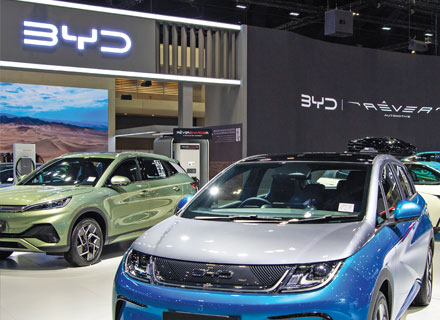

China has become the world’s electric car powerhouse almost overnight. In 2023, some 8.1 million new electric cars were registered in China, which is roughly 35% more than the previous year, and over one in three new cars sold in China is now electric.
Chinese automakers like BYD, NIO, and Xpeng have leveraged this massive home market to build global export businesses. As one analysis notes, China went “from a net car importer as recently as 2022” to a major manufacturer and exporter of finished vehicles within a few years. This has unleashed a wave of affordable, feature-packed Chinese electric vehicles across global markets, from Southeast Asia and Latin America to Europe, bringing significant economic, political, and environmental consequences.
Economically, China’s low-cost EVs are squeezing Western carmakers and forcing new trade debates. Geopolitically, Chinese dominance of batteries and supply chains creates new dependencies and potential leverage. From a climate perspective, we must ask whether the Chinese EV boom helps or hinders global sustainability. International Finance will unpack each dimension, drawing on industry data and expert commentary.
Cheap cars
Chinese EVs have hit international markets with a price shock. Models that cost the equivalent of $7000–$10000 in China can still undercut many rivals abroad, even if marked up for profit. In fact, BYD often sells its cars for much more in Europe than in China, sometimes double the price, but even those export prices are highly competitive.
The sheer scale and breakneck speed of China’s electric vehicle rollout have caught Western executives off guard. Ford boss Jim Farley, after touring China, warned that Beijing’s carmakers now pose an “existential threat” to Western incumbents. Mercedes CEO Ola Källenius described the competition as a “Darwinistic price war” that could wipe out many current players. In short, Chinese EV makers are no longer content to play catch-up; they’re sprinting into new markets.
These concerns are grounded in reality. According to the International Energy Agency (IEA), China’s share of global electric vehicle production and exports has significantly increased. In 2024, China manufactured over 70% of all the world’s EVs, and Chinese brands represented 40% of global EV exports, totalling 1.25 million cars. Alarmed by this surge, the European Union and the United States have initiated investigations and threatened to impose tariffs.
As EU Commission President Ursula von der Leyen recently put it, global markets have been “flooded with cheaper electric cars” from China, prompting a probe into possible unfair subsidies. The EU has proposed steep tariffs, ranging from 40% to 50%, on Chinese electric vehicles in an effort to level the playing field. Similarly, Washington is pushing back with EV-specific tariff legislation and “China-free” content requirements embedded in the Inflation Reduction Act, all aimed at curbing imports.
Western carmakers are racing to adapt, some slashing prices and pouring money into next-gen EV technology, while others hedge their bets by shifting production strategies. For example, BMW has announced a new plant in South Africa to serve African and European markets, and Ford plans to build EVs in Mexico rather than rely on Chinese imports.
Industry analysts note that Chinese brands have deliberately kept their early export prices high to build profit and brand equity, so they have room to slash prices in the future if needed.
As Ben Townsend of Thatcham Research observes, Chinese EV firms “aren’t looking to undercut” for now, but have the financial flexibility to do so. In a price-sensitive global market, that is a chilling prospect for established makers.
Chinese models are also stepping up in quality and features. A recent press study found BYD outperforming even Tesla in Europe. In April 2025, BYD’s sales jumped 359% year-onyear, overtaking Tesla (which fell 49%) in European registrations.
JATO Dynamics’ analyst Felipe Munoz called this a “watershed moment.” Tesla had long dominated Europe’s EV scene, but BYD, which only entered Europe in late 2022, is quickly catching up.
In fact, the once-derided notion of “cheap Chinese knockoffs” has faded. Chinese EVs now boast competitive range and technology. As one source notes, Chinese cars “are no longer knockoffs; they’re a serious threat with competitive range, features, and price.” Innovations like BYD’s new Blade Battery, safer, energy-dense, and lower-cost, show Chinese firms pushing technical boundaries as well.
Former Volkswagen CEO Herbert Diess warned on German TV in late 2024 that Chinese manufacturers are struggling, especially in terms of profit, and urged Europe not to concede defeat. Diess noted that Chinese EV makers, aside from BYD, “are burning through their capital” and are still unprofitable.
In practice, Chinese strategies seem mixed: building global sales and brands but not profitably so far. Nevertheless, governments see plenty of cause for alarm, and trade disputes are already brewing. The European Union and United States may well increase tariffs and non-tariff barriers, and automakers are lobbying hard for protection.
Chinese EVs have become massively cheaper and more advanced, grabbing market share worldwide. Western automakers now face a cutthroat price war, prompting protective responses such as tariffs and investigations, and a push to innovate. Analysts warn Europe and the US risk losing their lead unless they act aggressively.
Geopolitical leverage
China’s EV rise isn’t just an economic story; it’s also a geopolitical one. The world’s shift to electric mobility could wind up making many countries dependent on Chinese batteries, parts, and technology, giving Beijing new influence. At the heart of this is China’s stranglehold on battery supply chains. Chinese firms control roughly 70% of the global EV battery market.
CATL (Contemporary Amperex) alone has about a 37% share, and BYD around 17%. These companies supply virtually all the major automakers, including Tesla, Ford, and VW. In raw materials, China already dominates the mining, refining, and processing of critical minerals.
A US analysis notes that China intentionally poured some $100 billion into subsidies and investments over the past decade to lock in global lithium refining capacity, then even dumped excess product abroad to squeeze out rivals. China similarly cornered cobalt, nickel, graphite, and other key EV inputs.
Why does this matter? As one logistics analyst warned, “He who controls the supply chain controls the battlefield, economic or otherwise.”
In practical terms, major Chinese control of EV supply chains means that even if Western governments buy cars from other brands, they are still tied to China for batteries and materials.
This creates leverage. For example, Chinese companies like CATL already have plants overseas, and Beijing could, in theory, restrict exports or raise prices if it wanted to gain a political advantage, as it has done in the past with rare earths. Indeed, CATL has already drawn scrutiny as a national security concern. In January 2024, the United States labelled CATL a “Chinese military company” (an action CATL denies), reflecting Washington’s unease about Chinese firms’ role in key technologies.
Some analysts openly warn of national security risks. A recent policy brief argues that US dependence on Chinese battery and mineral supply is a direct vulnerability, and disrupting China’s supply could “cripple the US EV sector” as badly as cutting off critical weapons components. The Council on Strategic Risks notes that “the US dependence on China for critical minerals and battery supply chains represents a national security risk.”
It points out that China controls a substantial share of the entire value chain, from mining through final battery production. In response, governments are trying to diversify. The US is funding domestic battery projects and sourcing raw materials from allies, while Europe is pushing partners like Indonesia and Africa to develop their own supply chains.
Beijing is actively building EV manufacturing abroad to hedge against potential trade barriers and embed Chinese tech overseas. BYD’s huge Brazil plant, with assembly lines and battery production, is a case in point.
NIO and Xpeng are selling in Europe, and forming joint ventures to sidestep tariffs. The IEA notes that as Chinese exports face new tariffs in places like Brazil and Thailand, manufacturers have been frontloading shipments and seeking alternative markets.
Still, Chinese auto factories abroad remain a small share, which is around 5% of EV sales in emerging markets, and rising. For now, most of the global EV fleet still depends on Chinese-made parts.
The leverage shows up in politics. In 2024, Brazil imposed tariffs on electric vehicles to shield its emerging domestic industry, prompting China to delay shipments, while European capitals faced mounting pressure to follow suit.
Germany and France have considered “resilience” criteria for EV subsidies, making Chinese models less eligible, and the EU imposed antidumping duties of up to 38% on some Chinese EV brands.
Even in China itself, leaders talk openly about EVs as a geopolitical tool. At Davos 2025, CATL co-founder Pan Jian stressed that “it’s not going to be a one-country effort,” implying China intends to be the EV hub for the world. Experts warn this is a strategic vulnerability for the West. In response, governments are initiating new trade defences and subsidies to reshore or diversify their EV supply chains, but China’s first-mover advantage remains formidable.
Green dreams or dirty details?
On the upside, there’s no doubt that China’s EV fleet has cut fuel use. China is now the world’s largest EV market by far, so every Chinese EV on the road replaces one fossil-burning car.
According to the IEA, EV sales have driven China’s overall car market to grow, thanks to the EV segment, even as conventional car sales slump.
By enabling millions of drivers to switch off oil, China’s EV push can significantly reduce carbon emissions if the cars are charged from clean sources. The Chinese government is also rolling out renewables aggressively. Wind and solar capacity in China is booming, which will lower the carbon intensity of electric driving over time.
And Chinese manufacturers are adopting greener technologies. For example, CATL touts new battery chemistries and recycling plans to reduce waste. BYD and others are setting emissions targets for their factories. BYD even reports that its customers’ use of its EVs has saved 2.4 million tonnes of CO2, equivalent to planting 100 million trees.
But the current picture raises concerns. First, building EVs is carbon and energy-intensive. Producing the heavy batteries emits substantial CO2. One analysis finds a typical EV’s manufacturing embedded carbon is about 8.8 tonnes of CO2 (43% of that from the battery alone), compared to roughly 5.6 tonnes for a conventional car. In China, this matters especially because much industrial power still comes from coal.
Indeed, a 2024 lifecycle study of Chinese vehicles found that battery EVs in China emit only about 11.8% less CO2 than similar petrol cars, a modest gain, while they increase emissions of sulphur dioxide and fine particulates (SO2 up by 10%, PM2.5 up by 20%) due to coal-fired power and heavier vehicles.
In cold northern regions of China, EVs can even have higher lifecycle carbon intensity than ICE cars, because heating and coal use spike. In short, the climate benefit in China today is smaller than expected, and local air quality gains are uneven.
There are other environmental costs also. EVs are heavier and wear out tyres faster, generating particulate pollution. Studies estimate EV tyre wear currently spews millions of tonnes of microplastics per year, worse than on lighter cars. And then there are raw materials.
The mining of lithium, cobalt, and nickel for batteries often has serious environmental impacts. For instance, investigators once halted lithium mining in Yichun, China, after finding toxic pollutants in local water supplies.
Chinese companies have been criticised for labour and environmental abuses in mining projects overseas. Such issues have prompted some NGOs to argue that cheap Chinese EVs can’t be considered fully green unless their entire supply chain cleans up.
Moreover, electricity matters. An international study published in April 2025 warned that EV adoption by itself will not cut CO2 unless power grids decarbonise. In countries still reliant on coal, such as China, India, and even parts of Europe, charging an EV can produce more CO2 at the power plant than a fuel-efficient petrol car would at the tailpipe.
The University of Auckland study found that higher EV uptake often correlates with higher national CO2 emissions when grids are dirty. For China, this means the full climate payoff of its EV fleet will only come as coal plants retire and renewables expand.
The Chinese government is aware of these issues. In 2025, Beijing tightened battery safety regulations, not directly for emissions, but indicating higher production standards. It is also gradually redirecting industry toward greener factories under its “dual carbon” goals, which target peak emissions by 2030 and neutrality by 2060.
Some Chinese automakers are pushing carbon-neutral manufacturing. BYD has pledged to cut carbon intensity by 50% by 2030, and CATL claims to develop next-generation ultra-low carbon batteries. However, critics say that for now, Chinese regulators still favour rapid growth over strict environmental oversight, and that cheap pricing sometimes comes from cutting corners in sustainability.
China’s electric car revolution is already well underway, reshaping markets and politics worldwide. For consumers, it means more affordable EV options and faster innovation. For automakers, it means intense new competition and the imperative to adapt. For governments, it means balancing the climate benefits of faster electrification against the strategic risks of import dependence.
European and American industries are mobilising, building their own gigafactories, tightening supply chains, and exploring alliances. For example, the US and EU recently unveiled a joint plan to strengthen non-Chinese EV supply.
Meanwhile, Chinese firms are expanding overseas, betting that scale and state backing will eventually let them dominate. As VW’s Herbert Diess put it, “the automotive landscape…is still open for a second round.”
But he also warned that China’s domestic EV scene is a brutal, capital-burning contest, suggesting that not all Chinese newcomers will survive. The same could be said for the auto industry worldwide, as this is a round in which only the strongest, and perhaps luckiest, will be left standing.
What’s clear is that affordable Chinese EVs won’t disappear quietly. Their presence will continue to pressure prices and profits, shaping how the transition to electric transport unfolds. They could accelerate global decarbonisation by making EVs truly mass-market, or they could undercut environmental standards if shortcuts are taken. Vigilance is required because trade policies will need to evolve, supply chains may need safeguarding, and environmental regulations must catch up.
China’s EV surge is both a breakthrough and a challenge. It has sped up the global switch from oil to electrons, which is a win for climate goals, but it has also introduced new security and sustainability questions. Navigating this moment demands smart policy and industry strategy on all sides.
As one commentator puts it, China’s EVs show what careful long-term industrial planning can achieve, a lesson the West will not soon forget.