
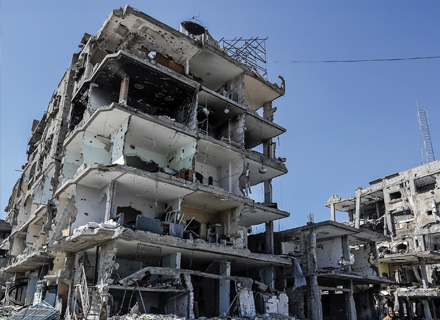

United States President Donald Trump, on February 26, through his Truth Social account, shared an AI-generated post-war utopian reality for the Gaza Strip, where the city, apart from being home to skyscrapers, has huge golden statues of the Republican, with the latter’s entrepreneur aide Elon Musk walking amid showers of cash. Meanwhile, the region is currently lying in ruins and reeling from the aftershock of a war involving Israel and Hamas, which has not fully ended yet.
Trump now sees Gaza as “Trump Gaza,” with a song preaching: “Donald is coming to set you free, bringing the light for all to see. No more tunnels, no more fear, Trump Gaza is finally here.”
The AI-generated video, which shows a post-war transformation of the territory along the lines of modern-day Dubai, arrived amid the ongoing three-phase ceasefire deal between Israel and Hamas, which has resulted in the exchange of prisoners and hostages between the two sides. A 15-month-long war pounded Gaza severely, as over 48,000 people have reportedly died. Israel, on the other hand, lost over 1,200 people during the attack by Hamas on October 7, 2023, which triggered the war.
What is Trump up to?
Immediately after taking over the administrative reins in January 2025, Trump presented his vision for rebuilding Gaza, under which some two million Palestinians would be resettled in neighbouring countries.
“No, they wouldn’t, because they’re going to have much better housing. I’m talking about building a permanent place for them,” he told Fox News in February. Then came another clip of the interview, where the Republican stated he was “committed to buying and owning Gaza.”
While Trump’s proposal invited backlash from all over the world, the Palestinian Authority and Hamas reiterated that Palestinian land was “not for sale.” However, Israeli Prime Minister Benjamin Netanyahu praised Trump’s proposal as “revolutionary and creative.” The United Nations (UN) has also warned that any forced displacement of civilians from occupied territory is strictly prohibited under international law and is “tantamount to ethnic cleansing.” Talking about Gaza’s situation, there is a ceasefire in place, as part of which Hamas has already released some of the Israeli hostages it was holding in exchange for Palestinian prisoners in Israeli jails.
Most of Gaza’s population has also been displaced multiple times. Almost 70% of buildings are estimated to be damaged or destroyed, the healthcare, water, sanitation, and hygiene systems have collapsed, and there are shortages of food, fuel, medicine, and shelter. Trump, on his part, has promised to build “beautiful communities” for the Palestinians of Gaza.
“Could be five, six, could be two. But we’ll build safe communities, a little bit away from where they are, where all of this danger is. In the meantime, I would own this. Think of it as a real estate development for the future. It would be a beautiful piece of land. No big money spent,” he added.
Trump believes that the Palestinians would have no right of return to Gaza because their lives would be “much better” elsewhere, contradicting Secretary of State Marco Rubio and White House Press Secretary Karoline Leavitt, who told reporters the relocations would be temporary during reconstruction. Egypt and Jordan’s leaders have rejected both Trump’s plan and his previous requests to take in refugees from Gaza. However, Trump further doubled down on his takeover plan.
“I’m committed to buying and owning Gaza. As far as us rebuilding it, we may give it to other states in the Middle East to build sections of it. Other people may do it through our auspices. But we’re committed to owning it, taking it, and making sure that Hamas doesn’t move back,” he told reporters on board “Air Force One,” without explaining who he would buy the territory from or how the US would own it.
In what seems to be an outrageous statement, Trump said people from all over the world would be able to move to Gaza and that Palestinians would not want to go back there. However, the proposal found support from Netanyahu, who stated, “For a full year, we have been told that on the ‘day after,’ the PLO (Palestine Liberation Organisation), the Palestinian Authority, needs to be in the Strip. President Trump came with a completely different vision, much better for the ‘State of Israel,’ a revolutionary and creative vision, which we are discussing. He is very determined to carry it out. This also opens many possibilities before us.”
Palestinians now fear a repeat of the Nakba, or “catastrophe,” when hundreds of thousands fled or were driven from their homes before and during the war that followed the creation of the “State of Israel,” in 1948. Many of those refugees ended up in Gaza, where they and their descendants now make up three-quarters of the population. Another 900,000 registered refugees also live in the West Bank, which Israel occupied in the 1967 Middle East war, along with Gaza, while 3.4 million others live in Jordan, Syria, and Lebanon, according to the United Nations. In fact, one of the bones of contention between Palestine and Israel has been the right of those refugees to return.
Israel unilaterally withdrew its troops and settlers from Gaza in 2005, though it retained control of its shared border, airspace, and shoreline, giving it effective control of the movement of people and goods. The UN still regards Gaza as Israeli-occupied territory because of the level of control Israel has. In fact, Trump’s plan drew severe criticism from Europe too, with former German Chancellor Olaf Scholz terming the proposal a “scandal.” Egypt’s reaction has been similar, while Saudi Arabia also appreciated the “condemnation, disapproval and total rejection announced by the brotherly countries towards what Benjamin Netanyahu stated regarding the displacement of the Palestinian people from their land.”
Realising the heat his comments generated, especially the angry responses coming from the Arab world, Trump has now asserted that his plan was only a ‘recommendation’ and not an ‘enforcement.’ Speaking to Fox News, Trump reiterated his belief that his plan was the “best approach” to resolve the situation in West Asia.
“I’ll tell you the way to do it is my plan. I think that’s the plan that really works. But I’m not forcing it. I’m just going to sit back and recommend it. And then the US would own the site, there’d be no Hamas. And they’d be developed, and you’d start all over again with a clean slate,” Trump said.
To cut a long story short: Trump’s “request” for Jordan and Egypt, both of which have peace agreements with Israel, to accept Palestinian refugees from Gaza, did not find any buyer. While the Republican justified his position by pointing to the significant aid the United States provides to these countries, the only face-saver for him came from Jordan, which agreed to take in 2,000 sick children.
However, Trump, staying true to his unpredictable nature, has continued to promote his “Gaza Vision,” with this statement: “It’s really essentially levelled now; you don’t have too much to do other than remove debris. That place is not livable. And if you gave people the choice between that and living in a nice community, I think I know where they’d go. But we’ll see what happens,” Trump said in his interview about Gaza.
He didn’t stop there but went ahead and questioned Israel’s 2005 decision to unilaterally withdraw from Gaza, removing settlements and military presence while transferring control to the Palestinian Authority.
Now the question arises: what kind of stakes does Trump have in the Gaza conflict? We will try to answer it below.
Maybe a good property hotspot
The Republicans’ vision for rebuilding Gaza, apart from resettling two million Palestinians in neighbouring countries, actually revived an idea previously touted by both him and his son-in-law, Jared Kushner.
Pay attention to this statement from Trump: “We have an opportunity to do something that could be phenomenal. And I don’t want to be cute. I don’t want to be a wise guy. But the ‘Riviera of the Middle East,’ this could be something that could be so, this could be so magnificent.”
The statement echoed sentiments expressed by Kushner in an interview at Harvard University in February 2024, when he said Gaza’s waterfront property could be “very valuable if people would focus on building up livelihoods.”
He further added that from Israel’s perspective, he would do his best to “move the people out and then clean it up.”
However, as outrageous as the two statements sound, the fact here is that for Trump and his family, the Middle East is as much a business interest as anything else. The region has become a growing focus for The Trump Organisation (the real estate and hospitality conglomerate currently run by Trump’s sons Eric and Donald Junior).
The Trump Organisation has entered into several agreements with Saudi Arabian real estate company Dar Global, the international arm of Saudi Arabia’s “Dar Al Arkan Real Estate Development Company.” Then we have a luxury Trump-branded hotel and golf resort in Oman, which is currently in its development phase. The Trump Organisation and Dar Global have announced plans for two Trump Tower projects in Jeddah, Saudi Arabia, and Dubai, United Arab Emirates.
“Trump already owns a golf club in Dubai, which was opened in 2017. The Dubai golf club was built in partnership with DAMAC Properties, run by Hussain Sajwani. In January 2025, Sajwani appeared alongside Trump at a press conference where it was announced that DAMAC would invest ‘at least’ $20 billion (€19.39 billion) to build new data centres across the US. The new agreements in Oman, Jeddah, and Dubai will see The Trump Organisation design, manage, and brand the towers and the luxury resort. The deals are primarily about branding rather than ownership, earning the family millions in exchange for using their name,” reported DW.com.
Trump and his relatives have been quite vocal about the Middle East’s growing relevance to their business interests. Take, for example, Eric Trump’s statement to the British financial newspaper Financial Times, in which he stated, “We will definitely be doing other projects in this region. This region has explosive growth, and that’s not stopping anytime soon.”
As well as the Dar Global goals, the “Trump Organisation” has also collaborated closely with “LIV Golf,” one of the much-vaunted sports investments in Saudi Arabia. The Trump Organisation owns many golf courses around the world and has been paid by LIV to host several tournaments at its venues in the United States. Kushner’s own private equity firm, “Affinity Partners,” has built up close ties with Saudi Arabia and its sovereign wealth fund, known as the Public Investment Fund (PIF).
The PIF, on its part, has invested $2 billion in Affinity. Several other major Gulf investors have also poured money into Kushner’s project, including the “Qatar Investment Authority” and the Abu Dhabi-based asset manager Lunate. Kushner also has substantial investments in Israel, particularly the insurance company “Phoenix Holdings” and the “Shlomo Group.”
Despite the world having severe reservations over the United States’ “Gaza Reconstruction” agenda, Washington is going ahead with the plan, as it eyes convening a summit with regional real estate developers to discuss its plans.
As per the US Middle East envoy Steve Witkoff, “We’re going to conduct a summit pretty soon with probably the biggest developers in the Middle East region, many of the Arab developers, lots of master planners. I think when people see some of the ideas that come from this, they’re going to be amazed.”
And yes, the plan is likely to face pressure from the Arab world, with the key players in this part of the world ramping up their efforts to put together a rival reconstruction plan that will ward off potential American intervention in the conflict. Egypt is engaging with European and Arab countries to put together a “comprehensive vision” for the Palestinian territory, which could receive up to $20 billion in funding from Arab states. Regional leaders also gathered in Cairo on 4th March for an emergency “Arab League Summit,” shedding more light on the plan.
Despite assuaging concerns around the displacement of Palestinians from Gaza, Witkoff said, “We’re not talking about an eviction, but that it would not be possible for residents to remain while the enclave is being rebuilt. It has nothing to do with relocation… right now, it’s a long-term redevelopment plan. Once the Saudis, the UAE, and Egyptians reincorporate that into their thinking, you’ll see plans more aligned with the President’s.”
Witkoff, a major real estate investor, was Trump’s primary negotiator in the Middle East conflict. He also played a key role in securing the ceasefire agreement between Hamas and Israel in January 2025. Witkoff and Kushner reportedly held discussions about bringing real estate executives on board to reconstruct Gaza.
So, things are becoming clear here: Trump’s “Gaza Reconstruction” plan looks more transactional in nature (readers can consider it a big-ticket real estate deal in the garb of a permanent geopolitical solution). The Republican wants to transform the territory into the “Riviera of the Middle East.” In fact, Kushner previously pitched the idea of developing Gaza’s waterfront as a luxury destination.
Can the idea be executed at all?
Trump’s desire to transform Gaza into the “Riviera of the Middle East, where the world’s people will live” looks impossible to implement, according to Brian Katulis, a Senior Fellow for US Foreign Policy at the Middle East Institute, who sees this desire as unlikely to translate into policy.
“It’s not terribly practical. If it’s rejected by most of the countries and people of the broader region, it’s a road to nowhere. So, it’s a distraction and not likely to produce any meaningful outcomes,” Katulis told DW.
And not to forget the fact that even if Trump presses ahead with his “Riviera of the Middle East” plan, he will once again face conflict-of-interest-related criticisms, given the extensive business ties his family and the affiliated business organisation have in the Middle East.
Despite Trump resigning from all management roles in his businesses during the first term (from 2016 to 2020), his family has remained prominent in his political activities and election campaigns, despite their continuing roles in the business. Kushner has leveraged contacts he made during his previous role as an adviser in the first Trump administration to build up his investment portfolio in the Middle East.
It needs to be reiterated that Washington has no legal claim to the territory of Gaza, and even if Trump intends to stick with his “Riviera of the Middle East” agenda, it is impossible for him to impose American rule in the area in a rules-based global order.
“As with his bullish claims about US control over Greenland or the Panama Canal, it is not yet clear whether Trump really means it or if the comments represent an opening, outlandish bargaining position ahead of a bruising set of negotiations on Gaza’s future,” stated Paul Adams, Diplomatic Correspondent of the BBC.
“Various plans have been discussed for the post-war governance of Gaza. In December 2024, the two main Palestinian factions, Hamas and Fatah, agreed to form a joint committee to oversee administration—an agreement which has so far come to nothing. At other times, discussions have focused on the creation of an international peacekeeping force, possibly made up of troops from Arab countries,” he added.
There were reports about the UAE, US, and Israel discussing the formation of a temporary administration in Gaza until a reformed Palestinian Authority (PA), which already has control in parts of the West Bank, was ready to take over. However, Netanyahu has previously insisted that the PA will have no role to play in running postwar Gaza.
In Paul’s words, “American boots are already on the ground,” as an American security firm has employed around 100 former US special forces to man a vital checkpoint south of Gaza City and screen the vehicles of Palestinians returning to the north for weapons. Egyptian security personnel have also been seen at the same checkpoint. These could be the first signs of an expanded international and possibly US-led presence in Gaza.
“But that is hardly a US takeover, something that would require a large-scale military intervention in the Middle East. That is the sort of thing Trump has long told voters he wants to avoid—and both the President and the White House later said they believe the proposal could be achieved without US soldiers being deployed to Gaza,” Paul concluded.
Most importantly, analysts are also keeping a close watch on the ongoing negotiations between Israel and Hamas on Gaza’s future, as Trump’s bombshell take on the ravaged territory will surely create some ripples on the talking table.
“If Hamas feels the end product of this whole process is a depopulated Gaza – devoid not just of Hamas, but of all Palestinians – it may conclude there is nothing to talk about and hold on to the remaining hostages it took on 7 October 2023,” Paul added.
In February, Hamas delayed the release of a group of hostages due to be freed over claims that Tel Aviv had violated the terms of the ceasefire deal. Netanyahu, in turn, said Israel would end the ceasefire and send troops back into Gaza if Hamas does not release the hostages. His critics have accused him of seeking excuses to sabotage the negotiations and resume the war. With his latest comments, Trump has further complicated the situation.