
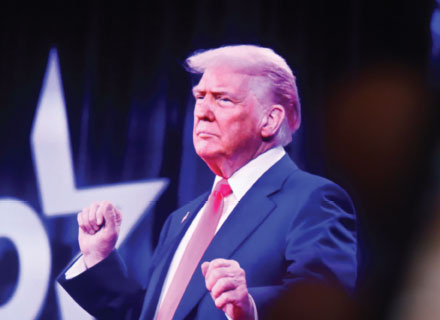

The global trading system that has supported and promoted free trade and global prosperity for nearly 80 years is now facing an unprecedented level of uncertainty. This is mainly because of the upheaval caused by the tariff regime of United States President Donald Trump.
Experts believe that the American tariff is causing fundamental shifts in the economic and political relationships between nations.
Free trade movement
Free trade imagines that goods and services move freely across borders with few restrictions, as opposed to protectionist policies that may include tariffs or import quotas. Yet free trade has never been pure.
After the Second World War, a rules-based global trading system emerged from the ashes. These rules, implemented by various organisations, helped countries maintain their sovereignty and reduce trade barriers.
The first-ever rules-based global trading system started with the 1947 General Agreement on Tariffs and Trade. This was signed in Geneva, Switzerland, by 23 countries. All the countries, through mutual talks and agreements, brought about significant tariff reductions on merchandise goods. These significant rounds of talking led the way for the creation of the World Trade Organisation (WTO) in 1995.
Setting up the trading system
The World Trade Organisation incorporated binding mechanisms to resolve trade disputes between countries, extended rules-based trade to services, intellectual property and investment measures, and allowed global trade to expand dramatically: merchandise exports increased from $10.2 trillion (A$15.6 trillion) in 2005 to more than $25 trillion (A$38.3 trillion) in 2022.
Yet, despite decades of liberalisation, truly free trade has remained beyond reach, with protectionism continuing through traditional tariffs and non-tariff measures such as technical standards, and increasingly, national security restrictions.
Trump’s trade doctrine
One of the economists who has argued that this current trade disruption is based on a ‘grievance doctrine’ is Richard Baldwin, who wrote that the Trump administration does not see trade as a way to benefit from exchanging goods and services between two countries, but instead sees it as a zero-sum game in which one country is stealing from another.
Baldwin stated that, in the world of tariffs, other nations are ripping off the United States. Trade deficits occur when a country’s imports exceed its exports. These deficits are often viewed not just as economic outcomes of the trade system, but rather as a form of theft. Similarly, international agreements are not treated as tools for mutual advantage, but as tools of disadvantage.
US rewrites global trade order
Trump has portrayed himself as a resetter of a system he says is rigged against the world’s largest economy. What used to be delivered by the United States in the form of defence, economic and political security, stable currency arrangements, and predictable market access now seems to be delivered more and more in the form of an economic bully demanding absolute advantage. This shift from global insurer to extractor of profit has generated uncertainty in relations with individual countries that goes well beyond the relationship itself.
Trump has also challenged the very basis of the World Trade Organisation: its principle of ‘most-favoured nation’ treatment, under which no country can make different rules for different trading partners, and “tariff bindings”, the limit on global tariff rates.
Even some analysts of American trade policy have argued that the United States might withdraw from the World Trade Organisation, an act that would formally repudiate the rules-based order of global trade.
US-China trade war
The rise of China as the manufacturing superpower of the world has completely transformed the landscape of international trade.
China is expected to make up 45% of global industrial output by 2030, with its manufacturing surpluses currently around $1 trillion (A$1.5 trillion) annually. This is largely due to substantial subsidies and market protections. This situation poses a fundamental challenge to American market capitalism, particularly for the Trump administration, as it contrasts sharply with China’s state capitalism.
While the year 2025 saw the trade war between Washington and Beijing dominating the media headlines, with tariffs and counter-tariffs taking the shape of an aggressive boxing match, there is no positive headway as despite the ongoing truce, analysts caution that the detente remains fragile in a rivalry that also involves fierce geopolitical and strategic angles, with China now firmly challenging United States’ established global hegemony.
Such was the ferocity of the trade war that it almost caused a near stoppage of the American manufacturing ecosystem, with China imposing strict controls over its rare earth exports. It took a meeting between Donald Trump and Xi Jinping last month in South Korea to cool things off to some extent. While the United States has halved fentanyl- linked tariffs on imports from China to 10% and extended for a year a truce that lowered the reciprocal tariff rate from 34% to 10%.
In return, China’s Ministry of Commerce rolled back export restrictions on critical minerals and rare earth materials to Uncle Sam. Those curbs, first imposed on October 9, had targeted materials vital for military hardware, semiconductors, and other high-tech industries. Beijing also reversed retaliatory limits on exports of gallium, germanium, antimony, and other so-called super-hard materials such as synthetic diamonds and boron nitrides. Those measures, introduced in December 2024, were widely seen as a response to Washington’s expanded semiconductor export restrictions on China.
However, Morgan Stanley economists said that Beijing has not completely relaxed the export-control framework it introduced in April and is likely to maintain a “calibrated choke-point” meant to preserve leverage in case the trade war resumes. China is also reportedly developing a so-called “validated end-user” system, or VEU, to block rare earth exports to companies with ties to the American military set-up.
According to the Wall Street Journal, if strictly implemented, the move could make it more difficult for automotive and aerospace companies with both civilian and defence clients to import certain Chinese materials.
How are countries responding
This polarisation puts pressure on many countries to pick sides, and Australia illustrates these tensions, with defence and security ties to the United States as part of the AUKUS agreement (a security pact between Australia, the United Kingdom, and the United States), but also strong economic ties with China, which has been the country’s largest two-way trading partner even during recent disputes.
While this fragmentation offers opportunities for cooperation between “middle powers,” particularly between European and Asian countries that are increasingly looking for alternative frameworks that do not always require American leadership, it cannot replace the scale and benefits of the United States-led system.
Ways to fix this?
In a recent summit in China, other non-Western members of the Shanghai Cooperation Organisation (SCO) also expressed support for the multilateral trading system, issuing a joint statement reiterating World Trade Organisation principles and criticising unilateral trade measures. This is a bid to assert global leadership while the United States negotiates with individual countries.
This has been regularly opposed by the ‘BRICS+ bloc,’ a larger group of countries, along with the BRICS countries. They were always against the Western-dominated institutions and advocated for alternative governance structures. The countries that raised their voice include Brazil, Russia, India, China, South Africa and Indonesia.
Experts stated that countries lack the institutional depth to serve as an alternative to the World Trade Organisation-centred trading system, absent enforceable trade rules, systematic monitoring mechanisms, or conflict resolution procedures.
Where is it heading?
Since 1990, more than one billion people have been lifted out of extreme poverty thanks to the global trading system. However, the era of United States-led multilateralism is coming to an end, and it is unclear what will take its place.
One possible scenario is that global institutions, such as the World Trade Organisation, may weaken over time. In contrast, regional trade agreements could become more important, maintaining some degree of rules-based trade while also accommodating great power competition.
It is likely that other countries might be willing to join like-minded countries. The countries that set high policy standards in certain areas, such as freer trade, regulatory harmonisation, or security restrictions, allow them to set up a global trade system.