
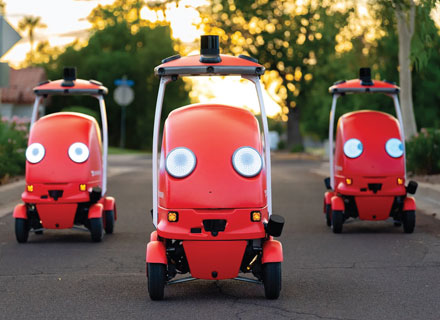

DoorDash has moved its road-going delivery robot called Dot from stage to street in early access service across the Phoenix metro after unveiling it at Dash Forward 2025, positioning a compact electric vehicle and an AI dispatcher to take on short local trips where a full-size car is overkill.
The pitch is simple and provocative as Dot targets neighbourhood distances at up to twenty miles per hour with a thirty-pound payload while an Autonomous Delivery Platform decides in real time whether a robot, a human Dasher, a sidewalk bot, or a drone is the best option.
Why this robot and why now?
The last mile has always been a series of last metres, and DoorDash argues that many everyday errands do not require a car, which is why Dot is designed to move through streets, bike lanes, sidewalks, and driveways rather than living only on the curb or only on the road. Phoenix and its nearby cities provide the proving ground with broad lanes, active cycling infrastructure, and a mix of suburban and urban blocks that let a small robot show it can coexist without clogging sidewalks or becoming a rolling hazard.
The company frames early access as a data gathering phase that tunes dispatch logic, improves merchant handoffs, and learns from friction in parking lots, curb cuts, and crosswalks before expanding to reach an estimated one and a half million residents in the region. That choice reflects hard lessons in autonomy where reliability at scale tends to favour orchestration over a single mode and where flexibility beats bravado in diverse neighbourhoods and rulesets.
The test is not just whether a robot can drive a good route on a good day, but whether a blended system can deliver on time, keep food quality high, minimise interventions, and earn enough goodwill among pedestrians, cyclists, and drivers to share space peacefully.
DoorDash’s public stance is that autonomy is additive rather than subtractive, with robots taking lightweight, predictable trips so people can focus on complex, time-sensitive, or higher-touch deliveries that still demand judgment and access skills.
That hybrid approach aims to absorb demand spikes and detours by matching each order to the right agent in real time, informed by distance, traffic weight, and readiness rather than one-size-fits-all dispatch.
It is a bet that the future of local logistics looks less like an all-or-nothing automation moonshot and more like a network that quietly blends people and machines to reduce cost and delay without compromising safety or access.
What Dot actually is
Dot is a compact four-wheeled electric vehicle that DoorDash describes as roughly one-tenth the size of a car, built to travel up to twenty miles per hour while carrying up to thirty pounds, which is enough room for about six large pizza boxes inside a front-opening storage bay.
The robot is designed to handle the transitions that often trip small sidewalk bots, including threading through driveways, crossing curb cuts without blocking traffic, and navigating parking lots to reach pickup counters rather than stalling at the edge of a plaza.
Company materials highlight a six-to-eight-hour battery endurance window with a swappable pack architecture to keep utilisation high during peak periods instead of tanking throughput on long charge cycles.
The platform emphasises visibility and legibility at a human scale with a bright red hull and lighting that reads clearly to other road and sidewalk users, which matters when operating near strollers, wheelchairs, scooters, cyclists, and cars.
Sensors and perception stacks combine cameras, radar, and lidar in configurations intended to perceive complex urban scenes where occlusions, construction, and parked trucks often mask cross traffic and pedestrians until the last moment.
The cargo area supports modular inserts such as cup holders or coolers so merchants can secure drinks and temperature-sensitive orders to reduce spills and condensation, because real-world delivery quality depends on small choices that prevent messes and go far beyond route planning.
Every design choice is meant to serve a simple thesis that a slightly larger, faster, and more robust robot than a sidewalk cooler can preserve food quality by moving at neighbourhood speeds without demanding the footprint of a car.
The point is to demonstrate predictability and courtesy, allowing a robot to blend into bike lanes and low-speed roads without becoming an obstacle or an irritant. This is exactly how trust is built, one quiet trip at a time.
The brains behind the wheels
Dot is only as useful as the dispatcher that assigns trips, which is why DoorDash launched an Autonomous Delivery Platform that weighs speed, cost, location, order composition, and conditions to route an order to a robot, a person, a sidewalk bot, or a drone.
SmartScale sits on the merchant side, using AI to validate bag weights, signal readiness, and improve order accuracy so the dispatcher does not send an overweight or mispacked order to a constrained mode that cannot carry it safely.
The idea is to cut idle time and avoid preventable errors, which are the small hinges that swing big doors in unit economics by reducing rework and lowering intervention rates across the fleet. DoorDash says Dot has been tested across millions of simulated and real-world miles, which reflects an industry-wide shift toward deploying learning machines with structured fallbacks rather than claiming literal full autonomy that ignores operational realities.
Remote assistance and documented handoff procedures are treated as part of the system because real streets throw edge cases constantly, and the fastest way to improve perception, prediction, and planning is to keep the service live while capturing those edge cases for training.
The platform’s advantage lies in more than route choice. It involves orchestration across people and multiple types of robots, enabling each agent to handle what it does best while the system as a whole smooths surges and detours that would otherwise jam a single mode.
That is why the early Phoenix footprint includes Tempe and Mesa, where Dot has already navigated bike lanes, parking lots, and sidewalks, placing real stress on the full stack from dispatch to the final handoff at curbs and driveways.
The company and press observers have stressed that safety and reliability matter more than flashy demos and that the metric to watch is not a viral video but consistent on-time deliveries with minimal friction for everyone sharing the lane.
What history says
If this sounds ambitious, it is also tempered by recent history as companies with deep pockets rethought sidewalk robots when support costs and exception handling overwhelmed early optimism.
Amazon scaled back its Scout programme, and FedEx shut down Roxo, illustrating that last-mile autonomy is a grind that punishes naive scaling plans and underestimates of real-world complexity.
Coverage of those decisions emphasised that robotics remains a strategic pillar at both companies even as they redirected resources away from costly field tests that did not meet near-term value requirements.
The lesson is less that robots cannot deliver and more that the operational design domain matters, which is why Dot’s remit includes streets, bike lanes, and driveways rather than constraining itself to narrow sidewalks with constant obstacles.
It also explains DoorDash’s hybrid posture that centres Dashers and multiple modes, because a blended network can keep service flowing when a single mode would stall due to rules, blockages, or unexpected detours.
Meanwhile, Serve Robotics has shown an urban path with sidewalk bots integrated onto platforms like Uber Eats, crossing the 1000-robot milestone and reiterating plans to reach about 2000 deployed by the end of 2025.
Serve’s disclosures focus attention on the levers that decide winners in autonomy: utilisation, intervention rates, and software revenue per unit, rather than raw robot counts, which is why cutting remote assists and idle time is the boring frontier that matters most.
DoorDash’s scale as the largest American food delivery marketplace could provide a data advantage if its dispatcher consistently routes robot-fit orders to bots while keeping humans on the hairier trips, improving network flow without stepping on the customer experience.
True test of success
The near-term markers to watch are pragmatic expansion pace in Phoenix, the diversity of merchants participating, and any disclosures around delivery completion times and intervention rates once the honeymoon phase gives way to the long tail of weird Tuesdays.
Local rules and public sentiment will shape the path because cities are still figuring out how to regulate small delivery vehicles on sidewalks and bike lanes in ways that protect accessibility and safety for everyone sharing the space.
Company materials and media coverage have underscored Dot’s ability to blend into bike lanes and low-speed roads without becoming a hazard, a design mission that must be lived on the street day after day rather than asserted on a stage.
If Dot consistently expands the range of trips where a small electric self-driving vehicle is the fastest, most affordable, and least impactful option, it will become a commonplace utility. That commonality will then be the true measure of success.
If interventions stay high and public patience runs thin, the platform will fall back on Dashers for routes robots cannot handle economically at scale, and the orchestration layer will remain the product that quietly allocates work to the right hands and wheels.
In the end, the case for Dot is a system shot, and Phoenix will show whether brains and form factor can outpace the city’s appetite for new edge cases while maintaining speed, safety, and goodwill.
So here is the test that matters: not the demo reel but the daily grind of orders, lanes, curb cuts, and human patience that does not care about press releases. Can an AI dispatcher keep choosing the right agent and shaving minutes without fraying nerves or spilling soup when the bike lane is blocked, and the driveway is tight?
If Dot keeps interventions low and completion times tight, the economics tip from novelty to inevitability and scale follows quietly. If exceptions dominate and goodwill thins, the platform routes work back to people and redraws the robot’s map with humility. Phoenix is only chapter one, and the verdict arrives when dinner arrives hot and on time, which is the only referendum that counts.