
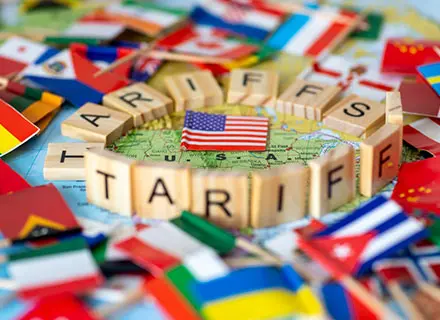

Republican Donald Trump’s return to the White House for the second term as the United States’ President in 2025 kicked off a chaotic year for global trade, with waves of tariffs on America’s trading partners that lifted import taxes to their highest since the “Great Depression,” roiled financial markets and sparked rounds of negotiations over trade and investment deals.
As per the noted policy research centre, Yale Budget Lab, “Trump’s moves, aimed broadly at reviving a declining manufacturing base, lifted the average tariff rate to nearly 17% from less than 3% at the end of 2024, and the levies are now generating roughly USD 30 billion a month of revenue for the US Treasury.”
These disruptive moves brought world leaders scrambling to Washington seeking deals for lower rates, often in return for pledges of billions of dollars in American investments. While framework deals were struck with major trading partners like the European Union (EU), the United Kingdom, Switzerland, Japan, South Korea, Vietnam and others, things have still remained pending with China and India, despite multiple rounds of talks, both at the leadership and trade mission levels. For India, the tariff amount has been the highest, 50%, including the penalty for buying Russian crude and weaponry, a move which geopolitical analysts dubbed as an arm-twisting one to make New Delhi fall in line with Washington’s line on the topic of Ukraine.
However, after months of decline, India’s exports to the United States rose 22.61% to USD 6.98 billion in November, while the Narendra Modi government has been focussing on aggressive policy reforms on the domestic front, apart from diversifying its export basket by signing trade deals with United Kingdom, Oman and New Zealand, to absorb the blows given by the 50% tariffs from Uncle Sam. All eyes will be on the fourth quarter, as the South Asian country’s bilateral talks with both the EU and the United States progress at a steady pace, with New Delhi anticipating the high-stakes deals to be signed by the end of March.
The EU got criticised by many for its deal for a 15% tariff on its exports and a vague commitment to big American investments. The then French prime minister Francois Bayrou even called it an act of submission and a “sombre day” for the bloc, while other bloc partners shrugged the arrangement as the “least bad” deal on offer.
“Since then, European exporters and economies have broadly coped with the new tariff rate, thanks to various exemptions and their ability to find markets elsewhere. French bank Societe Generale estimated the total direct impact of the tariffs was equivalent to just 0.37% of the region’s GDP,” noted Reuters, as it added further, “meanwhile, China’s trade surplus defied Trump’s tariffs to surpass USD 1 trillion as it succeeded in diversifying away from the US, moved its manufacturing sector up the value chain, and used the leverage it has gained in rare earth minerals – crucial inputs into the West’s security scaffolding – to push back against pressure from the US or Europe to curb its surplus.”
The tariff warfare took a limited toll on the American economy, as the latter suffered a modest contraction in the first quarter amid a scramble to import goods before tariffs took effect, but quickly rebounded and continues to grow at an above-trend pace thanks to a massive artificial intelligence (AI) investment boom, along with resilient consumer spending. The International Monetary Fund (IMF), in fact, twice lifted its global growth outlook in the months following Trump’s “Liberation Day” tariffs announcement in April 2025 as uncertainty ebbed and deals were struck to reduce the originally announced rates.
“And while the United States’ inflation remains somewhat elevated in part because of tariffs, economists and policymakers now expect the effects to be milder and more short-lived than feared, with cost sharing of the import taxes occurring across the supply chain among producers, importers, retailers and consumers,” Reuters reported.
A big unknown for 2026 is whether many of Trump’s tariffs will be allowed to stand, as a legal challenge has been registered to the Supreme Court, to counter the novel premise for what the Republican branded as “reciprocal” tariffs on goods from individual countries and for levies imposed on China, Canada and Mexico (tied to the flow of fentanyl into the US). The case was argued before the court in late 2025, and a decision is expected in early 2026.
The Trump administration insists it can shift to other, more-established legal authorities to keep tariffs in place should it lose. But those will likely be limited in scope, and a loss at the Supreme Court level might prompt the administration to renegotiate the deals struck so far, thereby ushering in a new era of uncertainty about where the tariffs will end up.