
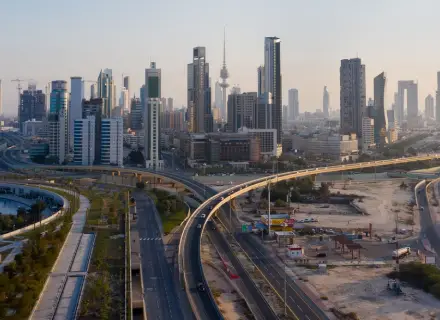

Kuwait’s Ministry of Public Works announced a wide range of completed and future infrastructure projects, with significant advances in road maintenance, transport networks, governance, and digital transformation, according to a detailed briefing at the Government Communication Centre, which was attended by the ministry’s official spokesperson, Engineer Ahmad Al-Saleh.
Al-Saleh revealed that the ministry had carried out comprehensive maintenance contracts comprising 9.5 million square metres of asphalt on internal roads within all governorates and 5.5 million square metres on highways, under 12 internal road maintenance contracts and six highway contracts.
The official further explained that the ministry is acting on a “clear and well-thought-out plan” that is being carried out in close coordination with the Ministry of Interior to ensure traffic flow during implementation of these projects, and that “the voice of the citizen is heard,” emphasising the ministry’s responsiveness to the public and solving problems.
“Al-Saleh also reviewed developments on the Gulf Railway project, connecting Kuwait with GCC countries, which includes a high-speed rail link to Riyadh. The project will cover 111 kilometres from the Nuwaiseeb border crossing to the Shaddadiyah area, where a two-million-square-metre main station has been reserved, and the final design is expected from the consultant in January, with implementation expected to be completed between December 2028 and 2030,” reported the Arab Times.
As per Al-Saleh, the contract for the Mubarak Al-Kabeer Port is expected to be signed in December 2025 as part of a memorandum of understanding with China, while significant progress has been made on the new Kuwait International Airport project, with state-of-the art passenger terminal, parking facilities, road network, and service structures are all set to make the airport a regional transport landmark.
The official also mentioned recent milestones, including the opening of the Darwazat Al-Abdulrazzaq intersection and the Avenues Bridge, as well as the near-completion of major phases of the Damascus Street development, South Surra roads, and the Sabah Al-Nasser Bridge, all of which will alleviate traffic congestion.
Discussing wastewater infrastructure, Al-Saleh talked at great length about the Umm Al-Hayman wastewater treatment plant, which was carried out as a public-private partnership, and currently produces 500,000 cubic metres of advanced treated water for agricultural and landscaping use in central and southern regions. The development of the Kabd North wastewater treatment plant is also underway to support the northern wastewater system and expand the treated water used for afforestation.
The official highlighted Kuwait’s efforts to maintain high standards, such as modernising the road laboratories, enhancing the government testing and quality-control centre, and using new technologies for inspecting roadworks, to ensure that they comply with specifications.
He also highlighted governance achievements, such as the adoption of the Corporate Governance Guide, participation in the “Performance” project with the National Anti-Corruption Commission (Nazaha), and the development of a Code of Conduct to promote integrity and accountability.
Talking about the progress in Kuwait’s digital transformation efforts, Al-Saleh mentioned the launch of new e-services via the “Sahel” application, along with the implementation of a unified GIS system to monitor road and maintenance projects with very high accuracy.
“Maintenance contracts have become 100% Kuwaitized, providing job security for Kuwaiti engineers and technicians and expanding training programmes for operating wastewater facilities,” he concluded.