
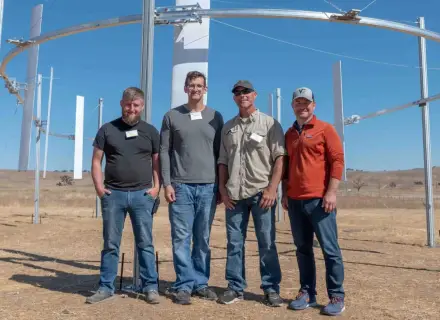

Airloom Energy, the company pioneering low-cost and resilient energy generation in the United States has been making waves in the renewable energy sector for quite some time now. Backed by Bill Gates’ Breakthrough Energy Ventures, the company recently announced its pilot site groundbreaking near Rock River, Wyoming. At this research and development site, the start-up will build its first utility-scale turbine, designed to generate more energy at a lower cost and with increased efficiency amid the prevailing need for energy security and independence in the world’s largest economy.
According to the North American Electric Reliability Corporation (NERC), approximately half of the United States is at risk of energy shortfalls that could cause outages and reduce power supplies by 2035. Combined with the surging demand driven by the increased use of AI and reliance on data centres, global research and advisory firm Gartner predicts that 40% of existing facilities around the world will face constraints in accessing sufficient power as soon as 2027.
Low-cost, high-efficiency energy is critical for the grid, requiring bold innovation and long-overdue improvements to power system design and deployment. This is where Airloom Energy aims to become a force of change.
What Airloom Energy Is Up To
In the words of Neal Rickner, CEO of Airloom Energy, “Current energy technologies can’t meet the growing complexity and demand of the next decade. With growing electricity needs, we need more flexible systems that can be built quickly and deployed anywhere at a large scale. That’s the only way we’re going to achieve and maintain energy security and independence. Airloom’s proprietary, US-manufactured turbines do just that: replacing bulky, costly models with low-cost, compact designs that generate more energy in less space. This groundbreaking marks a key milestone in validating our power curve and achieving essential cost efficiencies for wind energy.”
Traditional horizontal-axis wind turbines (HAWTs) are becoming less cost-competitive and harder to construct. Made in low volumes and at massive scales, this approach has resulted in restricted innovation, limited sites for deployment, and stagnation in the levelized cost of energy (LCOE). In contrast, Airloom Energy is designing the next generation of turbines that will contribute to the energy mix while yielding substantial cost savings and improvements in efficiency—even without subsidies.
“Breaking ground on a first pilot site is a major inflexion point for any wind technology product. Airloom has reached this point with remarkable speed and clarity of purpose. What sets Airloom apart is not only its innovative architecture, but the calibre of the team behind it, who understand how to move from concept to scale with tenacity and rigour. This pilot is more than a test site; it’s the beginning of a fundamentally new approach to resilient renewable energy generation: wind energy that’s faster to deploy, land-efficient, and built for the energy challenges ahead,” said Paul Judge, former head of Product Management at GE Onshore Wind and advisory board member for Airloom Energy.
The pilot site groundbreaking in Wyoming keeps Airloom on track to complete the project ahead of the commercial demonstrations of the start-up’s next-generation turbines in 2027. At this site, Airloom will install and test its turbine designs to validate its power curve, as well as ensure production efficiency, refine deployment costs, and expand maintenance documentation. Beyond standard onshore integration, Airloom Energy will also evaluate future use cases of its technology in domains such as defence, disaster relief, and offshore wind energy generation.
In October 2024, Airloom Energy raised USD 7.5 million in a seed financing round with participation from Bill Gates’ Breakthrough Energy Ventures, Lowercarbon Capital, WYVC, Crosscut Ventures, WovenEarth Ventures, and others. An additional USD 5 million in Energy Matching Funds was secured in the same year from Wyoming, along with a USD 1.25-million non-dilutive contract from the United States Department of Defence.
The start-up’s goal is simple: to build next-generation turbines with features like utility-scale capacity, low-cost design, reliability, and maximum energy production per square kilometre.
Meet The Key Technology
Backed by some of the biggest names in the renewable energy sector (Breakthrough Energy, Lowercarbon Capital, WovenEarth Ventures, and Crosscut), Airloom’s next-generation turbines efficiently convert kinetic energy into mechanical energy. Their simple and robust structure enables a large swept area without massive structures. These turbines can also survive some of the harshest operational environments. Also, Airloom’s site layout and smaller wake allow it to create more energy in less space.
Conventional turbines are made in low volumes using specialised materials and are shipped with specialised transportation equipment. To install them, renewable energy companies need large, specialised cranes and specially trained crews, making projects more expensive. Airloom has disrupted this practice by lowering the cost of wind energy. While first-of-a-kind Airloom systems will be expensive, cost reductions will result from increased scale, higher availability, lower capital costs, and extended system lifetimes.
Airloom Energy’s modular turbines feature rectangular swept areas instead of traditional circular ones, increasing wind capture and improving energy conversion efficiency. This meets the growing need to generate more power in less space as land use and regulations evolve. Also, unlike traditional turbines, which can take up to five years to deploy, Airloom’s turbines built with low-cost, mass-manufacturable components and minimal infrastructure needs can be installed in under a year, supporting more reliable energy generation through simplified supply chains.
By using smaller, mass-manufacturable parts made in the United States to simplify transportation, installation, and maintenance, Airloom Energy can deploy its wind turbines at low-wind sites, those with height or viewability restrictions such as airports or military stations, or even in difficult-to-access mountainous areas or islands with minimal infrastructure.
Image Credits: Airloom Energy