
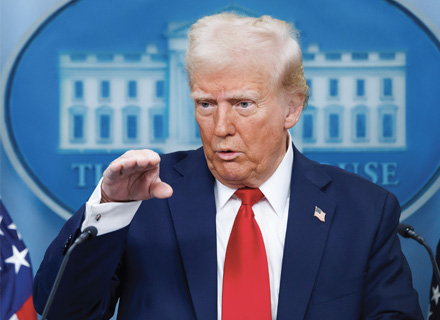

On April 2, 2025, President Donald Trump declared “Liberation Day” in the White House Rose Garden, launching an aggressive new wave of tariffs aimed at America’s largest trading partners. Branded as a push to “Make America Wealthy Again,” the announcement shocked global markets and ignited fears of a trade war.
The method behind the tariffs is reportedly based on dividing trade deficits by import values, which defied conventional economic logic. As nations scramble to respond, critics warn that Trump’s bold strategy could backfire, raising prices at home and straining diplomatic ties abroad. The world is watching, and the stakes are high.
What puzzled economists and analysts alike wasn’t just the scale of the tariffs, but the math behind them. Observers, including journalist James Surowiecki, noticed a curious pattern: the White House appeared to calculate tariffs by dividing the US trade deficit with a country by the value of imports from that country. For instance, the US trade deficit with China in 2024 was $295.4 billion against $438.9 billion in imports, resulting in a 67% tariff rate. This same logic seemed to apply to other nations like Vietnam.
Critics were quick to point out that such a method ignores the broader context of trade, especially the role of services, and does not align with traditional economic theory. The Office of the US Trade Representative later confirmed a similar rationale, stating that this formula was designed to offset “combined effects” of trade barriers, regulatory policies, and currency practices.
By tacking on an additional flat 10% tax on countries with a surplus, the Trump administration has stirred both concern and confusion globally. Economists argue the plan might hurt low-income nations that already struggle with American price points. While some suggest the vagueness of the policy gives the US leverage in negotiations, many warn that it may undermine American credibility in the long run.
Trade history before the tariff war
Though not without occasional conflict, especially over energy and softwood lumber, trade ties between the US and Canada have largely been solid and cooperative. Under the United States-Mexico-Canada Agreement (USMCA), which replaced NAFTA, the nations revised their trade laws in 2020. This agreement revolutionised areas including internet commerce, worker standards, and automobile production needs. Particularly oil and gas, the energy industry remains a major link between the two economies.
Political unrest arose from the Biden administration’s decision to abandon the Keystone XL pipeline; however, overall economic cooperation between the United States and Canada remains robust. Key imports from Canada include crude oil, automobiles, machinery, and plastics, while the US primarily exports vehicles, machinery, electrical equipment, and mineral fuels to Canada. Thanks to the United States-Mexico-Canada Agreement (USMCA), Canada maintains an average tariff rate of about 0.8% on American imports.
To counter China’s growing influence in Latin America, the United States has been increasing its trade involvement in the region. Since the USMCA took effect, trade with Mexico has surged significantly, making Mexico the top trading partner of the US in 2023. Emphasising sectors including agriculture, energy, and minerals essential for green energy transitions, the US has also increased trade with Brazil, Chile, and Colombia. Long-term trade projections have been further muddled, nevertheless, by erratic politics and protectionist policies in some nations.
While imports include agricultural goods, coffee, copper, oil, and cars, American exports to the region include refined oil, machinery, medical supplies, and electronics. While Brazil keeps average rates of 10%–12% on US goods, tariffs vary greatly; Mexico and Chile typically grant duty-free access.
Following Brexit, the United States and the United Kingdom have entered a transitional period. Though political and legal differences have caused obstacles in negotiations, both sides have expressed a desire for a full-scale trade accord. Still, commerce between the two has expanded, and the United States is still the top individual trading partner of the United Kingdom. Even without a formal agreement, key joint projects in financial services, defence, and technology are still in progress.
American exports include aircraft, drugs, machinery, and optical technologies; imports from the UK include alcohol—especially Scotch whisky—cars, and tools. British tariffs on American goods range from 0% to 10%; most industrial imports see either little or none at all.
The US-Korea Free Trade Agreement (KORUS FTA) has helped to drive a notable increase in trade between the two countries. The two countries have recently enhanced their cooperation in areas such as semiconductors, electric vehicles, and battery technologies. Their ties have strengthened further due to shared concerns about North Korea and the growing economic influence of China.
The Indo-Pacific policy of the Biden government has underlined the significance of South Korea in trade as well as in security. The United States imports autos, electronics, and machinery; it exports semiconductors, aircraft, medical equipment, and cattle. More than 95% of traded items under KORUS are tariff-free; the rest are on a phased reduction schedule.
Trade between the United States and the European Union has seen both conflicts and instances of cooperation. Key issues include digital service taxes, tariffs on steel and aluminium, and subsidies for aeroplanes, particularly in the ongoing competition between Boeing and Airbus. Despite these conflicts, both parties have managed to ease tensions by agreeing to suspend certain duties and by collaborating on trade policies related to climate change.
Particularly in view of the Ukraine crisis and the drive to lower reliance on China and Russia, the EU and the United States are also coordinating efforts on supply chain stability and export restrictions. While imports comprise autos, industrial machinery, and wine, US exports to the EU include aircraft, medications, medical instruments, and liquefied natural gas. Food and autos face higher charges up to 10%–12%; average EU tariffs on US imports are roughly 3% for manufactured goods.
Growing US-China tensions have given the trade dynamic between the United States and Taiwan fresh importance. Emphasising customs procedures, regulatory standards, and anti-corruption initiatives, both sides signed the first section of the US-Taiwan Initiative on 21st-Century Trade in 2023. A deeper US interest has been sparked by Taiwan’s central importance in the global chip supply chain. Although the US does not formally acknowledge Taiwan politically, trade ties keep developing behind structures meant to avoid upsetting Beijing. US goods sent to Taiwan range from machinery to aircraft to foodstuffs like corn and meat. Taiwan then supplies the United States with semiconductors, electronics, and machinery. Though particular agricultural items suffer more steep rates, average Taiwanese tariffs on American commodities range from 5% to 7%.
Despite occasional hiccups, US-India trade has been growing. Over import taxes, data security policies, and intellectual property, the two nations have disagreed. But more general agreement on strategic goals, such as balancing China’s influence, defence cooperation, and digital commerce, has driven the alliance ahead.
Under the “Generalised System of Preferences,” the United States has restored some trade rights for India and negotiated pacts emphasising semiconductor collaboration. Particularly in supply chain restructuring, India is now increasingly important in American goals for Indo-Pacific economic resilience.
American goods sent to India range from aircraft to crude oil to machinery to medical equipment. From India, the US imports textiles, IT services, drugs, and jewels. On US goods, particularly on vehicles, agricultural products, and wine, India’s import taxes are among the harshest worldwide, ranging from 10% to 60%.
Key takeaways
Following Donald Trump’s announcement of customised tariffs that appear to be the catalyst for a worldwide trade war, nations from all over the world are scrambling to adopt the new method of conducting business with the US.
Trump has made it plain that he intends to use the tariffs to generate tax revenue, address unfair trade practices from other nations, encourage crackdowns on migration and drug trafficking, and bring manufacturing back to the United States. However, South Korea has pledged an “all-out” response, while the EU and China have announced countermeasures. As billions of dollars are lost in economic growth, the political harm done to friends like the UK may also have a cost. Businesses are preparing for the meaning of “liberation.”
In keeping with his pledge on the campaign path to free the country from rising prices, the US President pitched the idea of international tariffs with a joyous air. Anyone who has been to a food shop in that time may disagree with the president’s assertion that “prices are way down” since he returned to office.
Additionally, US businesses are concerned about the broader ramifications of this decision, stating that increased expenses will be passed on to their clients. Neil Bradley, chief policy officer at the US Chamber of Commerce, the corporate lobby group, said, “We have heard from businesses of all sizes, across all industries, from all around the country that these broad tariffs are a tax increase that will raise prices for American consumers and hurt the economy.”
The additional tariffs, which raise the overall duty on Chinese imports to above 50%, have disproportionately hurt China and struggling South-east Asian countries, such as Myanmar, which has been devastated by earthquakes and war. One notion that has been proposed is that the target countries are those associated with significant Chinese investments. Dr. Siwage Dharma Negara, a senior fellow at the ISEAS-Yusof Ishak Institute in Singapore, said, “The Trump administration believes that by targeting these countries, it can target Chinese investment in countries like Cambodia, Laos, Myanmar, and Indonesia.
Targeting their products may have an impact on the economy and exports from China. The country is the actual target, but since this investment generates jobs and export income, it will have a huge impact on those nations.”
The levies are imposed at a time when many Southeast Asian nations are already dealing with the consequences of the cuts to USAID, which supports pro-democracy activists fighting oppressive governments and provides humanitarian aid to a region at risk of natural disasters. Important trading partners, Mexico and Canada, are exempt, but they will still suffer. Although these two countries are not subject to the most recent round of tariffs, as business leaders and Prime Minister Mark Carney reminded everyone, 25% duties on Canadian steel and aluminium, as well as autos, went into force within hours after the announcement.
Although Trump had maintained important aspects of the bilateral relationship, Carney cautioned that the worldwide tariffs that were announced earlier in the day “fundamentally change the international trading system.” According to a White House fact sheet, the two nations have been subject to previously announced 25% tariffs on a variety of items due to border control and fentanyl trafficking concerns. Claudia Sheinbaum, the President of Mexico, stated that her nation would prefer to unveil a “comprehensive programme” rather than engage in a “tit-for-tat on tariffs.”
Trump previously stated, “There is a period of transition, because what we’re doing is very big,” suggesting that he is ready for the announcement to trigger significant market volatility worldwide. Countries all across the world now have a very small window of time to decide their course of action, as the universal tariffs go into effect on April 5 and the reciprocal ones on April 9. There will always be uncertainty, whether some attempt to reach an agreement with Trump or retaliate with tariffs.
Despite being among Australia’s “external territories” that are classified separately for a 10% tariff, Heard Island and McDonald Islands are among the most remote locations on the planet, home solely to a variety of species. Australia’s Prime Minister, Anthony Albanese, stated that “I’m not quite sure that Norfolk Island, with respect to it, is a trade competitor with the giant economy of the United States, but that just shows and exemplifies the fact that nowhere on earth is safe from this” after the island, located just off the country’s east coast, was hit with a tariff of 29%, which is 19 percentage points higher than the rest of Australia.
Art of the deal
Some analysts propose that Trump’s aggressive tariff strategy could primarily be a pressure tactic designed to force key trading partners back to the negotiating table to secure more advantageous trade deals for the US, as Trump himself stated in his book “The Art of the Deal,” “The worst thing you can do in a deal is seem desperate to make it.” His history of negotiation, such as real estate transactions in New York City, often involved bold initial demands followed by strategic concessions to reach favourable agreements. In this view, the tariffs are not meant as a long-term economic policy but rather a short-term negotiating lever.
The ultimate objective may be to achieve improved terms that favour American economic interests without permanently damaging global trade relationships. Economists warn that maintaining such aggressive tariff practices as a long-term strategy could trigger prolonged global economic instability, harming American businesses and consumers.
President William McKinley, whom Trump calls the original “Tariff King,” championed protective tariffs through the “1890 McKinley Tariff,” imposing historically high tariff rates to protect American industries. Initially, these tariffs benefited domestic manufacturing by providing significant market protection against foreign competition. However, the economic consequences soon became apparent. Consumer prices rose sharply due to the lack of affordable foreign alternatives, burdening average American households and lowering their purchasing power. This led to widespread dissatisfaction among the working class and middle-income citizens, fuelling intense political debates and backlash against the Republican Party.
Politically, McKinley’s tariff policy had profound implications. His high-tariff stance solidified his support among industrialists and business leaders who benefited directly from reduced foreign competition. Conversely, it alienated large segments of the electorate, particularly farmers and labourers who faced higher living costs and retaliatory foreign tariffs on American agricultural exports. Consequently, this shift in public sentiment contributed significantly to Democratic electoral gains, influencing future legislative agendas and reshaping American politics.
Economically, the long-term consequences of McKinley’s tariff policies proved detrimental. The retaliatory tariffs imposed by other nations severely limited market access for American exporters, particularly in the agricultural sector. Farmers faced significant economic hardship as their products became less competitive internationally, leading to surpluses, declining revenues, and widespread rural economic distress. Furthermore, the restrictive trade environment hindered overall economic growth by reducing trade volumes and disrupting international economic relationships.
McKinley’s tariff policies also triggered international diplomatic tensions, as many trading partners viewed the tariffs as hostile economic aggression. These strained relationships complicated US diplomacy and impacted America’s global standing. Ultimately, while McKinley intended his tariffs to protect domestic industries, they instead created economic disruptions, diplomatic challenges, and political volatility that persisted long after his presidency.
Tariffs as political theatre
The way the United States determined its new tariff amounts under President Trump wasn’t based on traditional economic models or standard international trade practices. Instead, it appears Uncle Sam took a more symbolic, even provocative route—one that was driven by a political narrative rather than a purely economic rationale.
By reportedly dividing the trade deficit by total imports from a given country, the administration used an unconventional formula that ignored services, nuanced trade dynamics, and existing agreements. The move was pitched as a way to correct trade imbalances, retaliate against what the White House called unfair practices, and bring jobs back home. But in doing so, it shook the global economic order. The numbers didn’t just reflect policy; they sent a message. In truth, the formula seemed less about precision and more about leverage. This was classic Trump: start with a dramatic opening move, stir the pot, and then force your counterparts to the negotiating table.
The goal wasn’t just revenue or protectionism; rather, it was dominance. But the risk is real. Higher costs for consumers, angry trade partners, and a potential trade war that could hurt not just American exporters but the global economy at large. This strategy may succeed in getting the world’s attention, but whether it delivers long-term economic gains without lasting damage is a gamble history will have to judge. One thing is certain: trade policy just became a lot more personal and a lot less predictable.
Goldman Sachs, meanwhile, has raised the odds of a US recession to 45% in the next 12 months, joining other investment banks in revising their forecast as fears of a trade war grip markets. The financial services giant foresees a sharp tightening in monetary conditions, along with a rise in policy uncertainty that is likely to depress capital spending by a great margin.
The global economy, meanwhile, is preparing for the next menace, namely, Trump strong-arming trading partners in getting favourable deals, while wea-ponising the US position as the ‘world’s largest economy’. Senior Reuters scribe John O’Donnell said, “As the epicentre of the financial world and the issuer of the global reserve currency, the United States has several levers that Trump can pull to coerce other countries, from credit cards to the very provision of dollars to foreign banks.”
While deploying these unconventional weapons would come at a high cost for Washington itself and may even backfire altogether, observers, given Trump’s volatile personality, don’t rule out such possibilities.