
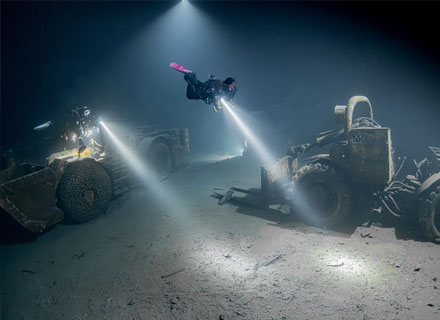

Imagine descending into the deep blue expanse of the Pacific Ocean, hundreds of miles from land. Sunlight fades to darkness at just a few hundred metres, and by 3,000 feet (about 900 metres), the blackness is complete. By the time you reach 12,000 feet (over 3,600 metres), you have arrived at the abyssal seafloor.
The vast Clarion-Clipperton Zone (CCZ) lies here, an underwater plain that stretches across approximately 1.7 million square miles (around 4.5 million km²) between Hawaii and Mexico. It’s an alien world where life has adapted to crushing pressure and eternal night. In fact, recent research catalogued over 5,500 species living in the CCZ, with an astonishing 88–92% of them new to science.
This zone is not alone in its significance. Scientists estimate that millions of species, perhaps up to 10 million, may inhabit the deep ocean below 200 metres. Yet as rich and mysterious as this marine biodiversity is, these same deep-sea floors are also home to something else of extraordinary value: untapped stores of critical minerals.
According to some estimates, a single swath of the CCZ contains more nickel, manganese, and cobalt than all known terrestrial reserves combined. Potato-sized black rocks called polymetallic nodules litter the seabed here.
First noted by 19th-century ocean expeditions, these nodules are rich in metals vital for modern technology, from copper and nickel for electric vehicle batteries to cobalt and manganese for renewable energy systems. For decades, the idea of harvesting this deep-sea mineral treasure was confined to theory.
With advancing underwater mining technology, that vision is hurtling toward reality. The year 2025 could mark a turning point. Dozens of exploratory missions have already probed the deep, and full-fledged commercial seabed mining looms on the horizon.
Treasures of the deep
In an era obsessed with smartphones, electric cars, and clean energy, these deep-sea minerals are often described as the “new oil” powering the global economy. Demand for critical raw materials is surging, and policymakers argue they are indispensable for the green transition.
Polymetallic nodules, which form over eons in the abyssal muck, are packed with these high-value elements. In fact, a study by the United States Geological Survey found that the Clarion-Clipperton Fracture Zone could hold more nickel, manganese, and cobalt than all land-based reserves worldwide. One consulting firm even valued the CCZ’s metal bounty at roughly $18 trillion.
Commercial interest in these “rocks” has been growing since at least the 1970s, but it accelerated after the International Seabed Authority (ISA) was established in 1994. The ISA, a body affiliated with the United Nations, is tasked with regulating mineral activities in international waters. To date, the ISA has issued 31 exploration contracts covering more than 1.5 million square kilometres of seabed—an area roughly four times the size of Germany.
Major economies like China, Russia, and South Korea are among those sponsoring deep-sea exploration ventures. Private companies have also entered the fray. A Canadian firm, The Metals Company, successfully tested a robotic nodule collector in 2022, proving that harvesting these seabed minerals is technically feasible. All signs point to the race to the ocean bottom now truly underway.
Proponents of deep-sea mining argue that it could relieve pressure on terrestrial mines, potentially sparing rainforests and communities from the ravages of surface extraction. However, this optimism glosses over a critical fact. Mining is destructive, no matter where it’s done.
On land, digging up minerals means clear-cutting forests, blasting open pits, and generating toxic waste. It leads to habitat loss, polluted waterways, and greenhouse gas emissions from energy-intensive processing.
If surface mining is any indication, doing it in the deep sea, an environment even more delicate and completely unspoiled by humans until now, could be catastrophic. Heavy machines would churn up seabed sediments and vacuum up nodules by the ton, disrupting a world that has existed in silence for millions of years.
Crucially, polymetallic nodules are not just inert rocks; they are a habitat. Some deep-sea creatures live on or around them, and even use them to lay eggs (scientists recently observed the “ghost octopus” breeding on these nodules in the CCZ). Removing the nodules is akin to ripping out the foundations of an ecosystem.
Life finds a way
What makes the prospect of deep-sea mining especially alarming is how little we know about the environments poised to be disturbed. The deep ocean is Earth’s largest ecosystem, comprising roughly 90% of the total volume of our oceans. Yet it remains mostly unexplored. By some estimates, 80% of our oceans have never been mapped or observed by humans.
In the past century, scientists have made one staggering discovery after another, revealing that life thrives even in the most extreme depths. In 1977, researchers diving near the Galapagos Islands found hydrothermal vents teeming with bizarre organisms, from giant tubeworms to clams the size of dinner plates. These creatures survive not through photosynthesis, but chemosynthesis, harnessing chemical energy from the vent fluids, an entirely new paradigm of life independent of sunlight.
Since then, numerous expeditions have catalogued countless oddities of the deep. Fish with transparent heads, crustaceans that withstand immense pressure, and corals that form forests in perpetual darkness are among them.
As new species are discovered on virtually every deep-sea expedition, scientists now believe the deep ocean’s biodiversity may rival or exceed that of shallow waters. Yet, these extraordinary creatures are equally fragile. Having evolved in an environment of constant conditions, even slight changes in temperature, chemical makeup, or light can be devastating.
Unlike surface ecosystems that might rebound after disturbances, deep-sea life often grows and reproduces slowly. A coral colony in the abyss might be hundreds or thousands of years old, and a disturbed nodule field might never recover at all in human terms.
The threats from seabed mining are manifold. Directly on the seafloor, bulldozing through sediment will smother organisms and eliminate habitats. But the impacts won’t be confined to the deep. Mining ships at the surface will shine bright lights into waters that have been dark for millennia, potentially disorienting animals adapted to near-total darkness.
The operation of machinery will introduce intense noise pollution, adding to the cacophony that marine mammals already struggle with. Whales and dolphins, which rely on sound to navigate and find food, could be gravely affected by the continuous roar of seafloor mining equipment.
Moreover, grinding up the seabed will create vast plumes of fine sediment that can drift for dozens of miles, clouding the water and clogging the gills and feeding apparatus of fish and filter-feeders far from the mining site.
Crossing the Rubicon
In April 2025, US President Donald Trump signed a controversial executive order aimed at fast-tracking deep-sea mining in American waters and international high seas. The order directed American agencies to expedite permits for seabed mining and even asserted American intent to allow mining “beyond national jurisdiction,” effectively thumbing its nose at international oversight.
This move is unprecedented. The United States is the only major economy that hasn’t ratified the 1982 United Nations Convention on the Law of the Sea (UNCLOS) and thus isn’t a member of the ISA. By unilaterally authorising seabed exploitation outside its exclusive economic zone, the United States is bypassing the ISA’s long-running effort to develop a global mining code for the oceans.
By creating its own parallel system for granting mining rights, the US has crossed a diplomatic Rubicon, clashing with global consensus and raising the spectre of a free-for-all scramble on the high seas.
This American stance comes at a time when much of the world is pumping the brakes on deep-sea mining. In late 2024, Norway’s government agreed to pause its plans for the first commercial deep-sea mining licenses after an outcry from environmentalists and a small support party in Parliament.
The decision halted what would have been the world’s first large-scale mining of the Arctic seabed. Likewise, a coalition of over 30 countries, including Germany, France, Spain, Canada, the United Kingdom, and many Pacific Island nations, has called for a moratorium of at least 10 years on all deep-sea mining.
Several major global corporations like BMW, Volvo, Google, and Samsung have pledged not to use any deep-sea minerals in their products until rigorous scientific studies demonstrate that mining would not harm ocean environments.
These companies, alongside environmental groups like the WWF, support a precautionary pause, noting that with so much of the deep ocean unexplored, forging ahead now would be “recklessly short-sighted.”
Even within the mining and metals sector, some executives quietly admit that the optics and risks of deep-sea extraction are troubling. Many have begun investing in improved recycling and terrestrial alternatives instead.
Need or greed?
Supporters of deep-sea mining insist they are driven by necessity, not greed. The narrative goes like this: The world’s appetite for metals is skyrocketing, and we will soon face critical shortages that could derail the clean energy revolution.
By some oft-cited projections, demand for minerals could increase by nearly 500% by 2040 as electric vehicles, solar panels, and batteries proliferate. “We have no choice,” say mining advocates. To meet climate goals and maintain supply chains, one must find new sources of metals, and the deep sea is our best option.
However, a closer look at market realities paints a far less dire picture. In fact, recent years have seen gluts and price collapses in several key minerals, calling into question the inevitability of shortages. The global production of lithium hit a record high in 2024. And instead of a shortage, the result was a surplus of roughly 154,000 tonnes of lithium (measured in lithium carbonate equivalent) that year.
Weaker-than-expected electric vehicle sales contributed to this oversupply, sending lithium prices plummeting by nearly 80% from their 2022 peak. Similarly, a massive expansion of nickel mining in Indonesia has flooded the market.
Indonesia now produces over 60% of the world’s nickel, and the surge in supply has led to three consecutive years of oversupply, driving benchmark nickel prices down to nearly half of what they were in early 2022.
Cobalt, another battery metal, is also in a state of excess. Record-high cobalt output (thanks in part to major producers in the Congo and China) has so outpaced demand that cobalt prices plunged to their lowest levels since 2016.
And even copper, often touted as the most crucial green transition metal, is currently abundant. Global copper inventories in mid-2024 reached their highest level in four years, reflecting the biggest glut in the copper market in at least four years.
In short, the doomsday supply crunch that proponents of seabed mining warn about has yet to materialise. Metals markets are cyclical and notoriously difficult to forecast. Demand forecasts can be wildly off the mark, swinging with new technologies, economic shifts, and policy changes.
For example, battery makers are already adapting to material concerns. Tesla, the world’s leading electric car maker, revealed that by early 2022, nearly half of its new vehicles were built with cobalt-free batteries (using lithium-iron-phosphate chemistry instead).
Other automakers and tech companies are investing in reducing reliance on rare minerals, from developing nickel- and cobalt-free batteries to improving designs for recyclability. Meanwhile, recycling programmes are ramping up for existing electronics and EV batteries.
According to the International Energy Agency, a major scale-up in critical mineral recycling could cut the need for new mining by 25–40% by 2050. In the face of such innovations, the rationale for an urgent dive into seabed mining starts to look shaky.
All of this begs the question: Is deep-sea mining truly about meeting an unavoidable need, or is it about opportunism and profit? The sceptics argue it’s the latter. They point out that many companies involved are junior mining firms and investors looking for the next frontier, hyping the deep sea as a trillion-dollar opportunity to boost their stock values. Governments, for their part, may be invoking “resource security” to justify power plays in regions beyond their sovereignty.
The Trump administration projected that domestic deep-sea mining could add $300 billion to US GDP over a decade and create 100,000 jobs, lofty numbers that critics say gloss over the likely colossal environmental cost. As one prominent marine policy expert noted, the economic merits of deep-sea mining are still far from clear. What is clear is that once the seabed is torn up, the damage cannot be easily undone.
The ocean floor
The push to mine the ocean floor cannot be separated from the broader context of international competition. Nowhere is this clearer than in the rivalry between the United States and China. For the past two decades, China has methodically cornered the market on critical minerals.
It accounts for about 61% of global rare earth element production and an overwhelming 92% of rare earth processing, essentially a near-monopoly on turning those raw oxides into usable materials.
“While the Middle East has oil, China has rare earths,” Chinese leader Deng Xiaoping famously quipped in the 1980s.
That statement has proved prophetic. Through heavy state investment and strategic partnerships, China built a dominant supply chain. Today, it effectively controls which countries or companies receive many crucial minerals, using this power as a geopolitical tool.
Potential exploitation
Our oceans produce most of the oxygen we breathe, regulate the climate, and sustain millions of people with food and livelihoods. And yet, they remain one of the least understood frontiers. Every deep-sea expedition yields new wonders, species and ecosystems we didn’t even know existed.
To disturb these habitats irreversibly before we’ve even documented them would not only be tragic, but it would be foolish. As one marine conservation group bluntly put it, the decision to mine the deep sea is “not just an economic question, it is an existential one.”
Companies and a handful of nations are ready to take the plunge. Giant machines sit poised to descend and crawl upon the abyssal plains. The regulatory net that should restrain them is frayed and incomplete. The ISA has been debating a mining code for years, with meetings in 2023 and 2024 struggling to finalise environmental safeguards.
However, with the two-year trigger rule invoked by one small nation (Nauru) in 2021, the ISA faces pressure to allow mining even without comprehensive rules in place. The governance gaps and loopholes are large enough for a mining vessel to sail through. If powerful countries now start ignoring the ISA entirely, the notion of collective stewardship of the “common heritage” could collapse overnight.