
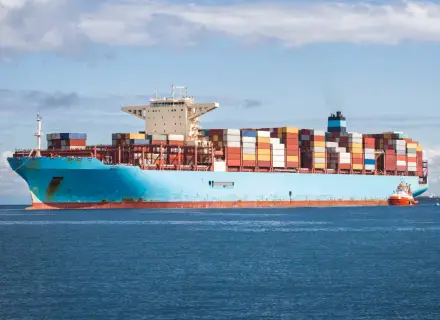

As the Strait of Hormuz becomes one of the world’s most dangerous waters, insurers are hiking the premium and prominent container liners are cancelling their services in Gulf waters.
The Iranian Revolutionary Guard announced on March 5 that the choke-point would be under their control for the duration of the war. This makes any voyage through the narrow pass extremely risky.
IRGC Navy official Mohammad Akbarzadeh claimed, “Currently, the Strait of Hormuz is under the complete control of the Islamic Republic’s Navy,” warning ships risk missile or drone damage.
Major international container liners like Maersk, MSC, and CMA CGM are all halting operations effective immediately and navigating their vessels to safe contingency ports.
Among them, Danish shipping titan Maersk also halted cargo bookings from most Gulf markets after a war-driven risk assessment. The company confirmed that there shall be no more bookings accepted from Iraq, Qatar, UAE, Kuwait, Bahrain, and certain parts of Saudi Arabia and Oman “until further notice.” Maersk assured that there will be humanitarian exceptions that apply to food, medicine, and essential goods.
However, operations to Jordan and Lebanon will remain unaffected, and there are two Maersk vessels in the Gulf currently.
The 33-kilometre-long strait controls roughly 20% of all global crude oil shipments, as well as noteworthy volumes of liquefied natural gas.
Khaled Ramadan, a Cairo-based economist, said that oil and gas transit through the strait would fall by 80% with escalating tensions. Consequently, worldwide prices for oil and goods are expected to spike.
Maersk is not the only company wary of Gulf waters. German carrier Hapag-Lloyd also suspended shipments to and from the upper Gulf. Hapag-Lloyd said: The suspension is “a necessary response to current security conditions and regulatory restrictions,” as “safety of its crews, vessels, and cargo remains its highest priority.”
China’s COSCO cancelled bookings to multiple Gulf ports. Mediterranean Shipping Co. also declared an end of voyage for all Gulf-bound cargo, is diverting vessels to the nearest safe port, and is imposing a surcharge of $800 per container.
France’s CMA CGM prioritised the safety of its crew and vessel, and APM Terminals Bahrain also used emergency measures to divert its vessels and sailors to Khalifa bin Salman Port.
Inflammatory remarks by Iranians like Brig. Gen. Sardar Ebrahim Jabbari, who said that the “Strait of Hormuz is closed,” while vowing to “burn any ship that tries to pass”, is of great concern to insurers.
The insurance markets are reassessing their insurance premiums. It’s going to be an expensive affair to insure all the transport ships passing through the strait under such perilous conditions. Some prominent London insurers are still willing to offer coverage, but at extremely sharp premiums that are rising daily.
Marsh McLennan, an insurance broker, met with US officials to remedy maritime trade woes amidst the deepening crisis. Without de-escalation, global supply chains and energy markets will be consumed by inflationary chaos.
However, US officials have promised respite and intervention. US President Donald Trump claimed that the US Development Finance Corporation (DFC) will provide political risk insurance at a very reasonable price, and added, “If necessary, the United States Navy will begin escorting tankers through the Strait of Hormuz.”
McLennan noted pre-conflict rates were 0.25%, now doubling as “insurers are cancelling pre-existing war risk policies and looking to renegotiate at higher prices.”
War-risk premiums could rise up to 50%, e.g., from $250,000 to $375,000 for a $100M vessel per voyage.
Experts say this could be part of Iran’s economic war. It doesn’t have to sink every ship that passes through the Strait of Hormuz. It just needs to make it unsafe enough to be uninsurable. Thereby driving up the costs of shipping and consequently the goods astronomically.
“Tanker traffic depends not just on whether ships can technically pass through Hormuz, but on whether operators can obtain war-risk coverage… Once coverage becomes uncertain or prohibitively expensive, trade slows faster than the formal status of the waterway changes. Insurance, in effect, becomes the market’s enforcement mechanism for geopolitical fear,” said Umud Shokri, energy strategist at Stimson Centre.