
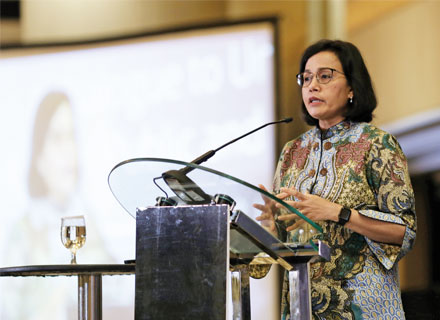

Sri Mulyani Indrawati, Indonesia’s long-serving finance minister, has guided the nation’s economy through crises and transformations with unwavering resolve. Over nearly two decades, Dr. Sri Mulyani Indrawati has become the woman Indonesia cannot do without. She has overseen the country’s finances for around 16 years across three administrations, earning a reputation for tough fiscal management and steady leadership. Today, at 62 years old, she remains at the helm of Southeast Asia’s largest economy. It’s a role she first assumed in 2005 amid national turmoil.
Where it all began
When Mulyani Indrawati was first appointed finance minister in 2005, Indonesia’s economy was in tatters. The country was still reeling from the late-1990s Asian financial crisis and struggling to recover from a devastating tsunami in Aceh and several earthquakes that required massive reconstruction funding. The cost to rebuild Aceh alone was estimated at around $4.5 billion, much of it needing foreign aid.
In Jakarta, the Finance Ministry she inherited was bloated and inefficient, while state institutions were rife with corruption. The nation’s largest bank, Bank Mandiri, had been mired in corruption scandals, and the banking sector at large was shaky. Poverty and unemployment were stubbornly high. Indrawati’s desk was piled high with urgent reforms from day one.
Facing this crisis, Indrawati moved swiftly. One of her first acts was to clean house. She fired dozens of corrupt tax and customs officers and disciplined thousands more, signalling a zero-tolerance stance on graft. She overhauled incentive structures in her ministry by paying honest officials better to remove the temptation of bribes. Backed by reformist President Susilo Bambang Yudhoyono, she slashed wasteful spending and tightened Indonesia’s budget. These efforts restored investor confidence, as foreign direct investment nearly doubled in her first year, from $4.6 billion in 2004 to $8.9 billion in 2005.
In 2008, Indonesia was affected by the global financial crisis, resulting in capital flight and a liquidity crunch. The crisis prompted the emergency bailout of Bank Century, a medium-sized lender, to prevent a widespread bank run. The government injected roughly Rp6.7 trillion (around $700 million) to rescue Bank Century, arguing it was necessary to protect the broader banking system. The bailout soon exploded into one of Indonesia’s longest-running political scandals. Critics alleged the rescue was mishandled and that some of the Rp6.7 trillion might have ended up in the wrong hands.
A special parliamentary enquiry claimed there were suspicious transactions and potential fraud associated with the bailout. Though Indrawati defended the decision as necessary to avert systemic collapse, the ruckus that ensued in the media and legislature put her under intense pressure.
Economist who means business
By 2010, Mulyani Indrawati had made a big impression on Indonesia’s economic trajectory. During her first tenure, growth rebounded (hitting 6.6% in 2007, the highest since the 1997 crisis), and public debt fell dramatically. Indonesia’s debt-to-GDP ratio, which had exceeded 90% in the aftermath of the Asian crisis, was brought down to around 30% by 2009, immensely improving the country’s fiscal stability. These achievements earned her international accolades.
Euromoney magazine named her “Finance Minister of the Year” in 2006, and she was lauded as Asia’s Finance Minister of the Year by Emerging Markets in 2007.
After six years at the World Bank, Indrawati returned to Jakarta in 2016 at the request of President Joko Widodo. Nearly 20 years after her initial appointment, she has now been back in the finance chief’s seat for almost a decade. The economic proof is there for all to see.
Under her stewardship, Indonesia’s economy was thoroughly overhauled and expanded. Annual growth has generally been robust (typically in the 5–6% range in the late 2010s), and prudent fiscal management has slashed government debt levels. Borrowing costs have fallen, and credit ratings have improved. GDP grew from about $286 billion in 2005 to nearly $1.5 trillion by 2025.
This rapid rise has vaulted Indonesia into the ranks of the world’s 20 largest economies. The once-sprawling Finance Ministry has been slimmed down and modernised, especially in tax collection and customs, which were hotbeds of corruption before. Indrawati’s reforms in those areas, including digitising systems and cracking down on tax evaders, helped boost the number of registered taxpayers from 4.35 million in 2005 to almost 16 million by 2010, and even more in the years since.
Insatiable desire for infrastructure
For all of Indonesia’s gains, Mulyani Indrawati has also faced an uphill battle against deeply entrenched challenges. Upon returning to office in 2016, she found that some reforms had stalled in her absence, and new issues had emerged. In 2017, an OECD research paper bluntly concluded that Indonesia still had significant room for improvement in public governance.
“The quality of public governance, as measured by the World Bank estimate of government effectiveness, puts Indonesia well behind countries like the Philippines, Thailand, Malaysia, Vietnam, and Singapore,” the OECD noted.
In other words, Indonesia’s bureaucratic effectiveness lagged many of its regional peers, affecting everything from business licensing to public service delivery. Indrawati has worked to streamline regulations and improve coordination between central and local governments, but changing a large bureaucracy’s culture is a slow process.
A particular sore point has been Indonesia’s inadequate infrastructure, which for years has been a bottleneck to growth. A 2016 World Economic Forum report on competitiveness highlighted that Indonesia’s overall competitiveness (ranked 41st out of 140 economies) was dragged down by the poor quality of infrastructure, which ranked only 60th. The country suffers from chronic shortages of power, congested ports and airports, and overloaded roads and railways.
“Indonesia’s competitiveness is dragged down by the poor quality of its infrastructure (60th),” the WEF report warned, citing factors like frequent electricity outages for industry and inadequate transport networks. For a sprawling nation of over 17,000 islands, building connectivity is a colossal and expensive undertaking.
Mulyani Indrawati has had to juggle demands for new infrastructure spending against the need to maintain fiscal discipline. Under her guidance, infrastructure outlays did increase, especially during President Widodo’s term, which prioritised new highways, airports, and a subway for Jakarta, but progress sometimes felt slow given the scale of needs.
Nonetheless, Indrawati is undeterred. She sees infrastructure and human capital investment as the keys to unlocking Indonesia’s next level of development. In the late 2010s, she oversaw innovative financing schemes, such as infrastructure bonds and public-private partnership frameworks, to stretch public funds further in building roads, power plants, and ports. By 2020, such efforts were paying off, with multiple new toll roads and transit projects completed.
She also championed major increases in funding for education and healthcare. Indeed, about 20% of Indonesia’s national budget is now devoted to education, a priority Indrawati has consistently supported. This reflects her belief that long-term growth depends on a skilled, healthy population.
A prudent finance minister
Even as she pushes forward on economic reforms, Mulyani Indrawati now faces perhaps her most delicate political test yet. In late 2024, Indonesia elected a new president. Prabowo Subianto, a retired army general, marked the third administration Indrawati has served under (after Yudhoyono and Widodo). Prabowo campaigned on ambitious populist promises to accelerate growth and tackle inequality. Once in office in 2025, he wasted no time rolling out bold (and expensive) programmes, with expectations of rapid results.
Among his headline initiatives is an “extreme poverty eradication” free meals programme targeting schoolchildren and pregnant women across the country. The plan aims to provide free nutritious meals to more than 80 million young and expectant Indonesians. Indeed, in January 2025, the government quietly launched the first phase, serving meals to some 570,000 students and pregnant women on the first day alone.
Prabowo Subianto envisions scaling up to reach 82.9 million people by 2029 under this programme. While few dispute the merits of fighting child malnutrition, the cost of this free food initiative is enormous. Initial estimates put the price tag at around $28 billion over five years. It’s a figure that alarms many economists, given Indonesia’s commitment to fiscal discipline. In its first year, 2025, the programme is budgeted at 71 trillion rupiah to feed 15 million people. Such sums risk blowing up the deficit unless offset by new revenues or cuts elsewhere.
Prabowo Subianto’s vision isn’t limited to free meals. He has also touted grand plans for Indonesia to achieve food self-sufficiency by dramatically expanding domestic agriculture. His administration talks of creating vast new rice paddies and even large sugarcane plantations to reduce reliance on imports of staples like rice and sugar.
Unsurprisingly, the markets have reacted nervously to these big-ticket promises. Investors worry that Prabowo’s agenda, which includes free meals for tens of millions, large-scale farming schemes, and a push for 8% annual GDP growth, could lead to bloated budgets or heavy borrowing. In mid-2024, as his campaign promises became known, Indonesian bond prices wobbled, and the rupiah currency weakened.
Upon Prabowo Subianto’s election, credit rating agencies signalled concerns that debt and deficits might rise. When he reiterated plans for free school meals (in a country of 270+ million people) and other subsidies, the rupiah fell as much as 0.4% in a single day, prompting Indonesia’s central bank to intervene to stabilise the currency. Financial markets were essentially firing a warning shot. They view Indrawati as the guardian of fiscal prudence, and any sign that her influence might be sidelined or that spending might spiral is met with anxiety.
This has set up a potential showdown between Prabowo’s expansive social spending agenda and Indrawati’s cautious fiscal approach. Behind closed doors, the technocratic finance minister has reportedly pushed back on some of the more expensive proposals, urging phasing or scaling them down to keep the budget sustainable. Rumours swirled in early 2025 of tensions between the president and his finance minister.
Political gossip even suggested Indrawati might resign rather than sign off on unsound fiscal policies. Prabowo’s own nephew, Thomas Djiwandono, whom Prabowo had installed as a deputy finance minister, could replace her. Such talk hit the news in March 2025, when The Straits Times reported on “whispers” that Indrawati might be replaced.
Whether Indrawati and Prabowo will continue to coexist amicably is a question that markets and Indonesians are watching closely. But if it comes to a true showdown, many believe that one of the region’s most capable finance ministers holds considerable cards. Sri Mulyani Indrawati carries the trust of investors, the respect of Indonesia’s civil society, and the hard-won experience of steering through many storms.