
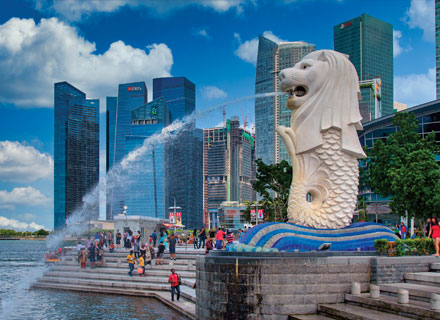

Singapore, now in its sixth decade as an independent country, faces many challenges in its pursuit of further growth and development. The most critical challenge is that the international system that underpinned Singapore’s economic policy has been undermined by the withdrawal from a multilateral rule-based order, which was compounded by United States President Donald Trump’s second term.
Singapore’s geopolitical approach is intricately linked to its economic survival, particularly in light of its small population and limited resources. Singapore, being an important hub of international trade and finance, has to contend with the challenge of navigating an increasingly fragmented world, characterised by shifting allegiances and economic uncertainty.
Geopolitics and economics
The US, as a key security ally and major investor in Singapore, has a corresponding role. Meanwhile, China’s proportion of trade with Singapore makes the nation a key economic partner. To this end, Singapore has kept its word. The city-state has cultivated close ties with both superpowers and promoted multilateralism through ASEAN and other regional economic frameworks.
Today, geopolitical tensions in the form of South China Sea disputes and the United States efforts to exit Chinese supply chains have left Singapore in a challenging situation. Counterintuitively, the city-state is extending its trade treaties with emerging markets, as well as working to advance digital trade with other value-hungry nations like Australia, the European Union (EU), and Japan.
Being a small country, Singapore is sensitive to changes in international trade, investment flows, and technological progress. With its policy of globalisation, Singapore’s open economy has thrived. However, the global shift away from a rules-based multilateral system due to prevailing protectionist policies poses a threat to Singapore’s economic stability.
The pandemic-induced supply chain disruptions and global push toward self-reliance in producing semiconductors have shed light on the middleman vulnerabilities of Singapore. In response, Singapore has shifted its attention towards diversifying its economic base through giant investments in frontier industries such as artificial intelligence, biotechnology, and financial technology.
The government has implemented incentives to attract multinational companies while backing local firms, particularly those involved in green energy and sustainable finance. Additionally, Singapore is going digital, focusing on cross-border e-commerce and fintech products, all to stay relevant in a future where digital commerce is as significant as traditional trade corridors. Despite these strategic initiatives, Singapore is also facing some long-standing issues that could slow down its economic growth in the future.
“With our population ageing and fertility rates dropping, the labour shortage problem remains a top priority. The government is trying to attract foreign skilled talent while ensuring that domestic workers are able to remain competitive through lifelong learning and retraining opportunities,” says Faizal Bin Yahya, Senior Research Fellow at the Institute of Policy Studies at the Lee Kuan Yew School of Public Policy, National University of Singapore.
However, immigration remains an issue that provokes strong emotions, with individuals voicing growing concerns about how the newcomers fit into society and what it does to our national identity.
“Singapore’s limited geographical size restricts its ability to expand its physical footprint. This limitation has resulted in innovative urban planning strategies such as underground infrastructure development and land reclamation schemes. Climate change further compounds our challenges, as the rising sea level and climate-related disasters pose threats to Singapore’s long-term sustainability,” Yahya added.
The government has made significant efforts to mitigate this challenge through investment in green technology. The government is introducing renewable energy, funding carbon capture initiatives, and advancing financial instruments tied to sustainability, as the world economy moves towards sustainability.
One important aspect of Singapore’s economic policy is trade diversification, which can mitigate some adverse effects. Beyond strengthening trade relations with its immediate neighbours, Indonesia and Malaysia, Singapore has signed 27 bilateral and regional free-trade agreements.
Moreover, Singapore has further deepened sub-regional development cooperation with Indonesia and Malaysia. In Batam, Indonesia, for example, Singapore has jointly developed industrial and high-tech parks. Furthermore, it is a partner to the Johor-Singapore Special Economic Zone, which aims to open Johor, Malaysia, to Singapore-based companies.
Structural and demographic challenges
Singapore’s labour force and resources, particularly its land, limit its ability to grow and develop. The number of foreign workers rose from 1.2 million in December 2021 to 1.52 million in December 2023, despite strict regulations such as the dependency ratio ceiling, which limits the number of foreign workers in relation to the overall labour force.
As of June 2024, the population of Singapore includes 1.86 million non-residents, 3.64 million citizens, and 544,900 permanent residents. The median age of the citizens was 42.8 years old in 2022. As of today, it is 43 years old. It is worrying that 19.9% of its citizens are 65 years and above, and in 2030, this number is expected to rise to 24.1%.
In 2023, 34,491 people were granted permanent residence, and 23,472 people were granted citizenship, a 1.7% increase from the previous year. To manage the flow of new citizens, social integration, ethnic, and interreligious peace activities have been at the forefront, although the number of new citizens granted has remained stable recently.
Immigration and foreign labour have become significant issues, particularly as general elections like the one in 2025 approach. The politicisation of immigration and foreign labour issues draws attention to the importance of maintaining racial harmony and ethnic balance. Racial classification by the Singaporean government is done using the Chinese-Malay-Indian-Others model.
During his 2025 budget speech, Singapore Prime Minister and Finance Minister Lawrence Wong presented several measures to aid Singaporeans to ensure that the nation maintains its economic growth and social compact with its residents.
These policies aim to encourage lifelong learning, offer job assistance, and help with workforce transformation. These included regular training subsidies for certain full-time and part-time courses, and enhanced workfare skills assistance for low-income individuals.
As part of its National AI Strategy 2.0, which the Singaporean government updated in 2023, Singapore is focusing on building its AI capability alongside leveraging technology to drive economic growth. The aim is to triple the number of AI experts to 15,000 by 2023. Furthermore, by enhancing its connectivity, the state continues to utilise and maximise its locational advantage.
Among the most densely populated countries is Singapore. Singapore’s housing market is in a dilemma situation—while it has made many homeowners by providing housing to residents through the Housing Development Board (HDB), it has also seen escalating property prices that have created giant concerns regarding affordability.
The government has introduced stringent regulations to curb speculation and ensure stability, such as cooling measures, additional stamp duties, and restrictions on loan-to-value ratios. However, demand continues to outstrip supply, leading to record resale levels and increasing rental costs.
Increasing foreign investment in luxury homes and a rising tide of expatriates have been pushing housing costs sky-high, posing difficulties for younger Singaporeans and lower-income groups in being able to find housing that they can afford.
The rising price of private flats has contributed to inflationary pressures, and Singapore is now among the most expensive cities to live in globally. The government has taken measures by increasing the supply of Build-To-Order (BTO) flats and introducing first-time homebuyers’ subsidies. However, the extent of their impact remains uncertain.
The current cost-of-living crisis is not limited to housing alone; it affects our everyday essentials such as food, transport, and healthcare. The global supply chain disruptions and higher energy prices have driven the increasing cost of living. Singapore imports most of its food and products, leaving it exposed to price fluctuations.
The hike in the Goods and Services Tax (GST) from 8% to 9% in 2024 has caused consumer prices to go up, despite the assurance of assistance from the government to lower-income earners.
The government has rolled out schemes such as U-Save rebates, cash handouts, and transport subsidies to alleviate the burden. But concerns about wage stagnation and income inequality persist.
As Singapore attracts increasing numbers of high-net-worth individuals and multinational companies, a means of balancing economic expansion with affordability for residents will be a key issue for policymakers over the coming years. Trade hub, sustainable energy, and AI: Singapore must enhance its global connectedness to consolidate its position as a node within the global value chain.
Changi Airport served over 58.9 million passengers in the aviation sector in 2023. Singapore is now restarting the construction of Terminal Five, which will be larger than Terminals One to Four combined and accommodate 50 million annual passengers to help it compete with other airline hubs.
The aviation sector supports around 200,000 individuals and contributes to 3% of Singapore’s GDP. In its 2025 budget, the government injected S$5 billion (US$3.7 billion) into the Changi Airport Development Fund.
The maritime sector supports around 170,000 individuals and contributes 7% of Singapore’s GDP. With the development of the Tuas Mega Port, Singapore continues to enhance its geographical benefits.
Singapore’s aspiration to be zero-emitting by 2050 means that it will have to rely increasingly on its neighbours because it is resource-constrained. S$5 billion (US$3.7 billion) was allocated to the Future Energy Fund in the 2025 budget.
To achieve its target of importing four gigawatts of clean energy by 2035, Singapore would purchase 1.2 gigawatts from Vietnam. Singapore also has deals with Indonesia to import one gigawatt of clean energy and two gigawatts of low-carbon electricity from Cambodia.
It is enabled by automation and investments in emerging technologies, such as AI, but this strategy must be accompanied by the retraining and education of Singapore’s ageing workforce. There must be collaboration with key stakeholders, such as small and medium enterprises, global corporations, and trade unions.
Singapore is employing sub-regional development and digital trade, including e-commerce, with like-minded partners in a bid to seek alternatives to strengthen multilateral trade. In the transition to a greener economy for more sustainable growth, connectivity also needs to be enhanced, but this has to be paired with cooperation with sub-regional partners.
Singapore’s economy grew faster than expected into the end of 2024. The city-state’s economy grew 5.0% in the fourth quarter from a year earlier, higher than both an official advance estimate of 4.3% and economists’ forecast of 4.7% growth. However, the government anticipates slower growth in 2025, as trade frictions and ongoing geopolitical conflicts may lead to higher production costs.
Ultimately, the city-state needs creativity, collaborative partnerships, and a relentless policy reform drive to ensure its prosperity as a vital stakeholder in the global marketplace, while the trade war wages on.