
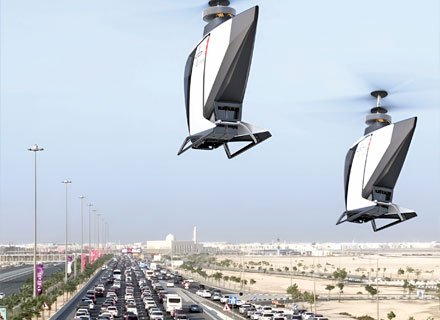

At the LEAP conference in Riyadh, industry leaders showcased the possibilities of flying taxis and driverless vehicles, demonstrating Saudi Arabia’s leadership in mobility innovation.
According to Yvonne Winter, Co-founder and Chief Operating Officer of FlyNow, a company that develops electric aviation solutions, the firm is preparing to launch a modular helicopter system designed to transport passengers and commodities.
During a panel discussion, Winter stated that “mobility and economic growth are closely related.”
She also added that “air transportation is the way to go to solve traffic issues related to congestion, air quality pollution, and noise pollution. Together, we must find a way to unlock it,” referring to this new sector as “the low-altitude economy.”
The lack of a workable implementation plan is one of the main obstacles facing foreign governments and regulatory agencies, according to Winter.
FlyNow has addressed this issue with a methodical approach that “is considered to be very safe.”
Before moving on to cargo applications, a regulatory sandbox has been created as part of this strategy to verify various automobiles, ATC systems, and operational data.
FlyNow intends to extend testing to metropolitan environments and passenger transportation after conducting comprehensive cargo experiments over sparsely populated areas.
According to Winter, e-helicopters will shorten wait times and be reasonably priced and available to everyone.
Push for mobility
Saudi Arabia is adopting new technology for land, air, and marine transportation, according to Ayman Mesfer, General Manager of the Intelligence and Future Sector at the Ministry of Transport and Logistics Services. The government intends to establish an incubator to offer small and medium-sized businesses developing mobility solutions financial assistance and advice.
Mesfer said, “The ministry will examine the implementation of new and significant technologies from every angle, including AI applications and data utilisation, as well as the skills of the enablers and the infrastructure.”
The Transport General Authority’s new Future Mobility Programme was presented by Omaima Bamasag, deputy of transport enablement. Twelve governmental and private sector parties are involved in the programme, which aims to pinpoint weaknesses in Saudi Arabia’s transportation infrastructure and suggest solutions. Omaima Bamasag serves as the Deputy for Transport Enablement at the Transport General Authority.
Crown Prince Mohammed bin Salman is the head of the Higher Committee for Transportation, which has approved 216 projects so far and found 16 gaps that need to be filled with alternative projects. A student shuttle at King Saud University, the deployment of scooters during the last two Hajj seasons, the creation of a framework for autonomous vehicle rules, pilot requirements for AVs, and the provision of Jahez food delivery services during Hajj are some of the major achievements.
“All of this is contributing to the achievement of AV goals and confirming the proposed AV policy and legislation. Additionally, be on the lookout for a pilot AV taxi that will soon be seen in Riyadh,” Bamasag remarked.
Partnerships and infrastructure
Mesfer claims that the Ministry of Transport and Logistics Services has collaborated with several organisations to create the infrastructure and legal framework for these technologies.
The ministry has created an advanced air mobility strategy that tracks drone deployment and aviation in collaboration with the General Authority for Civil Aviation.
To evaluate technology in the land, maritime, railroad, and aviation sectors, it has also teamed up with King Abdullah University of Science and Technology to build a new testing facility, dubbed a “living lab.” The Roads General Authority and TGA are other cooperating organisations.
The nation has already demonstrated its commitment to incorporating cutting-edge transportation options by piloting an air taxi in NEOM. In November 2023, TGA created a regulatory sandbox to make it easier to test unregulated mobility innovations. Micromobility, e-scooters, e-car rentals, ride-sharing, and drop-off and pick-up boxes are the five business concepts that have since surfaced.
Mesfer has gathered all these issues, attempted to address them, and paved the way for the regulation and eventual licensing of these technologies.
“Once licensed, these businesses or innovations will significantly boost GDP and create jobs,” he stated.
Antonio Jara, Libelium’s Chief Security Officer, discussed the company’s efforts to develop digital twins for low-emission zones in Saudi Arabia and Europe in his talk on innovative mobility solutions. These models incorporate noise, air quality, and IoT sensor data.
Antonio Jara is the top security officer of Libelium. Jara stressed the importance of data spaces for normalisation, intelligent modelling, classification, and quality assessment to create a safe space for stakeholders to share data. Data from that source is used by AI models that calculate CO₂ equivalents, simulate and predict pollution, create digital twins, analyse low-emission zones, and group things together by zone.
These models support crowd movement monitoring, sustainability impact evaluations, and pollutant source tracking. One of Libelium’s AI features is data harmonisation, which is already in place in big cities like Paris, Helsinki, and Amsterdam. Other models concentrate on clustering, traffic forecasting, weather information, and an effect assessment model for LEZ services.
Regarding Saudi uses, Jara told Arab News, “Aramco and Johns Hopkins are using these AI models to optimise parking.”
Another actual example is NEOM, which tracks the spread of pollutants from the tunnels in The Line.
“Both real-time data and predictive analysis are used in pollution tracking. We’re also conducting a proof of concept in the Riyadh municipality because they want to know how effective the metro is at lowering pollution from traffic,” Jara added.
In 2024, NEOM, the megaproject, also invested $175 million in German aircraft manufacturer Volocopter to bring urban mobility to life. The partnership focuses on eVTOL aircraft, electric vertical take-off and landing vehicles, designed to operate across NEOM’s skies.
NEOM CEO Nadhmi Al-Nasr said, “Together with the Kingdom’s General Authority of Civil Aviation, NEOM and Volocopter will make concepts like air taxis an everyday reality for its residents and visitors. Powerful partnerships such as the one that NEOM is cultivating with pioneering companies like Volocopter will fuel giant leaps forward, not just for the benefit of NEOM and the Kingdom, but for all.”
From experimental AV taxis in Riyadh to real-time pollution monitoring in NEOM, the nation is developing criteria for efficient and green mobility. Saudi Arabia is paving the way for a future of integrated, environmentally friendly, economically feasible mobility solutions that, by employing data-driven models, supporting public-private partnerships, and implementing forward-looking rules, promise to redefine world norms.
Saudi Arabia is moving fast to build new ways of transport across land, air, and sea. From flying taxis to driverless vehicles, the focus is on safety, testing, and clear rules. Strong support from the government, partnerships with private firms, and the use of data and AI are helping these ideas move forward. Together, these efforts aim to reduce traffic, cut pollution, create jobs, and improve daily travel for people.