
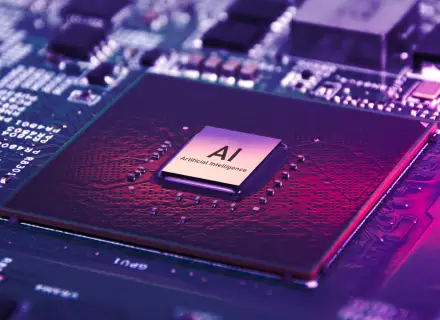

In the last few years, the story of artificial intelligence has often been told through one company’s rise. The explosive demand for AI computing power turned NVIDIA into the central supplier of the industry’s most important ingredient: GPUs capable of training and running large language models.
Nearly every major AI system, from research prototypes to widely deployed products, has depended on NVIDIA hardware. But somewhere beneath the surface of the AI boom, another story has been unfolding. It is slower, less visible, and far more structural.
Some of the biggest technology companies in the world are beginning to design their own AI chips. If the trend continues, the AI hardware ecosystem of the future may look far more fragmented and far more specialised than it does today.
A $100 Billion Signal
The conversation gained fresh momentum recently when Broadcom suggested that the market for AI chips could exceed $100 billion, driven largely by custom silicon designed for companies building large AI models, such as OpenAI and Anthropic.
That projection did not necessarily surprise industry observers. Demand for AI computing has already been surging at an extraordinary pace. But what caught attention was something else – the implication that some AI developers may want more control over the chips running their models.
“Broadcom’s projection signals that AI compute is becoming core infrastructure,” said Jeffrey Cooper in comments to International Finance. Cooper is an AI and semiconductor author who previously held leadership roles at ASML, ABB, and General Electric.
According to Cooper, the shift reflects a deeper strategic calculation inside the largest AI and cloud companies.
“Hyperscalers are beginning to design custom silicon to optimise performance, power efficiency, and cost at massive scale,” he said.
For companies operating data centres with hundreds of thousands of GPUs, even small efficiency improvements can translate into enormous savings.
Why Big Tech Wants Its Own Chips
The idea of designing custom chips is not entirely new. Large technology companies have experimented with specialised silicon for years.
Google introduced its Tensor Processing Unit (TPU) architecture nearly a decade ago. Amazon has developed its Trainium and Inferentia processors. Meta has been building AI accelerators for its recommendation systems and machine learning workloads.
What is different now is the scale. Artificial intelligence systems are becoming vastly more computationally demanding. Training large models requires immense clusters of GPUs running continuously for weeks or months. That kind of infrastructure is expensive.
“Controlling their own silicon allows hyperscalers to optimise chips for their specific AI models and datacenter architectures while reducing long-term dependence on external suppliers,” Cooper told International Finance.
There is also a basic economic incentive. NVIDIA’s GPUs, while powerful, come at a high price. The company’s margins reflect the extraordinary demand for its hardware.
Karl Freund, founder and Principal Analyst at Cambrian AI Research, pointed out that hyperscalers are keenly aware of that dynamic.
“They all have distinct workloads that can benefit from distinct hardware designs. Plus, they get these chips at manufacturing cost,” Freund told International Finance. And that difference matters.
“NVIDIA makes roughly 75% gross profit,” Freund added. “So, these companies hope to derive significant savings.”
In other words, designing chips internally could reduce long-term infrastructure costs, especially as AI deployments expand.
Broadcom’s Role In The New Ecosystem
In this emerging landscape, companies like Broadcom may play an important enabling role. Unlike NVIDIA, which mainly sells general-purpose AI GPUs, Broadcom often works directly with companies to design chips built for very specific AI workloads.
For AI developers, that can be appealing. Many have unique computing needs, but do not necessarily have the deep semiconductor expertise required to design complex chips entirely on their own.
“Firms like Broadcom are increasingly acting as key collaborators. They bring the chip design expertise and industry partnerships needed to turn hyperscalers’ architecture ideas into chips that can actually be manufactured at scale,” Jeffrey Cooper said.
The arrangement allows AI companies to focus on model design and infrastructure strategy while relying on experienced semiconductor partners for chip development. Such partnerships could gradually reshape how AI hardware is created.
Rather than purchasing standardised GPUs from a handful of suppliers, large technology firms may increasingly collaborate with chip designers to build processors optimised for their own models.
What Changes For NVIDIA
The rise of custom silicon inevitably raises another question: Does it threaten NVIDIA? For now, most analysts believe the answer is ‘not really’, at least in the short term.
NVIDIA’s dominance in AI computing is not based only on hardware. The company also controls one of the most powerful software ecosystems in computing: CUDA (Compute Unified Device Architecture), the programming platform used by researchers and developers to build AI applications. That ecosystem has been built over more than a decade.
“These developments do not meaningfully threaten NVIDIA in the near term. Its CUDA software ecosystem, developer base, and deployment scale remain extremely difficult to replicate,” Cooper said.
Freund agrees that NVIDIA’s position remains extremely strong, even if competitors gain ground.
“Broadcom only has a few very large customers. But, it is clearly looking to expand its revenue streams and bring in a wider range of customers,” Freund said.
Companies like Broadcom and Marvell Technology could carve out portions of the market that do not rely on NVIDIA GPUs.
But, Freund expects NVIDIA to retain a commanding position. “I would expect Broadcom and Marvell to carve out a significant portion of the it’s-not-NVIDIA market. But NVIDIA could retain at least 80% share,” he said.
In other words, the AI chip market may become larger and more diverse without fundamentally displacing the current leader.
Training Models Vs Running Them
Another key difference in the AI chip conversation comes down to how these chips are actually used in practice. AI computing typically involves two different tasks: training models and running them once they are deployed.
Training requires enormous computing clusters and extremely flexible hardware, making GPUs particularly well suited to the job. Inference, running the trained models, can often be optimised with specialised hardware. That is where custom silicon could become especially important.
“In theory, custom chips could compete with GPUs for training. In fact, Google’s TPU has been used to train many models, including Gemini,” Freund said.
But the economics often look different.
“The economics of an Application-Specific Integrated Circuit (ASIC) will look much better for inference,” he added.
In practice, that could mean a future where GPUs remain dominant in training large models while custom chips handle the massive number of inference requests generated by AI applications.
Will AI Chips Start Splitting Into Many Directions?
If large tech companies continue building their own chips, the AI hardware space could gradually start splitting into different directions. Instead of one dominant design, different companies may begin shaping chips around their own models, workloads, and data centre needs.
“The ecosystem is likely to become more diversified,” Cooper said, “with specialised chips optimised for different workloads, such as training, inference, networking, and memory-intensive AI tasks.”
Some startups are already pushing this idea to its extreme. Freund pointed to emerging companies designing highly specialised AI processors.
One example is Etched AI, which developed the ‘Sohu chip’, an application-specific processor designed specifically for transformer models.
“It strips out support for non-transformer workloads so it can pack in more transformer-optimised compute,” Freund said.
The result, at least in theory, is dramatically higher throughput and energy efficiency for models such as Llama-style or GPT-style large language models.
Another company, Taalas, is experimenting with an even more radical approach, designing chips tailored to individual models. These kinds of designs would have seemed impractical only a few years ago. But advances in semiconductor design tools, and the use of AI to assist chip development, may make them increasingly feasible.
“As the market expands and AI itself lowers the cost of silicon development, we will see some fragmentation,” Freund said.
How Custom Chips Could Reshape the Supply Chain
The growing push for hyperscaler-designed chips could also start changing how the broader semiconductor supply chain works. Designing advanced AI processors requires access to cutting-edge manufacturing technology, particularly the capabilities of foundries like TSMC.
Cooper believes this trend could deepen relationships across the semiconductor ecosystem.
“The rise of hyperscaler-designed chips will likely deepen relationships with advanced foundries while increasing demand across the semiconductor equipment and advanced packaging supply chain,” he told International Finance.
That includes not only chip manufacturers, but also the companies building the tools used to produce those chips.
The AI boom has already driven massive investment across the semiconductor industry, from lithography equipment to advanced packaging technologies needed to connect multiple chiplets in a single processor. Custom silicon could amplify that trend.
Why Only the Biggest Tech Companies Can Do This
One big reason custom chip programs are mostly limited to a few companies is scale. Designing advanced semiconductors takes massive resources, from large engineering teams to years of development, and huge financial investment. Historically, many companies that attempted custom chip programs struggled to sustain them. Two well-known initiatives are the Brainwave AI Chip by Microsoft, and Habana Gaudi by Intel.
“Successful in-house chip programs typically require massive scale, strong software integration, and long-term commitment,” Cooper said. That combination is typically available only to the world’s largest cloud companies.
As a result, the next generation of AI chips may be designed primarily by a small group of hyperscalers with global data centre networks.
The Next Five Years
Looking ahead, analysts expect the AI hardware market to not only grow dramatically, but also become more complex. The demand for computing power shows little sign of slowing. AI models continue to expand in size and capability, while new applications, from autonomous systems to generative tools, create additional workloads. In that environment, both general-purpose GPUs and specialised processors may co-exist.
“I see the market increasingly diversifying with specialised chips for specific companies and specific use cases,” Freund said.
But he also emphasised that GPUs will likely remain central to AI infrastructure.
“The versatility and broad usability of GPUs will likely keep them at the centre of AI computing,” he said.
Cooper offers a similar outlook.
“Five years from now, the market will likely include both dominant general-purpose GPU platforms and a growing layer of specialised silicon designed by hyperscalers,” he said.
A Subtle Shift
For now, the AI chip industry revolves around NVIDIA. But the emergence of custom silicon, designed by the very companies building AI models, suggests that the structure of the market could gradually evolve.
Hyperscalers want more control over their infrastructure. They want chips optimised for their own models. And increasingly, they have the resources to build them.
The result may not be the end of NVIDIA’s dominance. But it could be the beginning of a more diverse, and far more specialised AI hardware ecosystem. In the world of artificial intelligence, infrastructure shifts like that rarely happen overnight. They unfold slowly, almost quietly, until suddenly they are everywhere.