
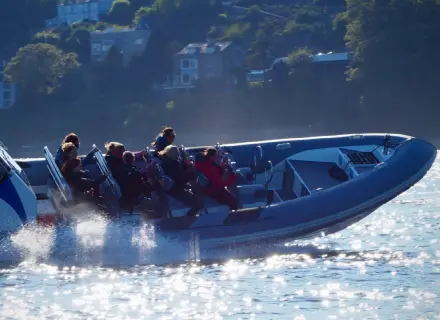

There is a narrow strip of water between mainland Wales and the Isle of Anglesey called the Menai Strait. From the shore, it looks calm and beautiful, turquoise water and green hills on either side, the kind of scenery that ends up on postcards. But anyone who has been out on it in a boat knows better. Beneath that pretty surface, the water churns, swirls, and surges. There is a stretch called the Swellies where the tides create whirlpools strong enough to swallow an unprepared vessel. It is not a place for beginners or flimsy equipment.
For twenty years, a company called Rib Ride Adventure Boat Tours has been taking people out onto that water. They know the Strait the way a taxi driver knows the backstreets of his city, reading its moods, its rhythms, its dangers. And now, with a 150,000-pound loan from the Development Bank of Wales, they are making the biggest bet in their history.
They claim that this stretch of water does not have to go quiet when the summer ends.
Phil Scott, Director at Rib Ride, explains the significance, “This investment allows us to take a significant step forward as a business. The new Explorer vessel has allowed us to offer more charter trips throughout the year, extending our season and creating new opportunities for training and employment. We’ve spent 20 years building Rib Ride into a high‑quality, year‑round marine operation, and this support from the Development Bank of Wales helps us to continue that journey while bringing more visitors to the Menai Strait.”
The Problem With British Tourism
If you have ever been to a seaside town in the United Kingdom in January, you will understand the problem. Shops shuttered. Car parks are empty. The fish and chip shop open three days a week, maybe. The bouncy castle deflated and rolled into a garage somewhere. British coastal tourism has always worked like a light switch, on in summer and off in winter. Businesses make what they can in July and August, then spend the rest of the year waiting.
This is an economically fragile business model. Staff cannot be kept on full-time if there is no work for nine months. Local suppliers, fuel depots, maintenance crews and equipment companies, cannot build sustainable businesses on three months of activity. And visitors who might have loved a trip in October or February never come, because there is nothing for them when they arrive.
Rib Ride has decided to stop waiting. Their plan is to turn the Menai Strait into a year-round destination, and the tool they are using to do it is a boat.
The New Boat
The vessel is called the Explorer, and it is a TITUS 10.5m built by Glasgow’s Ultimate Boats. It is 10.5 metres long and 3 metres wide, roughly the size of a large transit van but designed to sit on water. It is powered by twin Honda V8 engines, the same type of engine configuration used in professional search-and-rescue operations. The machine has a full navigation system from Garmin and Lowrance, which are trusted brands in marine electronics. And crucially, it is weatherproofed.
Beyond power and weatherproofing, the boat represents a technological shift in sustainability.
Shane Mugan, the CEO of Ultimate Boats’ parent company, ExoTechnologies, explains, “We are proud that this pioneering and internationally significant project is being delivered by our talented Clyde-based workforce. Our fully recyclable DANU composite material technology can tackle the ecological time bomb, which sees 250 million kilos of fibreglass and thousands of boats dumped into landfill across Europe each year.”
The older style of tour boats, open-decked and exposed to the elements, becomes genuinely dangerous and deeply uncomfortable in rough weather. They are summer tools. The Explorer is designed to operate in conditions that would have previously meant calling off a tour and sending customers home disappointed.
Rain, wind and cold stop being reasons to cancel. In the language of the industry, the Explorer can work in the “shoulder months,” the period between the busy summer season and the dead of winter. For Rib Ride, that potentially means running tours well into November and starting again in March, instead of shutting down after September.
Why This Matters Beyond One Company
When a single business expands, the benefits rarely stay inside that business. Think about what happens when Rib Ride runs a tour in November. The visitors who book that tour need somewhere to sleep, so hotels and bed-and-breakfasts nearby get bookings they would otherwise never have seen.
Those visitors eat lunch somewhere, buy coffee somewhere, and perhaps pick up gifts somewhere. The cafes, restaurants and small shops in Menai Bridge get customers on a Tuesday in November, which in the old model simply did not happen.
There is also the question of jobs. One of the quiet crises of seasonal tourism is what it does to workers. Skilled, experienced staff, boat captains, guides and maintenance engineers cannot live on four months of income.
Either they find a second job that may not fit neatly around the summer season, or they leave for cities where the work is steady. Southampton, Liverpool, and Aberdeen, where maritime jobs exist all year round. North Wales loses their expertise, and the region gets a little worse at what it does.
If Rib Ride can stay open year-round, it can offer proper full-time contracts. That keeps skilled people in the area, which makes the whole maritime sector in the region stronger over time.
Training The Next Generation
One of the quieter parts of the Rib Ride story is that the company has also become a training centre. The United Kingdom has a growing shortage of qualified sailors, skippers and marine crew. As the blue economy, a term that covers everything from fishing to underwater engineering, gets bigger, there simply are not enough trained people to fill the roles.
Rib Ride is connected to a 4.43-million-pound scheme called the North Wales Tourism Talent Network, which is designed to keep skilled workers in the region rather than losing them to bigger cities.
By running year-round operations, the company can offer apprenticeships and training that are not possible when it only operates for a few months. A person learning to be a skipper needs consistent time on the water, not just a summer burst.
This makes the company something more than a tourist attraction. It becomes a gateway into a maritime career for young people who grow up in North Wales and might otherwise see no route into that world without leaving home.
Electric Side Of The Business
There is an obvious tension in this story. Rib Ride is investing in twin V8 engines, powerful, loud and not exactly gentle on the environment, while the rest of the world is trying to reduce carbon emissions. The company is aware of this, and they have a second track running alongside the high-power tours.
Rib Ride already operates the United Kingdom’s first electric foiling school. Foiling, if you are not familiar with it, is a technology where a hydrofoil, essentially an underwater wing, lifts the hull of a boat out of the water as it picks up speed. This dramatically reduces drag, which means you need far less energy to move. An electric foiling craft is almost silent and produces no direct emissions on the water.
Director Tom Ashwell describes the tech as a game-changer for eco-conscious adventure through these words: “An eFoil is a surfboard with an electric motor that flies above a hydrofoil wing. The motor is near silent and can be charged with power from a renewable source. With no noise or wake, it’s a great way to interact with the beauty of our environment without imposing upon it. Soon you will be flying over water, which is the most amazing experience!”
The dual approach is honest and practical. The high-powered RIB is what keeps the business running and the lights on today. The electric foiling school is what keeps the business relevant tomorrow.
It is worth asking a basic question. Who goes on a boat tour in November? The answer is more people than you might expect, and the reasons say something interesting about how people are choosing to spend their leisure time in the mid-2020s.
There is growing evidence that travellers, particularly those who spend most of their time in offices and cities, are seeking experiences that feel real and slightly demanding, rather than simply comfortable. A RIB tour on the Menai Strait in October, with the wind up and the tide running, is not relaxing in the conventional sense. It is bracing, physical and slightly wild. Researchers use the term “blue mind” to describe the effect that proximity to open water has on people, a kind of mental clearing that you cannot get from a spa or a shopping trip.
Rib Ride’s private members’ boating club and its foiling school are popular for similar reasons. People do not just want to watch; they want to learn something, do something, come home with a skill or a memory that feels earned. A winter tour on a professional-grade RIB, navigating real tides in real weather, provides exactly that.
The Bigger Picture
The 150,000-pound loan from the Development Bank of Wales comes from a 50-million-pound fund set up specifically for tourism businesses. The terms are generous, with repayments spread over ten to fifteen years, which gives businesses the breathing room to invest in things that take time to pay off.
Andrea Richardson, Senior Portfolio Executive at the Development Bank of Wales, notes that Rib Ride represents exactly the kind of project the fund was designed to support: “Rib Ride is a well‑established tourism business with a strong reputation, a clear growth trajectory and a year‑round operating model. This investment will help the business extend its season, strengthen skills and employment opportunities, and continue to attract visitors to North Wales while supporting the local marine economy.”
North Wales is already seeing strong visitor numbers, with a 13% rise in arrivals to Anglesey this year. The gap is no longer in demand. People want to come. The gap is in the quality and availability of experiences that justify the trip. Rib Ride is closing that gap.