
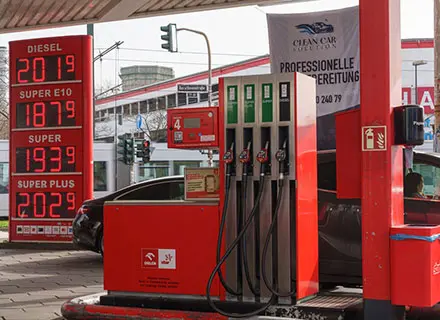

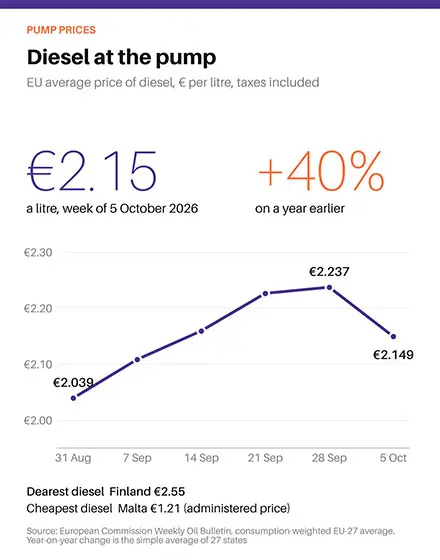
Across the channel, the picture is much the same. The European Union’s weighted average diesel price stood at 2.15 euro a litre in the first week of October, and drivers in Finland were paying 2.55 euro.
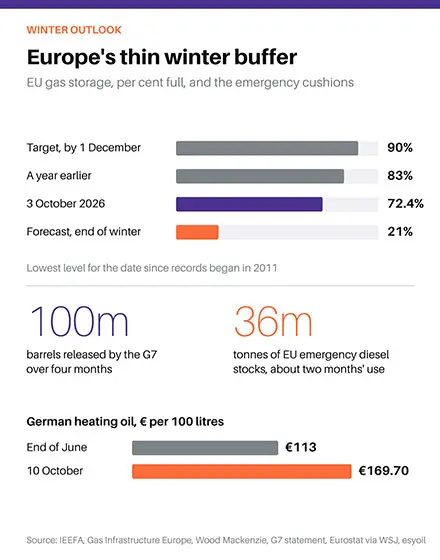
In Germany, households topping up their heating oil tanks before winter were paying close to 1.70 euro a litre, against about 1.13 euro at the end of June.
Diesel is the fuel that moves Europe. It powers the lorries that stock supermarket shelves, the tractors that bring in the harvest, and the excavators on building sites.
Its close cousin, heating oil, keeps millions of homes warm. When diesel becomes scarce, almost every price in the economy feels it.
This autumn’s squeeze has no single cause.
It is the product of two wars, a set of sanctions designed to punish Moscow, a pipeline network that has become a diplomatic weapon, and a gas market heading into winter with thinner reserves than at any point since records began.
In the past week, a new and unexpected variable arrived, when the United States struck its own diesel deal with Russia over the heads of its European allies.
A continent that cannot make enough of its own fuel
Europe’s diesel problem is structural. Its refineries turn out more petrol than the region needs and less diesel, and it has long relied on imports to cover the gap between what its plants produce and what its trucks, farms and factories burn.
Before Russia’s full-scale invasion of Ukraine, nearly half of those imports came from Russia.
In 2022, Europe still took about 630,000 barrels a day of Russian diesel.
The European Union’s ban on Russian refined products in February 2023 cut that to a trickle, and the bloc rebuilt its supply chain around the Middle East and India, with the United States playing a supporting role.
When Russian barrels disappear from Brazil, Turkey, or Africa, those buyers bid for cargoes from the Gulf or the US Gulf Coast instead, and Europe pays the higher price.
The first blow came from the Gulf
The crisis began not in Ukraine but in the Persian Gulf. Since the United States and Israel launched strikes on Iran on February 28, the Strait of Hormuz, which carries about a fifth of the world’s oil and gas in peacetime, has been largely blocked.
Traffic remains a fraction of its pre-war level, and Iran has stepped up attacks on shipping, with at least 12 tankers struck in and around the strait in a single week from late September.
Before the war, the Middle East was the EU’s largest external source of the fuel, ahead of the United States and India. By August, net diesel exports from the region had fallen to 390,000 barrels a day, just over a quarter of pre-war levels, according to the International Energy Agency.
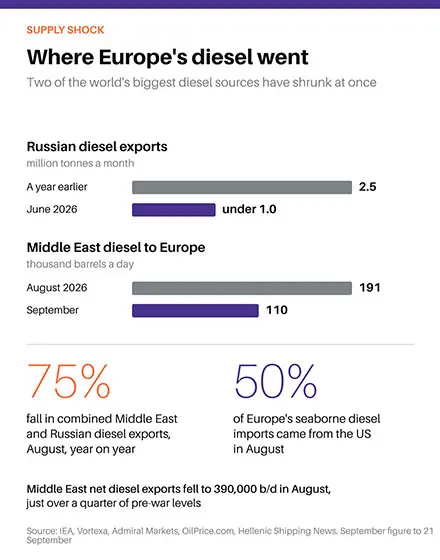
Shipments to Europe dropped to a six-year low in September.
That is why diesel prices have run ahead of crude. In early September, refining margins for diesel in north-west Europe topped $100 a barrel, while Brent crude was up about 45% on pre-war levels.
The fuel itself, rather than the oil it is made from, has become the bottleneck.
Then Ukraine went after the refineries
If the Gulf removed one leg of the supply chain, Ukraine’s drone campaign has knocked away another.
Kyiv stepped up its strikes on Russian oil refineries in August 2025 and has since widened the campaign dramatically, using longer range drones and sending them in waves to overwhelm defences.
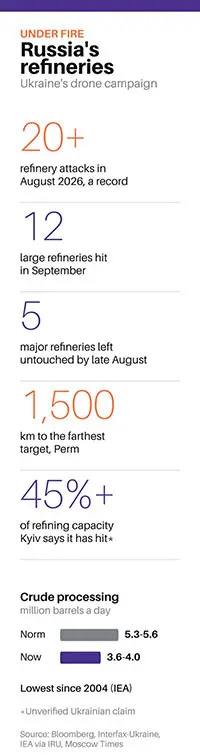 In August this year, Ukraine carried out more than 20 attacks on Russian refineries, its highest monthly total since the full-scale invasion.
By the end of that month, only five of Russia’s major refineries had escaped untouched.
In September, Ukraine’s defence ministry claimed that its forces hit 12 large refineries, the most distant being a Lukoil plant in Perm about 1,500 kilometres from the border.
Kyiv claims to have knocked out more than 45% of Russia’s refining capacity, a figure that cannot be independently verified.
Three of the six plants that together make about half of Russia’s diesel – Kirishi, Volgograd, and NORSI – have been shut or cut to roughly a quarter of their capacity.
The IEA estimates Russian crude processing at 3.6 million to four million barrels a day, against a seasonal norm of 5.3 million to 5.6 million, the lowest since 2004.
The effect on exports has been severe. Russia’s diesel exports fell below 1 million tonnes in June, against roughly 2.5 million tonnes a month a year earlier.
Before the restrictions, Russia supplied around a tenth of the world’s seaborne diesel and was usually the second largest exporter after the United States.
Ukraine has also struck the terminals that carry Russian oil abroad, including the Baltic port of Primorsk and the Black Sea port of Novorossiysk.
Kyiv’s argument is simple. Oil and gas sales fund Russia’s war, and every refinery taken offline reduces that income.
Moscow closes the tap
Russia’s response was to look after its own drivers first. A ban on diesel exports by traders and other non-producers had been in place since January. In July, it was widened to cover refineries, and it has since been extended month by month, most recently to October 31.
Several Russian regions have reintroduced fuel rationing. On October 1, President Vladimir Putin said Russia would not supply its diesel to world markets until sanctions on Moscow were lifted.
The ban was never watertight. Analysts at the Carnegie Endowment estimate from tanker data that 1.6 million to 1.8 million tonnes of diesel still left Russian ports by sea after the ban took effect.
But the formal closure removed a large, predictable source of supply just as winter demand approached.
Putin’s condition turned out to be an opening bid, and the buyer who took it up was not in Europe.
The deal that split the West
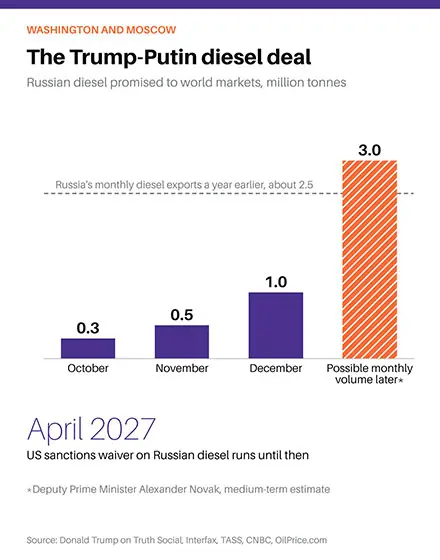
On October 9, after a telephone call with Putin, President Donald Trump announced that Russia would supply 300,000 tonnes of diesel to the US and global markets immediately, 500,000 tonnes in November and 1 million tonnes after that.
The US Treasury issued a licence waiving sanctions on Russian diesel until April 2027.
The following day, Moscow partially lifted its export ban to allow an initial 500,000 tonnes abroad, and Deputy Prime Minister Alexander Novak said monthly volumes could eventually reach three million tonnes.
The politics behind the deal are domestic. US diesel prices hit a record USD 6.53 a gallon in late September, farmers are paying more for both fuel and fertiliser, and Americans vote in midterm elections on November 3.
In the weeks before the call, Washington had pressed Europe to release its emergency diesel stocks and floated a ban on US diesel exports, a threat that carried weight because the US now supplies about half of Europe’s seaborne diesel imports.
Trump had also grown angry about Ukraine’s refinery strikes, which he blamed for higher American pump prices.
Europe’s reaction was swift and hostile. The EU’s foreign policy chief, Kaja Kallas, warned that suspending sanctions gave Moscow ‘more revenues to wage war’ and urged Washington to tighten pressure on Russia instead.
The rift deepened over the weekend. Trump suggested Ukraine should find a new leader, then announced on October 11 that Russia and Ukraine had agreed to an immediate ‘energy ceasefire’.
President Volodymyr Zelensky said it was the first he had heard of it.
Ukraine held off striking Russian refineries for two days, but Zelensky said Russian attacks on Ukrainian power and gas facilities continued and argued that a truce covering only refineries made little sense for a country with a single, long-damaged refinery of its own.
For European consumers the deal is a mixed blessing. EU sanctions still bar Russian diesel from the bloc, so any extra Russian barrels will reach Europe only indirectly, by easing competition for cargoes elsewhere.
Analysts doubt the volumes will move the market much.
The Kyiv School of Economics estimates that the Gulf disruption removed 152 million barrels of exports between March and August, more than double the 68-million-barrel fall from Russia, whose seaborne diesel now makes up roughly 4% of world trade.
The bigger cost for Europe may be political, a sign that Washington will trade sanctions relief for cheaper fuel when the pressure at home becomes intense enough.
The diesel crisis has unfolded alongside a long fight over the pipes that still tie Europe to Russian energy.
The southern leg of the Soviet-era Druzhba pipeline, which carries Russian crude across Ukraine to refineries in Hungary and Slovakia, stopped flowing on January 27 after a Russian drone strike damaged it near the western Ukrainian oil hub of Brody. Ukraine blamed Moscow.
Budapest and Bratislava blamed Kyiv for dragging out the repairs.
In February, both countries suspended diesel exports to Ukraine in the middle of winter, asked Croatia to ship Russian oil to them through the Adria pipeline and used their vetoes to hold up a €90 billion EU loan for Kyiv and a new sanctions package against Russia.
Flows resumed only in late April, after Ukraine declared the repairs complete and Hungary dropped its block on the loan.
On the northern leg, Russia stopped carrying Kazakh crude to Germany’s PCK refinery at Schwedt from May 1, citing a lack of technical capacity.
The refinery, which supplies most of the fuel used in Berlin and Brandenburg, had relied on Kazakh oil for about 17% of its intake since Germany stopped buying Russian crude.
Berlin said national fuel security was not at risk, but the episode showed how easily Moscow can squeeze even oil that is not its own.
Gas follows the same pattern.
The EU has adopted a law to phase out Russian gas entirely, ending long-term LNG contracts from January 1, 2027, and pipeline gas by September 30, 2027.
Slovakia has said it will challenge the rules in court.
Winter and the heating bill
All of this is converging on the heating season. Diesel and heating oil are near-identical products drawn from the same pool of middle distillates, so households refilling their tanks compete directly with lorries and tractors for the same barrels.
The IEA expects demand for these fuels to rise by almost 1.2 million barrels a day between August and November, double the usual seasonal increase, partly because households delayed buying heating oil earlier in the year.
 Germany shows what that means in practice. About one in five homes there is heated mainly with oil, according to the 2022 census.
The advisory group co2online expects annual oil heating costs for a typical 70 square metre flat to rise 24% this year, to about 1,275 euro, and a temporary energy tax cut on petrol and diesel does not apply to heating oil.
In Greece, heating oil could reach about 1.80 euro a litre this season, against roughly 1.13 euro at the start of last winter.
Gas, which heats far more European homes than oil, offers little relief. EU storage was about 72% full on October 3, down from roughly 83% a year earlier and the lowest for the time of year since records began in 2011, according to the Institute for Energy Economics and Financial Analysis.
It warns the bloc may need to cut winter gas demand by 7%. Wood Mackenzie forecasts that storage could end the winter just 21% full.
Lost Qatari LNG, delays to new supply and outages in Norway leave Europe with almost no margin if the weather turns cold.
Who is paying
Eurozone inflation jumped to 3.8% in September, its highest in three years, with energy prices up 18.8% on a year earlier and accounting for close to half of the headline rate.
The European Central Bank had already raised interest rates on September 10.
The EU Institute for Security Studies reckons the bloc has spent an extra 100 billion euro on oil and gas since March with nothing extra to show for it.
Road hauliers are among the hardest hit, because fuel is one of their largest costs and margins in the industry are thin.
Germany, the EU’s biggest diesel market, let its fuel discount lapse at the end of June, and pump prices there reached €2.50 a litre in mid-September before Berlin brought back a temporary tax cut in October.
Poland, Bulgaria, and the Czech Republic have seen diesel rise by close to 50% since the crisis began.
Government help is patchy.
France has extended aid to fishermen, farmers and construction firms but not to road freight. Slovenia, by contrast, will cover up to 70% of hauliers’ extra diesel costs above a reference price.
Farmers face a double blow, because the Gulf crisis has also pushed up fertiliser costs, and producers in the Czech Republic and Poland have talked of curbing ammonia output.
Several countries have cut fuel taxes to cushion households, among them Spain, Austria, and the Czech Republic, while Poland has lowered VAT on fuel to 8% until the end of the year.
Those measures ease the pain at the pump but add no supply and can keep demand high just when barrels are scarce.
Buying time
Governments’ main tool has been their emergency stockpiles. On October 2, the G7 agreed to release 100 million barrels of crude and diesel through the IEA over four months, with a large diesel release front-loaded into the first 20 days.
Spread evenly, that is about 830,000 barrels a day.
European leaders insisted the move was collective action rather than a concession to Washington and won a G7 pledge that members would not impose energy export bans on each other.
The EU held about 36 million tonnes of emergency diesel stocks at the end of June, roughly two months of consumption.
A large release could lower pump prices by 10-to-15-euro cents a litre, according to Alan Gelder of Wood Mackenzie, who warned that ‘any further release only buys time’ while global supply remains below demand.
Every barrel drawn down also leaves Europe less protected against the next shock.
What happens next
Three things will decide how hard this winter bites.
The first is the Gulf. A reopening of the Strait of Hormuz would ease both crude and diesel markets quickly.
But Iran says the strait will stay closed until Washington accepts its terms, talks remain deadlocked, and attacks on shipping have intensified this month.
The second is the energy war between Russia and Ukraine. If the refinery truce holds and Russian plants recover, more Russian diesel could reach world markets over the winter.
Energy Intelligence estimates that Russia has about 200,000 barrels a day to spare for export once its home market is supplied, provided no more capacity is lost.
If the truce collapses, as Zelensky has warned it will should Russia keep striking Ukraine’s grid, Russian output could fall further.
The third is the weather. A mild winter would ease gas demand and help storage last. A cold one would send households, power plants, and industry into competition for the same scarce molecules and barrels. Even in the better case, few in the industry expect quick relief.
US refiners Valero and Phillips 66 expect tight markets to last into 2027, and the IEA has warned that diesel will remain undersupplied in the coming months unless demand falls sharply.
For four years, Europe has spent heavily, in money and political capital, to free itself from Russian energy. It has largely succeeded in cutting direct imports.
What it has not escaped is a market in which its fuel bill is set by decisions taken in Washington, Moscow, Kyiv, and Tehran. This winter, those decisions will be felt at every pump and every boiler on the continent.