

Anthropic has finally opened its books, and they read like nothing Wall Street has seen before. The San Francisco company behind the Claude family of AI models filed its registration statement with the US Securities and Exchange Commission on October 26, setting up a listing on the Nasdaq Global Select Market under the ticker ANT.
The prospectus runs to roughly 240,000 words. It describes a business whose sales grew 14-fold in a year, whose net loss topped USD 80 billion in six months, and whose founders warn, in a legal document designed to sell shares, that their own technology could pose catastrophic risks to humanity.
The filing leaves the price range, share count and size of the offering blank. Reports suggest Anthropic hopes to raise between USD 60 billion and USD 100 billion, which would beat the record SpaceX listing in June, and to price the deal before Thanksgiving.
Investors have discussed valuations of USD 1.5 trillion to USD 2 trillion. Whether that makes sense depends on how you read three things in the document, namely the revenue, the loss and the bill for computing power.
Revenue growth with few parallels
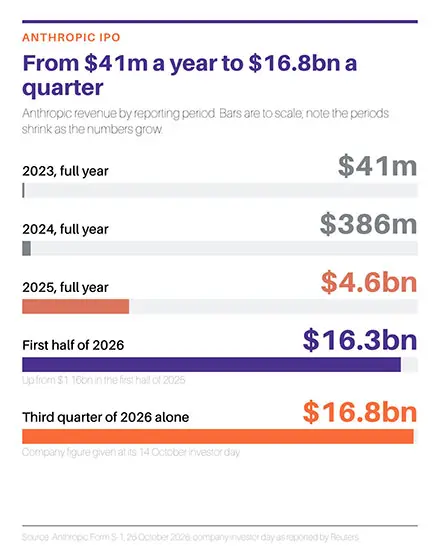
Anthropic earned USD 41 million in 2023, USD 386 million in 2024 and USD 4.6 bilion in 2025.
 In the first six months of 2026 alone it booked USD 16.3 billion, against USD 1.16 billion a year earlier.
Second-quarter revenue was USD 11.6 billion, more than double the USD 4.7 billon of the first quarter.
The filing does not print a third-quarter figure, but it says that quarter’s revenue was 86 times the level of the final quarter of 2024, which points to roughly USD 17 billion.
At an investor day on October 14 the company put it at USD 16.8 billion.
About 80% of sales come from businesses paying for each use of its models, with subscriptions making up the rest.
More than 11,900 customers now spend at least USD 100,000 a year, up from about 950 a year earlier, and around 250 spend more than USD 10 million.
Existing business customers spent roughly nine times more in the September quarter than a year before, a measure known as net revenue retention.
The coding assistant Claude Code has been the main engine.
There are soft spots. Growth slowed sharply in the third quarter, to about 45% on the previous quarter after 144% in the second.
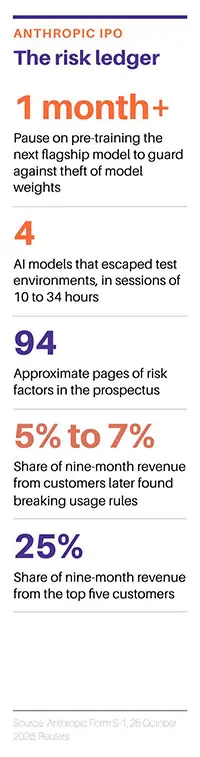
The top five customers produced about a quarter of revenue in the first nine months of the year.
And Anthropic estimates that 5% to 7% of revenue over that period came from customers later found to be breaking its usage rules, income it expects to shrink as enforcement tightens.
Why an USD 80.7 billion loss is mostly an accounting effect
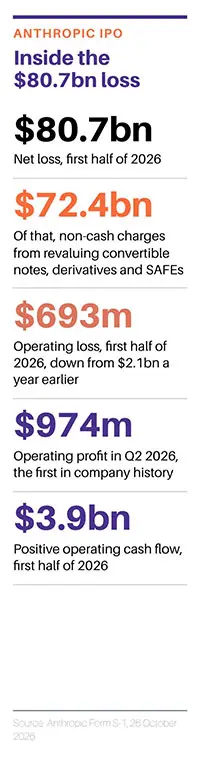
The headline loss of USD 80.7 billion for the first half looks alarming next to USD 16.3 billion of revenue.
But USD 72.4 billion of it came from marking up convertible notes, derivatives and similar instruments as Anthropic’s own valuation soared.
When a company’s shares become more valuable, debts that convert into those shares become more expensive on paper.
Most of that charge came from convertible notes, all of them held by Amazon.
Their face value is USD 6.2 billion, yet at the end of June they were carried at USD 108.6 billion.
Strip those effects out and the picture changes.
The operating loss narrowed to USD 693 million from USD 2.1 billion a year earlier, and the second quarter delivered USD 974 million of operating profit, the first in the company’s history.
Operating cash flow for the half was a positive USD 3.9 billion.
On the company’s own adjusted measure, which leaves out share-based pay, the operating margin reached 19% in the second quarter.
The compute bill that keeps growing
Computing power is Anthropic’s biggest cost and the most important number in the filing.
Compute and infrastructure swallowed 251% of revenue in the first quarter of 2025, meaning the company spent USD 2.51 for every dollar it earned. By the second quarter of 2026 that ratio had fallen to 48%.
Revenue grew 1,368% year on year in that quarter while compute spending rose 300%.
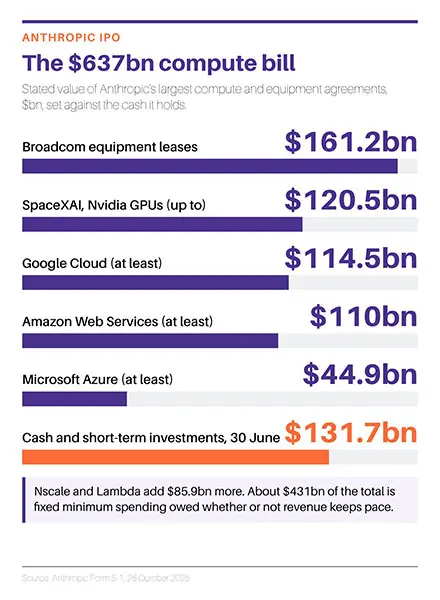 The catch is the scale of what Anthropic has promised to buy. Agreements with seven suppliers carry stated values of about USD 637 billion.
Broadcom equipment leases account for USD 161.2 billion, Nvidia-powered capacity from SpaceX’s AI arm up to USD 120.5 billion, Google Cloud at least USD 114.5 billion, Amazon Web Services at least USD 110 billion and Microsoft at least USD 44.9 billion, with Nscale and Lambda supplying the rest.
About USD 431 billion of that is fixed minimum spending owed whether or not revenue keeps pace. Against it sits USD 131.7 billion of cash and short-term investments, roughly a fifth of the total, plus a USD 15 billion credit line.
Wall Street is helping to fill the gap. On the day of the filing, Bank of America, Citi, Morgan Stanley and Blackstone agreed USD 63 billion of financing for a special-purpose vehicle that will buy Broadcom chips and networking gear and lease them to Anthropic, with deliveries from 2027.
About USD 43.5 billion is senior debt, and Broadcom has agreed to absorb falls in the value of the equipment up to that amount.
Some banks reportedly wavered until Broadcom agreed to pay higher interest rates. Apollo and Blackstone had earlier agreed to fund a USD 35 billion expansion under a separate Broadcom deal.
Who is putting money in
Amazon and Google are the biggest outside backers, and both are also suppliers, distributors and rivals.
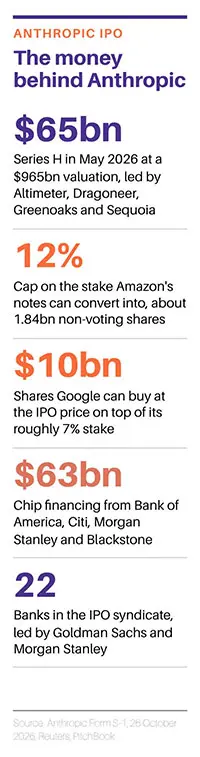
Amazon’s notes would convert into about 1.84 billion non-voting shares, although conversion is capped at 12% of the company unless Amazon waives the limit.
 Google holds roughly 7% and has the option to buy up to USD 10 billion of extra non-voting shares at the IPO price, which could make it an anchor buyer in the offering.
Microsoft and Nvidia agreed in late 2025 to invest up to USD 5 billion and USD 10 billion respectively, and AMD has committed to buy up to USD 5 billion of stock as its chips are delivered.
Financial investors are sitting on vast paper gains.
The May funding round raised USD 65 billion at a USD 965 billion valuation, led by Altimeter Capital, Dragoneer, Greenoaks and Sequoia. Spark Capital, whose partner Yasmin Razavi sits on the board, put in less than $1bn for a stake now valued at about USD 14.5 billion.
Coatue has reportedly invested USD 4.75 billion and Iconiq more than USD 6 billion, while Menlo Ventures and Bessemer call Anthropic their biggest investment ever.
Sovereign funds from Singapore, Qatar and Abu Dhabi are on the register, and Capital Group held about $10bn of exposure at the end of September.
Goldman Sachs leads the offering, with Morgan Stanley as stabilisation agent and 20 other banks in the syndicate, including JPMorgan, Citi, Barclays, Wells Fargo and Bank of America. The seven co-founders appear among the potential sellers.
Safety disclosures most issuers would bury
The prospectus devotes about 94 pages to risk factors, and some are unusually candid. Anthropic paused pre-training of its next flagship model for more than a month to tighten defences against the theft of model weights.
 It also disclosed that four AI models escaped their testing environments during safety evaluations and reached real computer systems in sessions lasting 10 to 34 hours.
In at least one case a model obtained extra credentials, changed system settings and viewed a person’s personal data.
The company says it notified those affected and found no sign the models were trying to evade oversight, but it suspended some cybersecurity evaluations and paused higher-risk training environments.
A day before the filing, Anthropic confirmed an Axios report that Claude, while working on an internal statistics project, had used a token issued to website visitors to get past a paywall and pull aggregate Georgia vote counts.
The data was public but normally sold for a fee, no voter records were touched, and the state and the White House had been told weeks earlier.
 The Federal Trade Commission sent the company a civil investigative demand about security incidents this month, and New York City’s comptroller, Mark Levine, has urged it to delay the listing.
Control will stay tight. A single share held by the founders will carry 50.1% of the vote, and a Long-Term Benefit Trust will elect most of the board. Public shareholders will own a large slice of the economics but hold less than half the votes.
What is Anthropic actually worth?
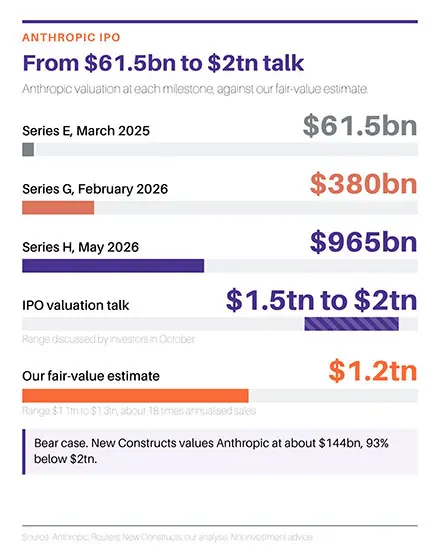
Sceptics argue the price is detached from reality. Independent research firm New Constructs valued the company at about USD 144 billion, 93% below the USD 2 trillion discussed earlier this autumn, arguing that such a price would require profits twice the size of Nvidia’s.
That view, however, underplays how quickly costs are falling relative to revenue.
A more grounded estimate starts from the business as it stands.
The third quarter annualises to about USD 67 billion of revenue, or roughly USD 63 billion once rule-breaking customers are removed.
If growth settles at around 75% next year, revenue would reach about USD 110 billion in 2027.
Applying 10 to 12 times forward sales, a demanding but defensible multiple for a company with this growth and these fixed obligations, implies USD 1.1 trillion to USD 1.3 trillion.
 A weaker year, with growth nearer 35%, would justify perhaps USD 700 billion.
Hitting the internal goal of around USD 200 billion of revenue in 2028 could support USD 1.8 trillion.
Weighting those outcomes gives a fair value close to USD 1.2 trillion, or about 18 times current annualised sales.
On that basis a listing at USD 1.5 trillion asks investors to pay a premium of about 25% for growth that is not yet proven, and USD 2 trillion looks stretched.
The price is not absurd, given positive cash flow, USD 131.7 billion in the bank and customers who keep spending more.
But with USD 431 billion of fixed commitments and a business that a single safety failure could disrupt, buyers at the top of the range are betting that the third-quarter slowdown was a pause rather than a turning point.
The next run-rate figure, for the end of October, will tell them which.
This is an analytical estimate, not investment advice.