

In October 2026, Wall Street began asking a far more uncomfortable one. Who pays for the buildings, the chips and the power lines while everyone waits for the revenue to arrive, and at what price?
The first answer came from the bond market.
CoreWeave, the Nvidia-backed cloud company that became the poster child of the so-called neocloud model, watched yields on some of its bonds climb above 15% in the middle of the month, a level usually reserved for companies in genuine distress.
Its shares lost roughly a quarter of their value in a single week, and by the close on October 22, they had sunk to their lowest point of the year.
The cost of insuring its debt against default hit a record.
Half a world away, the same tremor reached Seoul.
On October 23, SK Hynix, the memory chip giant that has been one of the biggest winners of the AI boom, put on hold a planned US listing of Solidigm, its American flash memory unit.
The company blamed volatile markets and its own sliding share price. The move also followed loud warnings from South Korean regulators and shareholder groups that the deal could short-change existing investors.
The two stories look very different. One concerns a heavily indebted American company, the other a cash-rich Korean chipmaker deciding not to raise money it may not strictly need.
Yet, both reflect the same shift in mood.
Investors who spent two years rewarding almost any company linked to AI infrastructure are now asking how that infrastructure is financed, who carries the risk and whether the returns will ever cover the bill.
A neocloud under pressure
CoreWeave’s rise was built on a simple proposition. Big technology groups and AI laboratories need vast amounts of computing power faster than they can build it themselves.
CoreWeave borrows money, buys Nvidia graphics processors, leases data centre space and power, and rents out the resulting capacity to customers, such as Microsoft and OpenAI, on multi-year contracts.
The model works as long as three things hold. Customers must keep signing contracts, projects must come online on time, and borrowing must stay affordable. In October, the third condition broke.
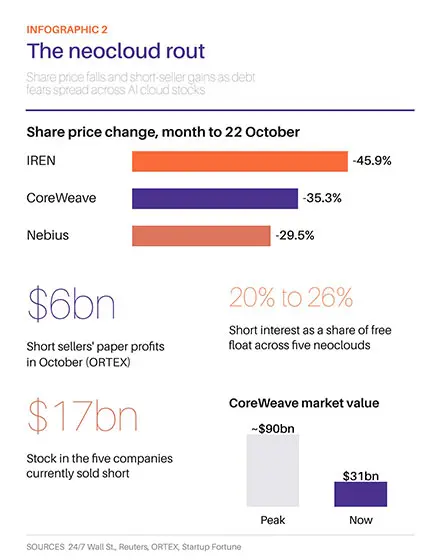
CoreWeave carries close to USD 50 billion in obligations, made up of roughly USD 35 billion of debt and about USD 16.3 billion of data centre lease commitments.
It plans to spend between USD 35 billion and USD 39 billion on capital projects this year alone.
Those numbers had been public for months. What changed was the price of money.
On October 14, a hotter than expected US inflation report showed consumer prices rising 3.7% in the year to September, driven partly by the energy shock that followed the outbreak of war with Iran in February.
Traders sharply raised the odds of another Federal Reserve rate rise at its meeting on October 27 and 28, and the yield on the 10-year Treasury note briefly touched about 5.3%, close to levels last seen in early 2002.
For a company whose entire business rests on borrowed money, that was the worst possible signal. CoreWeave’s shares fell 15% that day, while Oracle, another heavily indebted AI infrastructure play, dropped 7.3%.
Within days, yields on CoreWeave’s 2030 notes had jumped past 15%, and its 2032 bonds were trading at around 78 cents on the dollar, having changed hands close to their issue price just four months earlier.
Its five-year credit default swap spread, in effect the yearly cost of insuring its debt, hit a record intraday high of roughly 1,195 basis points on October 15, according to ICE Data Services.
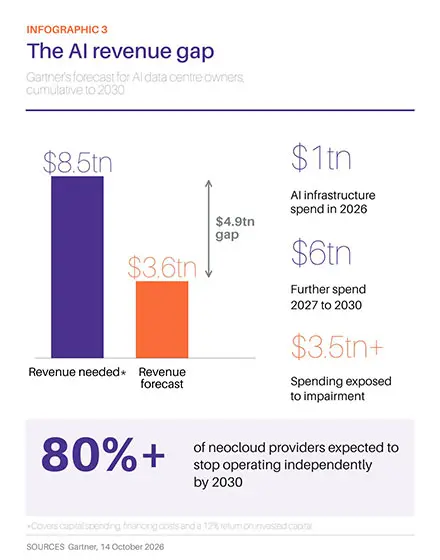
The market had also been handed a narrative. On the same day as the inflation figures, research firm Gartner warned that more than USD 3.5 trillion of planned AI infrastructure spending could be exposed to impairment by the end of 2030.
It expects AI providers to spend nearly USD 1 trillion on infrastructure in 2026 and a further USD 6 trillion between 2027 and 2030.
To cover that outlay, the cost of financing it and a 12% return on invested capital, data centre owners would need around USD 8.5 trillion in cumulative revenue.
Gartner expects no more than USD 3.6 trillion, and predicts that more than 80% of neocloud providers will stop operating independently by 2030.
The numbers behind the panic
CoreWeave’s own accounts show why investors are nervous. In the second quarter, it reported revenue of USD 2.58 billion, up 112% from a year earlier.
It also posted a net loss of USD 626 million, and its net interest expense of USD 640 million was larger than that loss. Interest costs for the third quarter are guided at between USD 860 million and USD 950 million.
The company points to its order book. Revenue backlog stood at about USD 104 billion at the end of June, and more than USD 25 billion of new customer commitments were signed in the opening weeks of the third quarter.
Chief executive Michael Intrator has argued that the gloom stems from a failure to understand the business, insisting that the model ‘more than supports’ its debt obligations.
Backlog, however, is not cash. It turns into revenue only when CoreWeave secures power, installs hardware, and delivers capacity to specification, and every step requires more spending first.
Not everyone on Wall Street has turned bearish. JPMorgan analysts said concerns about the debt were probably overdone, arguing that the financing need reflects rapid expansion rather than weak project economics.
Goldman Sachs upgraded the stock to buy on October 19, reasoning that CoreWeave could absorb an increase in borrowing costs of 100 to 200 basis points.
Altimeter Capital founder Brad Gerstner, an early backer, has argued that the market misreads the debt, since its costs rise only when the company refinances or borrows afresh.
That argument offers both reassurance and a warning. CoreWeave has no intention of borrowing less. Every new data centre needs new money, and the price of that money has just jumped.
Contagion across the neoclouds
 Had the sell-off been confined to CoreWeave, it might have been dismissed as one over-leveraged company meeting a tougher market. It was not.
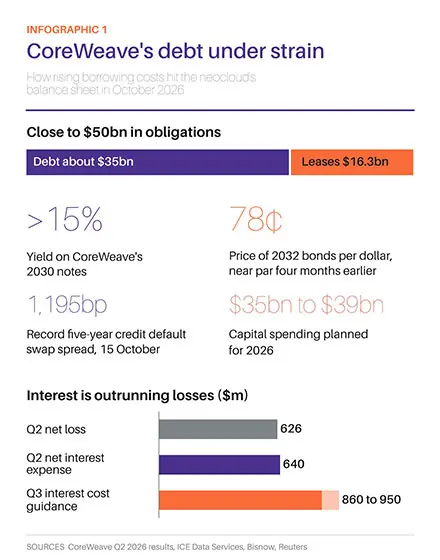
In the month to October 22, CoreWeave shares fell about 35%, Nebius Group dropped about 29%, and IREN lost almost 46%. Applied Digital, Hut 8, TeraWulf, and Cipher Digital were dragged down alongside them.
Nebius is a telling case. Its balance sheet is far less stretched, with about USD 8.55 billion of debt against roughly USD 8 billion of cash. On October 22, it announced a USD 3.5 billion financing facility from Citi, and its shares still fell more than 7% that day.
Investors were no longer pricing individual capital structures.
They were pricing the business model.
Short interest across the five ranged from about 20% to 26% of their free float, with roughly USD 17 billion of their stock sold short.
CoreWeave’s market value has shrunk to about USD 31 billion from a peak of close to USD 90 billion.
Nvidia as lender of last resort
The slump has put an awkward spotlight on Nvidia, which has spent the past year acting less like a supplier and more like a financier for the companies that buy its processors.
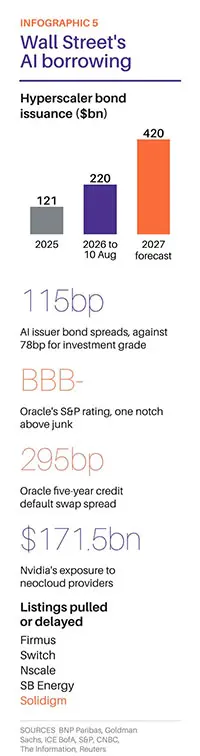
According to reporting by The Information and CNBC, its exposure to AI cloud providers now runs to about USD 171.5 billion, made up of roughly USD 7 billion of direct investment and USD 164.5 billion in guarantees and commitments.
 Some arrangements are strikingly direct. Nvidia has committed to buy up to USD 6.3 billion of CoreWeave’s computing capacity if the company cannot find another customer.
It also had USD 36 billion of off-balance-sheet agreements with neoclouds as of its July quarter, guaranteeing a minimum level of revenue in return for a share of anything above that floor.
Those commitments helped neoclouds raise money cheaply when markets were calm. They now mean that stress among Nvidia’s customers can travel back up the chain.
Nvidia’s shares were down 7.6% for October by October 23, and its five-year credit default swap spread hit a record of about 101 basis points, while Meta’s reached a record 108, according to the Financial Times.
Both remain firmly investment grade, yet even the strongest names in the sector are no longer treated as risk free.
Oracle and the investment-grade cliff edge
The bigger worry for credit markets is Oracle. The software group has committed around USD 250 billion to AI data centres, much of it to serve OpenAI, whose roughly USD 300 billion contract is not expected to start paying until 2027.
S&P Global Ratings cut Oracle to BBB- in July, the lowest rung of investment grade, and Moody’s holds a negative outlook.
Its borrowings now exceed USD 125 billion, and its five-year credit default swap spread has climbed to about 295 basis points.
Barclays has gone as far as advising clients to buy protection against an Oracle default. Oracle insists that keeping its investment-grade rating is its top capital allocation priority.
The stakes are high because many pension funds, insurers and bond funds can hold only investment-grade debt. Deutsche Bank’s Jim Reid has warned that a cut to junk status could force such investors to sell.
S&P has said it could downgrade again if Oracle’s leverage stays above four times, if it fails to show a path to positive free operating cash flow by fiscal 2029, or if the agency takes a dimmer view of the AI industry itself.
Forced selling of one of America’s largest corporate borrowers would weigh on prices across the entire AI debt market.
Big Tech’s borrowing binge
Oracle and the neoclouds sit at the riskier end of a much larger shift. The five big hyperscalers, namely Amazon, Alphabet, Meta, Microsoft, and Oracle, once paid for data centres almost entirely from their own cash flow.
That is no longer enough. In 2025, the five issued about USD 121 billion of US corporate bonds, more than four times their average over the previous five years.
By August 10 this year, their issuance had already reached about USD 220 billion, according to BNP Paribas data, and Goldman Sachs expects a record USD 420 billion in 2027.
Bond investors are charging more for the privilege.
By September, spreads on debt from AI-related issuers were hovering around 115 basis points over Treasuries, against 78 basis points for the broader investment-grade market.
Demand cover on new hyperscaler deals, a measure of how many orders arrive for each dollar of bonds on offer, fell from about five times in February to about two times in July, based on Apollo data reported by Reuters.
Below investment grade, the terms are tougher still.
CleanSpark, a bitcoin miner pivoting to AI data centres for Meta, sold USD 2.3 billion of high-yield bonds at 98.5 cents on the dollar with a 7.875% coupon, among the steepest concessions of the past year.
A blue-chip tenant on the lease is no longer enough to erase construction risk in the eyes of lenders.
Much of the borrowing also sits off the balance sheet.
Meta’s USD 27 billion Hyperion campus in Louisiana was financed through a joint venture majority-owned by Blue Owl, whose bonds carried an A+ rating yet yielded 6.58% at launch, a rate more typical of riskier borrowers.
Morgan Stanley has tallied more than USD 3.1 trillion of such off-balance-sheet commitments, and credit support across seven hyperscalers and chipmakers.
AI-related debt now makes up roughly a tenth of the largest long-dated investment-grade bond funds, which means ordinary savers in index funds are lending to the AI build-out whether they realise it or not.
Solidigm and the listing that never was
It is against this backdrop that SK Hynix pulled back from what would have been one of the largest technology flotations on record.
Solidigm, built from the NAND flash memory and solid-state drive business that SK Hynix bought from Intel, had been weighing a US listing to help fund a new American factory and meet surging demand for storage chips in AI data centres.
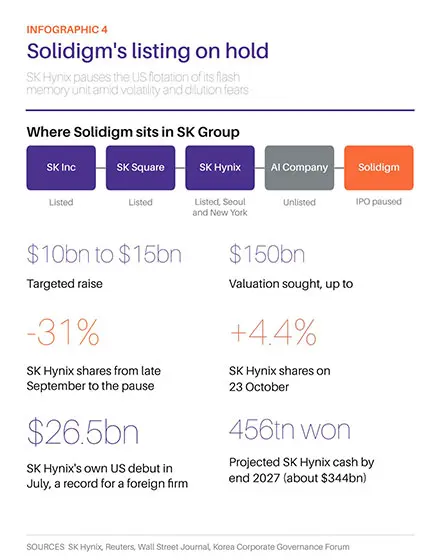
It had aimed to raise USD 10 billion to USD 15 billion at a valuation of up to USD 150 billion, according to industry estimates cited by the Wall Street Journal.
On October 23, SK Hynix said Solidigm was suspending its reviews of both a pre-IPO funding round and the IPO itself.
Given recent capital market conditions and share price trends, the company said, Solidigm needed to reassess whether a listing was the best option for SK Hynix and its shareholders.
Market volatility was only half the story. In South Korea, the plan had become a lightning rod in a long-running argument about duplicate listings, in which a listed parent floats a prized subsidiary and dilutes the value its own shareholders thought they owned.
SK Group’s chip empire already runs through several listed layers, from the holding company SK Inc to SK Square and then SK Hynix, with an intermediate vehicle called AI Company sitting above Solidigm.
Lee Chan-jin, governor of the Financial Supervisory Service, told a parliamentary hearing this week that regulators were examining whether the US listing would require a review under dual-listing rules that were tightened in July.
Shareholders had already voted with their feet. SK Hynix shares had fallen 31% since news of the potential listing emerged in late September, weighed down by the wider AI sell-off and fears of dilution.
When the suspension was announced, they closed 4.4% higher in an otherwise flat market. The Korea Corporate Governance Forum, an independent watchdog, welcomed the decision and suggested SK Hynix could fund Solidigm directly through AI Company instead.
Citing brokerage estimates, it said SK Hynix’s cash holdings could reach 456 trillion won, about USD 344 billion, by the end of 2027.
There is a geopolitical layer too. People familiar with the matter told Reuters that SK Hynix had been using the prospect of a US factory as a bargaining chip with Washington, linking it to hoped-for approval to ship American chipmaking equipment to its plant in Dalian, China.
Different balance sheets, same message
In one sense, Solidigm is the mirror image of CoreWeave. SK Hynix is not short of money.
It held about half of the global market for high-bandwidth memory in the second quarter and has already announced a 40 trillion won programme of share buybacks and cancellations.
It reports third-quarter results on October 29, when it is expected to set out further returns to shareholders.
Yet, the decision tells the same story from the other end of the market. In July, SK Hynix raised USD 26.5 billion in its own US debut, the largest American listing ever by a foreign company.
Three months later, the window for AI-linked equity has narrowed sharply. Firmus, the Nvidia-backed Australian data centre operator, withdrew a planned USD 5 billion listing in early October that would have valued it at about USD 30.6 billion.
Data centre operator Switch and AI infrastructure provider Nscale have pushed back their listings, and SoftBank-backed SB Energy has postponed its own. Anthropic is a notable exception, still pressing ahead with a listing planned for mid-November.
When equity investors will not pay the hoped-for price and debt costs are climbing, companies have three choices. They can fund growth from their own cash, accept worse terms, or slow down. SK Hynix can afford the first.
CoreWeave and most of its peers cannot.
Echoes of earlier booms
Comparisons with the telecom bubble of the late 1990s are now common. Back then, carriers borrowed heavily to lay fibre on the assumption that internet traffic would grow without limit.
Traffic did grow, but not fast enough to service the debt. The parallel is imperfect. Today’s demand is real, often contracted years ahead, and the biggest spenders are among the most profitable companies ever created.
The more useful lesson concerns timing. Processors lose value quickly as each new generation arrives, while the debt raised against them and the leases on the buildings that house them run far longer. If revenue arrives on schedule, the mismatch is manageable.
If it arrives late, or at lower prices, the gap has to be filled with fresh borrowing at whatever rate the market demands.
That is the heart of Gartner’s warning, that the bill may fall due before the revenue does. It also points less towards a sudden collapse than towards consolidation, with weaker neoclouds absorbed by stronger rivals or by their own lenders.
What to watch
The coming weeks will test which reading wins. The Federal Reserve’s interest rate decisions will show whether borrowing costs are about to rise again. SK Hynix’s results will reveal how much cash the memory boom is still generating and how it plans to fund Solidigm without a listing.
CoreWeave’s third-quarter figures, expected in November, will show whether its interest bill is growing faster than its revenue.
None of this means the AI boom is over. Demand for computing power still outstrips supply, and the companies at the top of the chain remain enormously profitable. What has changed is that capital is no longer close to free.
For two years, the market treated AI infrastructure as a growth story. In October 2026, it began treating it as a credit story, and credit markets have a habit of asking the hard questions first.