
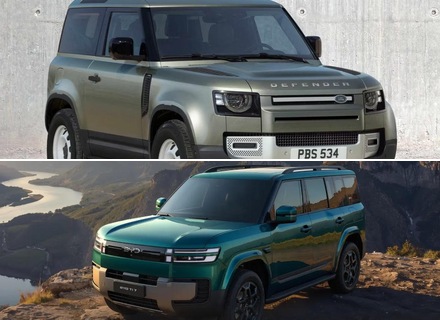

China’s BYD has been barred from selling its seven-seat Ti7 sports utility vehicle (SUV) in the European Union after a Dutch court ruled that its design infringes the intellectual property rights of Jaguar Land Rover (JLR), dealing a setback to the Chinese carmaker’s expansion plans in Europe.
The District Court of The Hague issued a preliminary injunction on November 20, prohibiting BYD from importing, manufacturing, offering for sale, selling, storing or delivering the vehicle anywhere in the 27-member bloc.
The restriction will also prevent the company from producing the SUV at its planned Hungarian manufacturing facility while the legal dispute continues.
The ruling follows a complaint by JLR, owned by India’s Tata Motors, who said BYD’s Ti7 was a close copy of the distinctive exterior design of its Land Rover Defender.
The British manufacturer brought the legal action earlier this year after BYD said it would start taking orders for the seven-seat SUV from UK customers, with deliveries expected to begin in January 2027.
The Dutch court ruled in its judgment that the Ti7 infringed JLR’s registered European Union design rights for the Defender, finding that the Chinese vehicle reproduced several characteristic elements of the British SUV.
The court identified features including the Defender’s rounded shoulders, distinctive signature panel, rounded-corner wheel-arch cut-outs, continuous window design, proportions and overall silhouette.
It said the similarities dominated the overall impression created by the two vehicles, while the differences highlighted by BYD were insufficient to produce a substantially different appearance.
The injunction is preliminary rather than a final determination of the wider intellectual property dispute. JLR has been given six months to initiate full legal proceedings.
If it fails to do so, the injunction could lose its force.
BYD strongly rejected the judgement, maintaining that the Ti7 was developed independently by its design team and did not infringe any of JLR’s rights.
The company said it would appeal and pursue all available legal avenues to overturn the decision.
JLR declined to comment on the ongoing proceedings, saying in a statement, “We protect our intellectual property and take legal action when necessary.”
The ruling does not prevent BYD from selling the Ti7 in Britain. The Dutch court said it lacked jurisdiction over the Chinese company’s UK affiliate and dismissed the claims against its Dutch subsidiaries concerning the alleged infringement of British design rights.
The distinction is commercially significant because BYD has already begun marketing the vehicle to British customers.
The Ti7, sold in China under the Fangchengbao brand as the Fangchengbao Tai 7, is priced at £47,995 in the United Kingdom, more than £20,000 below a comparable seven-seat Defender. Deliveries are expected to begin in January.
The vehicle was introduced in China in 2025 and is among BYD’s larger SUV offerings. Its boxy profile, upright proportions, squared-off wheel arches and rear styling have drawn comparisons with the Defender, one of JLR’s most recognisable models.
The Defender is also commercially important to JLR.
In 2025, the company sold over 100,000 units globally, making it the best-selling model.
It’s become a major contributor to the British manufacturer’s premium vehicle business and gives JLR a commercial reason to defend its distinctive design.
The move comes as BYD is accelerating its international expansion to offset rising competitive pressures and weaker demand in its home market. Europe is gaining importance as Chinese manufacturers look for new customers and diversify their revenues away from China.
BYD has experienced rapid sales growth in Europe since launching the market in late 2022. The company had sold more than 280,000 vehicles in Europe through September 2026, more than double sales in the same period a year earlier, data from the European Automobile Manufacturers’ Association (ACEA) show.
Its combined market share in the EU and UK was 2.7%, up from 1.2% in 2025, ahead of JLR’s 0.9%.
The Ti7 was meant to raise BYD’s game in the premium and large-SUV segments where European players have traditionally had the upper hand.
Its competitive pricing and plug-in hybrid technology were intended to appeal to buyers seeking the size and styling of an off-road vehicle without paying traditional luxury-brand prices.
The European restriction also has implications for BYD’s manufacturing strategy. The company is preparing to begin mass production at its new factory in Hungary, part of a broader effort to manufacture vehicles within Europe and reduce exposure to import costs and trade barriers.
The court’s decision means the Ti7 cannot be manufactured at the Hungarian facility for sale in the EU while the injunction remains in force. This could complicate production planning if BYD intended to include the model in its European manufacturing portfolio.
The dispute is also unusual because European carmakers have frequently accused Chinese competitors of copying their designs, but relatively few such complaints have resulted in court rulings of this nature. JLR previously won a legal battle in 2019 against Jiangling Motors over the design of the Landwind X7, which it argued imitated the Range Rover Evoque.
The latest case has also involved a separate dispute over evidence gathered from BYD’s Dutch offices. In August, court bailiffs acting on JLR’s behalf seized digital records from two BYD premises.
A subsequent ruling ordered JLR to destroy the seized material, finding that the evidence-preservation exercise had gone beyond what was necessary at that stage.
Image Courtesy: BYD and Land Rover