
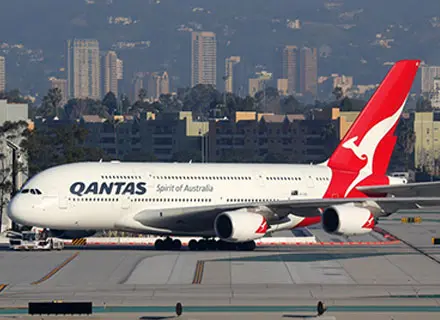

The Aussie carrier is currently in talks with Airbus and Boeing about converting 20 options to firm orders for A350s and 787s from 2030 because it would start replacing the inconic superjumbos about four years earlier than previously planned.
“The A380s are no longer in production, which means that the maintenance expenses for those aircraft will increase over time, as will the costs associated with disruptions,” Qantas CEO Vanessa Hudson told reporters.
The new widebody order would be separate from the ones earmarked under Qantas’ all-important “Project Sunrise,” under which non-stop flights from Sydney to London and New York will start operating next year.
Talking about the A380, Airbus developed the four-engine A380 to challenge the dominance of the Boeing 747 in the long-haul market.
The full-length, double-deck aircraft, capable of carrying up to 853 passengers on two decks, first entered commercial service with Singapore Airlines in 2007.
Before ending the aircraft’s production run in 2021, Airbus delivered a total of 251 A380s. While Qantas and Emirates emerged to be the aircraft’s major operators, A380’s high fuel and maintenance expenses, along with the difficulty of consistently filling 500-plus seats, limited its appeal to most airlines outside the Gulf.
While more efficient twin-engine widebodies like the Boeing 787 and Airbus A350 further weakened A380’s operational economics, the Covid pandemic, which grounded almost the entire global A380 fleet due to the global travel disruption, accelerated its decline.
Out of the 251 aircraft delivered, 196 remain in service, according to Airbus July data. Already Air France, China Southern Airlines, and Malaysia Airlines have retired the superjumbo.
During the pandemic, Qantas grounded its A380 fleet for more than 500 days as international travel collapsed, with aircraft placed in long-term storage in California and Abu Dhabi.
Other operators like Thai Airways, Lufthansa, Korean Air, Singapore Airlines, and Qatar Airways have downsized their A3820 fleet, as per the Airbus data.
Emirates is the largest A380 operator, with a current fleet of 116 aircraft, representing nearly half of all A380s ever delivered. Singapore Airlines and British Airways each operate 12 A380s, making them the largest non-Emirates operators.
Lufthansa, Qatar Airways, and Etihad Airways each operate eight A380s. Korean Air, Asiana Airlines, and Japan’s All Nippon Airways also operate the model.
Emirates plans to keep flying the A380 into the 2040s, while other operators expect to phase out the aircraft in the early 2030s.
Qantas reported an underlying profit before tax of AUSD 2.06 billion (USD 1.48 billion) for the year ended June 30, slightly ahead of the Visible Alpha consensus estimate of AUSD 2.00 billion.
As per the carrier’s CEO, Qantas, in 2026, they have encountered two “very different operating environments,” as robust travel demand through much of the year collided with a surge in fuel costs driven by the Middle East conflict that reduced the business’ second-half earnings by AUSD 420 million.
“In the first half, Qantas and Jetstar were both performing strongly, with demand growing across the domestic and international networks. Our new aircraft allowed us to add capacity and open new routes, which helped us to increase revenue. Qantas continued to experience growth in the premium segment of the market, while Jetstar consistently improved and provided value during a time when many were facing cost of living pressures. This performance highlights the benefits of our dual brand strategy,” Hudson stated.
“Higher fares, a reduction in domestic capacity, and redeploying aircraft to stronger international routes only partially offset the headwinds from rising fuel costs,” she noted further.
Despite easing tensions in the Gulf region, Qantas forecast that its fuel bill would rise by AUSD 1 billion in the current half relative to a year earlier, despite the hedging options covering 85% of the carrier’s fuel needs.
On the revenue front, the airline expects 8-10% growth per seat flown in the first half of the year.
While the airline had increased fares after the fuel price rose, the strong revenue forecast also included factors like baggage, charter, and other fees, while taking into account the percentage of seats filled.
The airline said travel demand remained resilient. However, Qantas sees its forecast domestic capacity declining 3% in the H1 2026, while international capacity rises 2%.
“The final four months of the year saw business and consumer confidence fall as the conflict and economic headwinds created uncertainty, and some large corporates and the government responded by managing their costs more tightly, reducing demand for travel. In response to the surge in fuel prices, we quickly adjusted fares and capacity and redeployed aircraft to give customers more options to fly to Europe. These actions, along with other mitigations, limited the net impact on earnings to USD 420 million, despite a USD 610 million increase in our fuel bill,” Hudson told the investors and analysts.
Qantas Loyalty continued to deliver value for frequent flyers with a record number of reward seats booked, with double-digit earnings growth that provided stability while the flying businesses carried a higher fuel bill.
Our fleet renewal continued at pace, with 17 new aircraft arriving during the year and up to 31 more to arrive in the year ahead, the majority of which will join Qantas. Customers are telling us how much these aircraft are improving the flying experience, and they’re a big part of what’s driving our financial performance too. With our first Project Sunrise A350-1000ULR to arrive in April and more A350s and 787s on the way, it’s a new era for Qantas’ international fleet, with these next-generation aircraft set to transform the way our customers travel. This means we can commence the retirement of our A380 fleet from 2028,” Hudson remarked.
“There is a lot for our customers to look forward to. This year we’ll begin direct flights from Sydney to Las Vegas, reopen the Sydney International Business Lounge, continue to upgrade Jetstar’s 787s, and have Wi‑Fi available on the vast majority of Qantas International flights,” she said, while announcing about around 25,000 non-executive employees getting USD 1,000 in shares as part of a share plan.
“Transformation continues to be a priority, helping offset rising costs so we can keep investing in our business for the future. With cost pressures set to continue, transformation will help us manage these increases and keep delivering for our customers and our people, including through the increased use of technology and AI.
“Qantas has seen a rebound in demand for flights between Australia and the US in both directions over the last six months,” International and Freight CEO Cam Wallace said, following a tougher first half in 2025.
Stephanie Tully, the CEO of budget arm Jetstar (a wholly owned subsidiary of Qantas), said the low-cost carrier had confidence in the outlook, pointing to two months of strong forward bookings.
“We’re seeing tremendous intakes. Jetstar had a record week last week, in fact,” she said.
Apart from declaring a final dividend of 19.8 Australian cents per share, Qantas will also be scrapping its AUSD 150 million share buyback program announced in February, which it never began after the Iran war began.