
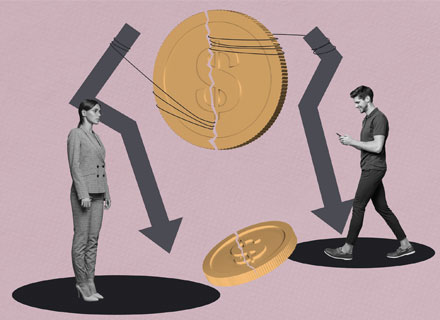

The economic narrative of late 2025 is defined by a distinct bifurcation that was first identified in the depths of the pandemic years. It was an anonymous Twitter personality known as “Ivan the K” who first articulated the theory that would come to define the post-pandemic era.
In 2020, he posed a question regarding why the economic recovery was being framed as a V or a U when the reality was far more disjointed. Ivan wrote that some would bounce back while others would not recover.
This dynamic is formally known in sociology and economics as the “Matthew Effect.” The term was coined by sociologist Robert Merton in 1968 and describes a process of cumulative advantage.
It traces its sentiment back to the biblical Book of Matthew 25:29, which states that everyone who has will be given more and will have an abundance, but from the one who does not have, even what he has will be taken away. In the economic landscape of late 2025, this ancient text reads less like a parable and more like a precise description of the divergence between capital owners and wage earners.
Mark Zandi, the chief economist for Moody’s Analytics, suggests that this structural divergence began in the 1980s during the Reagan era, when productivity growth began to outpace median wage growth. However, the data from 2025 suggests that this long-standing trend has accelerated into a profound fracture.
The upper arm of this K-shaped economy is being driven by an unprecedented concentration of consumption among the wealthy. Research conducted by Mark Zandi at Moody’s Analytics revealed that in the second quarter of 2025, the top 10% of wealthiest Americans were responsible for 49.2% of all consumer spending. This figure represents the highest level of spending concentration since record-keeping began in 1989.
The economy has become so lopsided that the richest Americans essentially account for half of all economic activity. This concentration distorts aggregate economic data. When the top 10% continue to spend lavishly on luxury goods, travel, and services, it masks the severe contraction occurring in the bottom 90%. High-income households have benefited from a wealth effect driven by soaring asset prices, including record highs in the stock market and continued appreciation in home values.
Lisa Shalett, the chief investment officer at Morgan Stanley Wealth Management, has raised alarms about this disparity. In a research note from November 3, 2025, she described the income inequality data as completely wackadoo and noted that the widening chasm between the haves and have-nots is critical to understanding the current economic cycle.
While the wealthy propel the markets to new heights, the lower arm of the K is extending downward with increasing velocity. This is visibly manifested in the earnings reports of major fast-food and fast-casual restaurant chains, which have historically served as reliable indicators of lower-income spending power.
Chains like McDonald’s and Chipotle have reported softening traffic as their core customers pull back on spending. Since 2019, the price of a chicken burrito at Chipotle has risen from $7.45 to $10.80 in 2025, while a McDonald’s Big Mac combo has jumped from $8.19 to $11.29. These price increases have forced a trade-down behaviour where consumers abandon fast-casual dining for home cooking or discount grocery options.
Dollar General reported a 4.6% increase in net sales in the third quarter of 2025, which executives attributed to share gains in consumables as financially pressured shoppers hunted for value. This shift indicates that the lower-income consumer is not merely cutting back on luxuries but is struggling to afford basic conveniences.
This performative wealth signals a desire to participate in the upper arm of the K even as financial reality confines consumers to the lower arm. Charitable organisations are working overtime, with the Portland Press Herald Toy Fund reporting a notable influx of struggling families trying to keep the Christmas spirit alive despite cutting back on their expenses.
The labour market mirrors this bifurcation. While the headline unemployment rate remained relatively low at 4.4% in November 2025, beneath the surface lies a story of two distinct job markets. Companies are retaining talent but aren’t hiring anymore, because of which the youth unemployment rate for those aged 16 to 24 reached 10.4% in September 2025.
Gen Z is struggling to find work as entry-level job openings declined 29% since 2024. A part of the reason is that AI is wiping out low-skilled jobs. Now, the American youth from poor and lower-middle-class families can’t even get their foot on the rung of the career ladder. This is an important development, as resentful young people can create significant unrest in a nation.
There is also a white-collar recession. American employers announced 71,321 job cuts in November 2025, a 24% increase from the same month in 2024. Over 153,000 job cuts were announced year-to-date in 2025 in the IT sector as firms pivot toward AI and efficiency.
The disconnect is further highlighted by the fact that despite these layoffs, the broader layoff rate remains historically low because companies are reluctant to let go of workers in a labour-constrained environment.
Policy impact of ‘Big Beautiful Bill’
The policy landscape of 2025 has played a significant role in calcifying this economic divide. The “Big Beautiful Bill” became law on Jul 4, 2025. The bill cuts taxes on overtime pay and tips, provides additional tax deductions for seniors, and introduces a new deduction for auto loan interest. However, it also makes a $3.4 trillion cut to social security for the next ten years, to make up for the lower tax revenue.
Medicaid and the Supplemental Nutrition Assistance Programme (SNAP) will take a huge hit with $1.4 trillion in slashed government funding. The government is cutting social security and lowering taxes for the rich, which is a wealth transfer mechanism from the poorest households to the richest in the country.
Trade policy has further exacerbated the strain on the lower arm of the K. The administration implemented widespread tariffs in 2025 with the stated goal of protecting American industry. However, the Yale Budget Lab estimates that these tariffs function as a regressive tax. The average annual cost of the 2025 tariffs for a household in the bottom income decile is approximately $900. While this is lower in absolute terms than the $3,900 cost for the top decile, it represents a much larger share of income. The burden on the bottom decile is 2.4% of their post-tax income compared to just 0.8% for the top decile. This policy directly erodes the purchasing power of those least able to afford it.
The administration had promised a tariff dividend check of $2,000 to offset these costs for working families. Trump fought his tariff war on the promise that he would give the American people a piece of the tariff dividend and bring jobs back to America. No such dividend arrived in 2025, and Treasury Secretary Scott Bessent clarified that it is unlikely till mid-2026 and that there is also the question of whether the Supreme Court would uphold the legality of the tariffs.
And the math doesn’t add up either. The tariffs generated approximately $120 billion so far, which is not enough to send $2,000 checks to 150 million Americans. It would cost nearly $300 billion to do so. This leaves low-income households paying the higher prices associated with tariffs without receiving the promised financial relief.
The lock-in effect
The housing market stands as perhaps the most formidable barrier between the two arms of the K-shaped economy. A phenomenon known as the lock-in effect has paralysed the market and created a distinct advantage for existing homeowners. As of late 2025, approximately 80% of mortgage holders have interest rates below 6%.
These homeowners are effectively shielded from the current market reality, where the average 30-year fixed mortgage rate hovered around 6.34% in December 2025. This disparity has created a two-tiered housing society. Existing owners are building equity and enjoying low monthly payments that were secured during the pandemic era of cheap money. Aspiring buyers, particularly Millennials and Gen Z, face a market where the income needed to afford a median-priced home has nearly doubled since 2020.
High interest rates have not only made mortgages more expensive but have also suppressed inventory. Homeowners are unwilling to sell and trade a 3% mortgage for a 6% one, which keeps the supply of homes for sale near 30-year lows.
This lack of supply keeps prices historically high despite the elevated rates. Consequently, renters find themselves trapped. The housing ladder, once the primary vehicle for middle-class wealth creation in America, has been pulled up out of reach for those not already on it.
A fracture that deepens
As 2025 draws to a close, the mechanisms driving the K-shaped economy appear to be entrenching themselves further. The Federal Reserve’s restrictive monetary policy, while necessary to fight inflation, disproportionately hurts those who rely on borrowing. The fiscal policies of the One Big Beautiful Bill Act reinforce the advantages of capital owners while fraying the safety net for the vulnerable.
The rich will continue to accumulate wealth through assets and favourable tax treatment, while the poor and the middle class will continue to navigate a landscape of high costs and limited mobility. The question remains regarding how long this divergence can sustain itself before the tension snaps the economy entirely.
With consumer spending so heavily reliant on the top 10%, any shock to asset prices could cause the upper arm of the K to falter. If the wealthy pull back, the illusion of resilience provided by the aggregate data will vanish, revealing the fragile state of the broader economy beneath. Until then, the United States remains a nation of two distinct economies operating in parallel but moving in opposite directions.
The K-shaped economy in 2025 is not a theory or a chart, but a lived reality that shapes everyday life, determining who can buy a home and who must rent, who can retire and who must keep working, and who can afford abundance while others cut back. Wealth, opportunity, and security continue to move upward, while costs, risk, and uncertainty are pushed downward, reinforced by policy choices and a stagnant housing market.
The economy seems strong mainly due to the spending of the wealthiest households. However, this strength is limited and fragile. Without better wages, improved housing access, and a more robust safety net, the divide will deepen, leading to enduring social and political tensions.