

The United Nations Economic Commission for Europe (UNECE) Inland Transport Committee (ITC), the body that coordinates road, rail, and waterway transport rules across 151 countries, has wrapped up two landmark annual sessions that together mapped a cleaner, smarter, and more connected future for inland transport worldwide.
Pledge For Innovation At The 88th Session
True to its theme, ‘Driving Innovation for the Future of Inland Transport’, the 88th session of the ITC, held from February 17 to 20, 2026, put technology and the future of transport front and centre. The headline day, February 18, brought together ministers, industry leaders, and global safety advocates for three major discussions.
The first focused on self-driving vehicles and artificial intelligence. Riccardo Mariani, a senior executive at chip and software giant NVIDIA, told delegates that as vehicles become increasingly software-driven, governments must build strong, science-based systems to oversee them. The message was unambiguous. Innovation must not outpace safety.
The second discussion was on data. As roads and railways grow more connected, the question of who controls transport data and how it is shared securely becomes critical. Delegates explored how countries can build common rules so that their systems can talk to each other without creating privacy or security risks.
The third panel looked at trade. The focus was on using technology to make cross-border movement of goods faster and simpler, with particular attention to a broader UN effort to modernise its transport frameworks for the digital age.
Running through all three discussions was a simple but important idea. Transport innovation should serve people, not just efficiency targets. The committee agreed on four guiding principles for the road ahead: keeping people safe, being transparent with their data, ensuring the benefits of new technology are widely shared, and making sure no one is left behind.
One of the session’s more visible moments came during a technical demonstration of Vehicle-to-Everything, or V2X, communication. This is a technology that allows vehicles to exchange real-time information with traffic lights, road infrastructure, and other vehicles, potentially cutting accidents and reducing congestion. The demonstration gave delegates a hands-on look at where road safety technology is heading.
The session also marked a milestone, the 70th anniversary of the CMR Convention, an international agreement that governs the legal rules for transporting goods by road across borders. Signed in 1956, the convention remains a cornerstone of international trade, and its anniversary was an occasion to reaffirm its relevance as the industry goes digital.
On the governance side, the United Kingdom was elected as the new Chair of the ITC, taking the helm as the committee navigates an increasingly complex policy landscape. The session closed with the adoption of a formal list of decisions aimed at making ITC activities more focused and exploring new ways to fund the shift to digital transport systems.
The 87th Session And The Groundwork It Laid
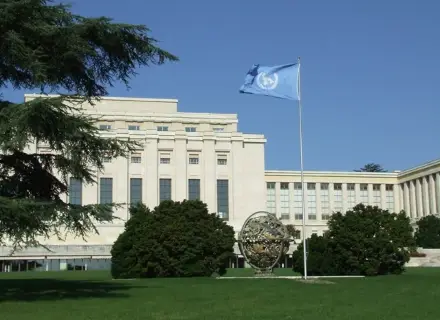
The 88th session did not emerge from a vacuum. Much of its ambition was seeded at the 87th annual session, held at the Palais des Nations in Geneva, where policymakers, technical experts, and working group chairs gathered to chart the committee’s long-term direction.
That meeting built on a major commitment from the previous year, where the ITC adopted its Strategy on Reducing Greenhouse Gas Emissions from Inland Transport, setting out specific goals and milestones for the sector. Delegates dug into how existing international legal frameworks could remove barriers to digitalisation and help standardise new technologies, including automation and data-sharing between transport networks.
Much of the conversation was designed to lay the groundwork for the UN Decade of Sustainable Transport, a global initiative running from 2026 to 2035 that recognises transport as a critical driver of sustainable development.
Road safety was a recurring concern. Delegates called for stronger national road safety systems built around ITC recommendations.
On clean energy, discussions focused on two promising solutions, retrofitting older vehicles to run on electricity and adopting hydrogen fuel cells as a replacement for petrol and diesel engines in commercial transport.
The urgency behind this work is clear. Transport is responsible for nearly a quarter of all energy-related carbon emissions worldwide. The ITC’s strategy aims to reverse that trend by 2030, in line with outcomes from COP29, the most recent UN climate summit.
A small but telling example of the ITC’s reach came on April 1, 2025, when Iraq activated the TIR system. TIR is an international customs transit arrangement that speeds up cross-border movement of goods by reducing paperwork and inspections, making trade faster and more secure.
UNECE Executive Secretary Tatiana Molcean highlighted the ITC’s 75-year legacy of harmonising transport regulations and described it as the UN’s dedicated platform for inland transport policy. Participants also praised a special symposium focused on the UN Decade, which reviewed the ITC’s existing achievements, including its greenhouse gas strategy and road safety work, and used them as a springboard for future planning.
Building A Resilient Future
Taken together, the two sessions trace a clear arc, from strategy to action, and from ambition to implementation. Whether through decarbonisation targets, digital governance frameworks, or people-centred innovation principles, the ITC is steadily positioning inland transport, the movement of people and goods over land and waterways, as a cornerstone of global resilience against both climate disruption and economic shocks.
Image Credits: UNECE