
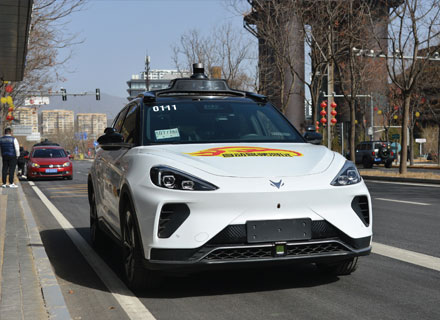

By 2025, the trillion-dollar race to replace the human driver moved from the laboratory to the curbside. But as fleets swarmed cities from San Francisco to Shanghai, the industry found itself split between those who bet on safety and those who bet on scale.
If you stood on the corner of 4th and King in San Francisco Street Station late in 2025, you would have witnessed a quiet revolution. It wasn’t marked by flying cars or neon-soaked cyberpunk aesthetics, but by something far more mundane: a white Jaguar I-PACE pulling up to the curb, hazard lights blinking, with absolutely no one in the front seat. A mother, holding a newborn, steps out. She doesn’t thank a driver. She taps her phone, and the car silently merges back into the chaotic flow of traffic.
For a decade, the promise of Level Four autonomy (vehicles that can drive themselves in specific conditions without human intervention) was just that, a promise. It was perpetually “five years away.” But 2025 was the year the timeline collapsed. It was the year the “gamble” began to pay out for some, while others realised they were holding a losing hand.
Method vs mania
Nowhere was the divergence in strategy more palpable than in the United States, where the market split into two distinct realities. There was the methodical conquest of Waymo and the chaotic ambition of Tesla.
By the close of 2025, Waymo, the Alphabet-backed juggernaut, had effectively won the first round of the American autonomy wars. They were running a utility, not a test. With over 14 million paid trips logged in 2025 alone, Waymo had moved beyond the “science project” phase to become a genuine alternative to Uber and Lyft in cities like Phoenix, San Francisco, Los Angeles, and Austin.
The company, formerly known as the “Google Self-Driving Car Project,” stuck to its expensive, sensor-heavy approach, utilising LiDAR (Light Detection and Ranging), radar, and cameras to create a redundancy that allowed its “Driver” to see through fog, glare, and darkness.
Critics had long argued that this hardware stack was too expensive to scale. They were wrong. As the market matured, the cost of solid-state LiDAR plummeted from $75,000 a decade ago to under $500 per unit in 2025, allowing Waymo to wrap its cars in a digital safety blanket without breaking the bank.
The result? A valuation soaring to $126 billion following a massive $16 billion funding round. Investors like Andreessen Horowitz and Sequoia Capital bought tech, and also the only thing that matters in this industry: trust.
Contrast this with the turbulent reality in Austin, Texas, where Tesla finally launched its long-awaited “Cybercab” service.
Elon Musk had bet the house on a different philosophy, “Pure Vision.” The argument was seductive in its simplicity. Humans drive with eyes (cameras) and a brain (neural nets), so why does a car need lasers?
However, the gamble faced a harsh reality check on the streets of Texas. Without the precise depth perception of LiDAR, Tesla’s vision-only system struggled.
Data released by the National Highway Traffic Safety Administration (NHTSA) revealed a troubling statistic: Tesla’s robotaxi fleet in Austin was crashing approximately once every 55,000 miles. To put that in perspective, human drivers typically go nearly 500,000 miles between police-reported accidents.
While Waymo was scaling into Atlanta and Miami with a “boring” reliability, Tesla was fighting a PR war, forced to keep human safety monitors in their vehicles long after competitors had removed them. The market reacted brutally, with Tesla posting its first-ever annual revenue decline as the “robotaxi premium” in its stock price began to evaporate.
The Chinese industrial machine
While the US wrestled with these philosophical debates, China simply built the future. If the US approach was defined by corporate competition, the Chinese approach was defined by industrial inevitability.
In Wuhan, a sprawling metropolis of 11 million people, Baidu’s “Apollo Go” achieved the holy grail of the robotaxi industry in late 2025. They have grasped unit-level profitability. This was a demonstration of scale. With a fleet of over 1,000 remotely monitored vehicles in a single city, Baidu drove down operating costs until they dipped below the daily wage of a human driver.
The Chinese strategy relied on a “heavy” infrastructure model. Unlike US robotaxis, which are designed to be independent geniuses figuring out the road on their own, Chinese robotaxis communicate with the city itself. Smart traffic lights and roadside sensors beam data directly to the cars, letting them “see” around corners before they even arrive.
The ecosystem birthed a fierce competitive landscape. Pony.ai achieved a “clean sweep” of regulatory permits in China’s Tier-1 cities (Beijing, Shanghai, Guangzhou, Shenzhen), cementing its status as a heavyweight. Meanwhile, DiDi Autonomous Driving (the spin-off of the ride-hailing giant) began the massive task of cannibalising its own mothership. By integrating robotaxis into the main DiDi app in Guangzhou and running 24/7 service, they signalled to the world that the gig economy era of human drivers was drawing to a close.
For the Chinese players, the “gamble” was less about technology and more about export. Could they take this model global? The answer, it turned out, lay in the desert.
The deregulation sandbox
In 2025, the geopolitical centre of gravity for autonomous mobility shifted unexpectedly to the Gulf. The United Arab Emirates (UAE) and Saudi Arabia, hungry to diversify their economies, essentially hung an “Open for Business” sign on their highways.
Abu Dhabi granted WeRide the world’s first city-level fully driverless permit outside the United States and China. This was a commercial license to print money.
WeRide, along with Pony.ai, flooded the region with Chinese tech, finding a receptive market that US companies (hamstrung by export controls and data privacy concerns) struggled to penetrate.
In Riyadh, Uber partnered with WeRide to launch the Kingdom’s first robotaxi service. It was a strange-bedfellows situation: an American ride-hailing app dispatching Chinese autonomous vehicles on Saudi roads.
This highlighted a growing trend. There was a decoupling of the “app layer” from the “fleet layer.” Uber, realising it couldn’t win the hardware race, decided to become the universal interface for everyone else’s robots.
Awakening of the sleeping giant
For years, Europe had been the Old World in every sense, with conservative regulations and a scepticism of AI keeping robotaxis off the streets of Paris and Berlin. But 2025 was the year the giant woke up.
Facing the threat of irrelevant automotive industries, European regulators began to fast-track approval processes. The result was a flurry of announcements for 2026. Uber announced partnerships to bring Wayve’s self-driving technology to London, while Mobileye and Volkswagen are preparing to launch commercial services in Munich.
But perhaps the most interesting European story was Verne. Founded by EV visionary Mate Rimac, Verne unveiled a purpose-built robotaxi set to launch in Zagreb. Unlike the utilitarian “toasters” of Zoox or the retrofitted SUVs of Waymo, Verne promised a premium, design-forward experience, a reminder that in Europe, style still counts for something. Underpinning this global explosion was a quiet victory for hardware. The debate over whether to use LiDAR is largely over, and LiDAR won.
In 2025, the “Vision-Language-Action” (VLA) model began to take hold. Powered by chips like NVIDIA’s “DRIVE Thor,” which packs 2,000 teraflops of compute, robotaxis began to understand the world, not just measure it.
Old systems could tell you, “There is an obstacle at X coordinates.” The new VLA systems, utilising the same transformer architecture as ChatGPT, could understand, “that is a police officer gesturing for me to stop because of a parade.” Such semantic understanding was the missing link for operating in chaotic urban environments.
Moreover, the hardware became cheap. The solid-state LiDAR units that cost as much as a luxury car in 2015 were now being stamped out like smartphones. This deflationary pressure meant that companies like WeRide and Pony.ai could deploy redundant, hyper-safe sensor suites for a fraction of the cost of a human driver’s annual salary.
The friction of progress
However, the “Great Robotaxi Gamble” was not without its losers. As the technology scaled, the social friction became visceral.
In San Francisco, the “Cone Army,” protesters who disabled robotaxis by placing traffic cones on their hoods, evolved into more aggressive resistance. People slashed tyres and spray-painted sensors.
The demonstration was an incoherent scream against automation. For the ride-share driver in a Prius, seeing a robotaxi glide past represented an existential threat. In 2025, we saw the first real dip in peak-hour earnings for human drivers in saturated markets like Phoenix.
The robotaxis were taking the easy, profitable short trips, leaving humans to deal with the complex, low-margin edge cases.
Safety, too, remained a paradox. Waymo could legitimately claim a 10x reduction in injury-causing crashes compared to humans. Yet the public holds machines to a standard of perfection, not comparison. When a Waymo vehicle in Austin failed to yield to a stopped school bus repeatedly, it triggered a federal investigation and a media firestorm.
The AI understood the bus as a vehicle but failed to understand the social contract of the flashing red lights. It was a stark reminder that driving is as much a sociological activity as a physical one.
Pragmatism takes over
As we look toward 2026, the chips are stacking up on the side of the pragmatists. Waymo and the Chinese cohort (Baidu, WeRide, Pony.ai) have proven that the technology works if you are willing to pay for the hardware and do the grind of mapping and testing. They are building a utility: boring, reliable, and increasingly profitable.
Tesla, meanwhile, remains the wild card. Their gamble on “vision-only” and “end-to-end AI” offers a theoretical ceiling that is infinitely higher, a car that can drive anywhere, anytime, without maps, but a floor that is currently much lower. In 2025, the market showed us that in the transport business, boring wins.
The trillion-dollar race is no longer about who can build the car but who can build the business. The technology is here. The sensors are cheap. The capital is flowing. The only thing left to remove is the driver. And judging by the empty seats rolling down the streets of our cities this year, that train, or rather, that taxi, has already left the station.
The steering wheel didn’t disappear with a bang, but with a software update. And for the millions of people who will hail a robotaxi in 2026, the gamble has already paid off. They just want to get home.