
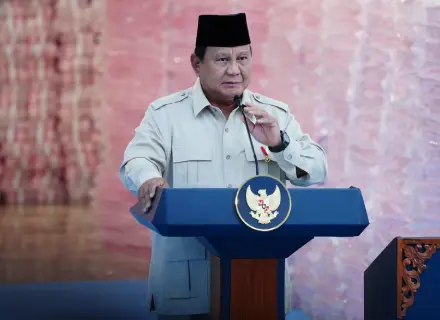

Indonesian President Prabowo Subianto has announced his government’s latest move: conducting exports of palm oil, coal, and ferroalloys through a state agency, as the Southeast Asian country seeks to tighten its control over its natural resources, apart from boosting state revenue.
“The government of the Republic of Indonesia that I lead will issue a regulation on the governance of natural resource commodity exports. This is a strategic step to strengthen the governance of our natural resource commodity exports,” he said, while delivering a parliamentary speech that was broadcast live on the Presidential Secretariat’s YouTube channel.
“The policy aims to strengthen oversight and monitoring, while combating under-invoicing, transfer pricing, and the flight of export earnings overseas. Export under-invoicing over the 1991-2024 period reached USD 908 billion,” Subianto stated further.
As per the reports, while the full force of the new policy will come into effect after a transition period of three months, the timeline will likely be extended till the end of 2026. During the transition period, commodity exporters and buyers will be allowed to carry on their usual business, but the transactions will be overseen by state firm PT Danantara Sumber Daya, a unit of sovereign wealth fund Danantara Indonesia.
Former director of nickel miner Vale Indonesia, Luke Thomas Mahony, will be the chief executive of Danantara Sumber Daya. As per the Jakarta Globe, once the transition period gets over, Danantara Sumber Daya will buy products from domestic sellers and then sell them to foreign buyers at a price benchmarked against prices set by exchanges.
“The new regulation will be implemented in stages wherein the first stage will cover exports of palm oil, coal, and ferroalloys. Every three months, there will be a review to add more commodities,” Jakarta Globe reported further.
Under the old industry practices, Indonesian companies used to export coal and palm oil directly to foreign buyers. However, the government controlled how much quantity could be produced and the benchmark price to use.
Justifying the regulatory reform, the Subianto administration has said that it wants to improve the transparency aspect of Indonesia’s commodities sector by putting a stop to under-invoicing practices, optimise the government’s earnings, and help stabilise the rupiah and enlarge foreign currency reserves.
Talking about Indonesia’s commodities trade, the archipelagic state is the world’s largest exporter of thermal coal and palm oil. It has consolidated its position as the top thermal coal supplier to many of the world’s largest importers, including China, India, Vietnam, and the Philippines.
Apart from the latest rule, Indonesia has also issued a new export earnings regulation that requires exporters of natural resources to store 100% of their earnings in state banks. The regulation will take effect in June 2026.