
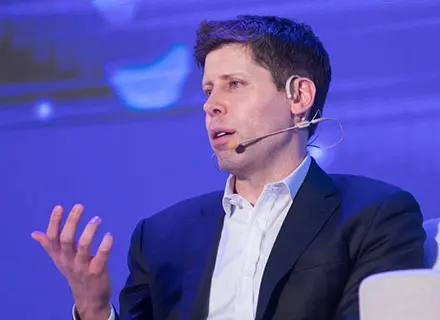

Citing safety concerns over artificial intelligence, OpenAI CEO Sam Altman has ruled out an IPO for the company in 2026. Altman believes even a 10% risk of AI causing human extinction by the end of the decade would be “unacceptable.”
“I actually think that, given everything happening with safety, right now would be an ill-advised moment to go public, and we don’t feel pressure on that,” Altman told business magazine Fortune on Saturday (September 11).
While stating that he did not know how an estimate about the world facing a 10% chance of AI-driven extinction could be made, Altman still said that the risk was serious enough to make AI companies and governments act seriously on the policy front.
“Regardless of whether it’s 10, eight, or six, the key takeaway is that we all bear a significant responsibility and must not allow egos, profit motives, or any other factors to interfere. We must act to avoid those risks, and I think we can,” the OpenAI boss said.
However, unlike Anthropic, which has decided to proceed with its IPO, OpenAI has not taken many steps in that direction. In June, the New York Times (NYT) reported that the San Francisco-based venture was considering whether to hold off the market listing until 2027 on a potentially trillion-dollar IPO.
Altman told Fortune, “I would say we are not aiming for 2026. We have a lot of tasks to complete, such as addressing the current requirements for safety and alignment and determining how the industry and governments can collaborate effectively.”
He also suggested that OpenAI and other leading AI firms were closing in on unveiling a pact to slow AI development and work together to tackle safety risks.
Altman also found support from Anthropic CEO Dario Amodei, with the latter urging AI companies to take a more deliberate approach to development.
“We must slow the pace at which we improve the capabilities of AI models,” Amodei wrote in an essay on X (formerly Twitter).
Agreeing with his rival CEO, Altman wrote on the popular micro-blogging platform, “I agree with Dario that we need to pace the frontier. This has been a primary topic of discussions we’ve had at OpenAI in recent weeks.”
Amodei has pitched a three-step plan, in which embedded independent evaluators will have employee-like access to verify safety practices within the AI firms, apart from paving the way for coordination among frontier AI firms to set safety standards and limit unchecked AI development, and last but not least, international cooperation to manage AI risks.
Both XAI boss Elon Musk and Altman agreed with Amodei.
“Committing to having independent evaluators with employee-like access is a great idea, and we will do the same,” Altman said, adding that more information on the roadmap would be shared soon.
Amodei made his essay public after his company released a threat intelligence report on September 10, detailing how several actors had used its Claude AI models for activities ranging from weapons development and cyber operations to surveillance and fraud.
Amodei also talked in detail about how AI’s growing ability to improve itself could become a threat for mankind, backing the long-held concerns about the technology surpassing the human ability to control the cutting-edge element.
He cited the recent incident involving OpenAI and Hugging Face as his main reason for halting model advancements.
Anthropic researcher Jacob Coxon resigned last week, stating that the “people building AI earnestly believe that it could kill us all by the end of the decade.”
On the other hand, various OpenAI executives have suggested that leading labs should be willing to coordinate a voluntary slowdown to build confidence in their safety measures.
Anthropic, in this backdrop, has positioned itself as the more safety-conscious frontier lab. Last week, it disclosed another instance of an AI model hacking external systems, after a July incident in which some of its Claude models had hacked into the systems of three companies during cybersecurity tests.
“Given the accelerating rate of AI capability development, it’s my worry that in 6-12 months such a swarm could be capable of taking over the entire internet, potentially causing hundreds of billions of dollars in damage,” Amodei wrote.
While Amodei didn’t call for halting model training or technical progress, he asked the frontier AI labs to ensure that companies take adequate time to align and safeguard their models. Third-party evaluators should play an equally important role in confirming and validating these steps.
“A coordinated approach would enable leading US AI companies to carry out necessary safety research and safeguards without putting themselves at a competitive disadvantage. Such an approach likely would require targeted antitrust exemptions in the United States to permit collaboration in certain areas,” the Anthropic boss’ roadmap stated.
“Any slowdown by democratically governed countries should be limited to preserving the lead US AI firms hold over China,” Amodei observed, arguing that a Chinese advantage in the cutting-edge technology would pose US national security risks.
“Pacing within democracies will be limited by the lead that U.S. companies have over authoritarian regimes, chiefly the Chinese Communist Party,” Amodei wrote.
He also called for tighter controls on advanced AI chips, model distillation, and theft of model weights to prevent China from narrowing the gap.
“I believe all frontier labs should partner with the government to formalize the idea of permanent embedded evaluators to better prevent and document internal alignment incidents like those that have occurred in the last few months and to implement regulation focused on keeping capabilities in balance with safety,” Amodei concluded.