
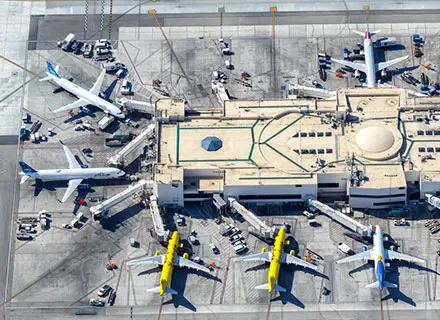

For a little over four hours on Friday November 13, the busiest airspace in the world fell quiet.
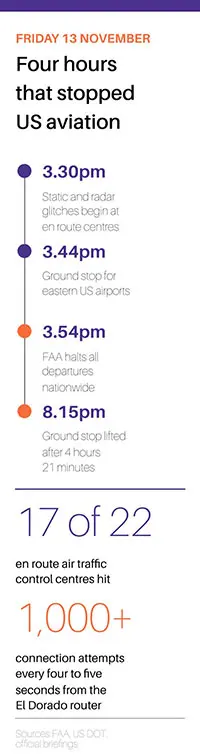
At 3.54 pm Eastern Time, the US Federal Aviation Administration (FAA) ordered every departing flight in the country to stay on the ground after communications and radar feeds at 17 of its 22 en route air traffic control centres began to falter.
Aircraft already in the air, more than 3,000 of them, were guided down safely. Everything else waited.
The order was lifted at 8.15 pm, but the damage was done.
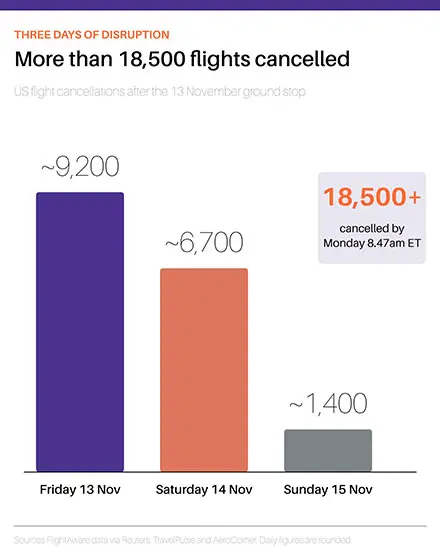
More than 18,000 flights into, out of or within the US had been cancelled by Monday morning, according to FlightAware data.
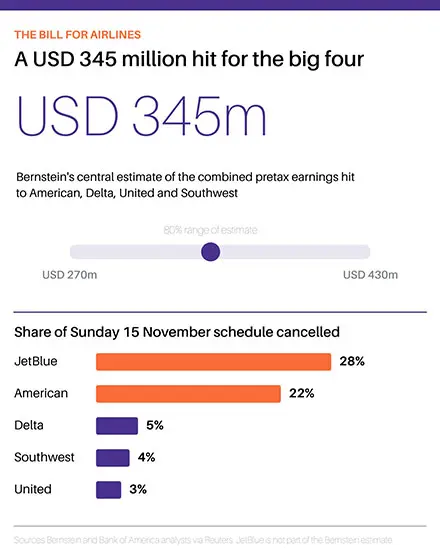
Brokerage Bernstein estimates that the four largest US carriers, American Airlines, Delta Air Lines, United Airlines and Southwest Airlines, face a combined pretax earnings hit of about USD 345 million.
The cause, officials say, was not a cyberattack. It was a single router at a remote radio site in Arkansas.
 What happened on Friday afternoon
Trouble began at around 3.30pm, when controllers started hearing static on voice lines and watching radar displays flicker or go blank.
Early reports describe a cascade that began at the Chicago centre before spreading to Boston, Washington, New York and Minneapolis. A ground stop for flights bound for eastern US airports followed at 3.44 pm.
Ten minutes later, unable to pin down a root cause, the FAA halted departures nationwide, citing “extraordinary circumstances and reasons for safety”.
It was only the third nationwide ground stop in US history, after the attacks of September 11, 2001, and the failure of the Notice to Air Missions (NOTAM) system in January 2023.
It was also the longest since 9/11.
Homeland Security Secretary Markwayne Mullin later said no one had been in danger.
Transportation Secretary Sean Duffy defended the call, saying the FAA isolated the problem, shut it down and brought the network back online before reopening the skies.
Airlines then spent the weekend repositioning aircraft and crews stranded in the wrong places.
Why a router in Arkansas grounded a nation
Duffy has since traced the trouble to an FAA radio communications facility in El Dorado, a small city in southern Arkansas.
There, defence contractor L3Harris Technologies, which owns and runs the FAA’s telecommunications network, was carrying out what he called routine maintenance.
Engineers were moving the site from old copper lines to fibre and installing a new router made by Juniper Networks, which is now part of Hewlett Packard Enterprise (HPE).
Once the router came online, it began flooding the network with traffic.
The Department of Transportation says it made more than 1,000 connection attempts every four to five seconds.
Out-of-sync data rippled across the system, and a second Juniper router at a radar site in Amarillo, Texas, which L3Harris had swapped in about three weeks earlier, also started to flood the network.
The FAA says L3Harris blocked both sites once the data inconsistencies appeared and switched off the broadcasting function on all the new routers as a precaution.
Why the installation went wrong is still unknown.
Duffy says investigators are trying to establish whether the fault lay with the installer or with the hardware itself. HPE has said that, based on what it knows, the Juniper device was working as configured.
L3Harris says it is supporting the investigation.
Both routers have been taken to an L3Harris facility in Florida for deep diagnostic testing, with engineers from the FAA, Juniper and Cisco assisting.
The FBI is also assisting, although officials have found no sign of an attack.
On Tuesday, the FAA confirmed it had paused installation of the Juniper routers.
The move followed a letter from all 13 Democratic members of the Senate Commerce Committee, led by ranking member Maria Cantwell, asking for an immediate halt until further testing shows the devices can be deployed safely.
The senators point out that the FAA Technical Center tested only a sample of the routers before installation, and they question whether those tests reflected real operating conditions.
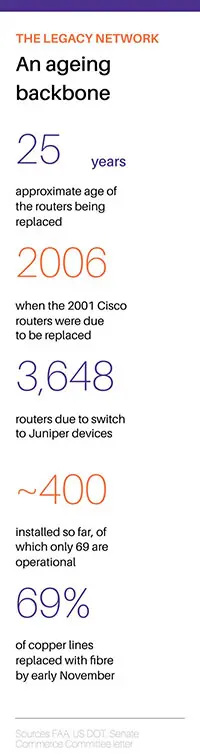
Of 3,648 routers due to be converted to Juniper devices, about 400 have been installed and just 69 are operational.
The senators want answers by November 23 and a joint technical briefing with the FAA, L3Harris and Juniper before the rollout resumes.
 A network that should have retired in 2006
The episode has thrown an unforgiving light on the FAA Telecommunications Infrastructure, known as FTI, the private network that carries voice, radar and data links between roughly 5,000 FAA facilities.
Harris Corporation, which later merged into L3Harris, won the contract to build it in 2002 in a deal worth about USD 3.5 billion. Because L3Harris owns it, the FAA cannot simply walk away.
The new Juniper routers were replacing Cisco units built in 2001, which the FAA says should have been retired in 2006. Duffy puts the age of the outgoing routers at about 25 years.
The Government Accountability Office (GAO), Congress’s watchdog, says the backbone still relies on copper cabling dating back to the 1960s, and a 2024 GAO review rated 51 of the FAA’s 138 air traffic systems unsustainable, with another 54 potentially so.
The copper-to-fibre programme is meant to fix this.
L3Harris says more than 70% of the conversion is done, and the FAA says 69% of its copper had been replaced by early November. The completion date has been pulled forward by 21 months to December 2028.
That still leaves two more years in which old and new equipment must run side by side, with every cutover connecting a fresh device to a neighbour that may be a quarter of a century old. Auditors flagged that risk over 15 years ago.
The bill for airlines
Bernstein’s USD 345 million estimate sits within a range of roughly USD 270 million to USD 430 million.
The brokerage has not broken the figure down by airline, but the pain was not shared evenly.
 FlightAware counted about 9,200 cancellations on Friday, around 6,700 on Saturday and some 1,400 more on Sunday.
Bank of America analysts found that American cancelled 22% of its Sunday schedule, against 5% at Delta, 4% at Southwest and 3% at United.
The recovery was then marred by a fresh glitch. On Monday afternoon, United suffered a separate, systemwide technology outage that hit departing mainline flights, leaving 418 flights delayed by late afternoon before the airline said the problem had been fixed. Nothing linked it to the FAA failure, but it showed how little slack remained.
L3Harris shares fell 3.3% on Monday and HPE dropped 4.5%. Duffy told CNBC the wider economic losses probably ran into billions of dollars, and used the moment to press Congress for money.
 Lawmakers approved USD 12.5 billion for air traffic control upgrades last year, and the administration wants about USD 30 billion more to finish the job.
Democratic senators, for their part, want a full account of how the USD 50 billion now being sought would close the gaps exposed on Friday.
AAA expects 81.5 million Americans to travel between November 24 and 30, with 5.96 million flying domestically on tickets that average USD 800 for a return trip, 17% more than last year.
Officials insist operations will be back to normal well before then, but a repeat during peak week would multiply the cost many times over.
How this compares with past FAA failures
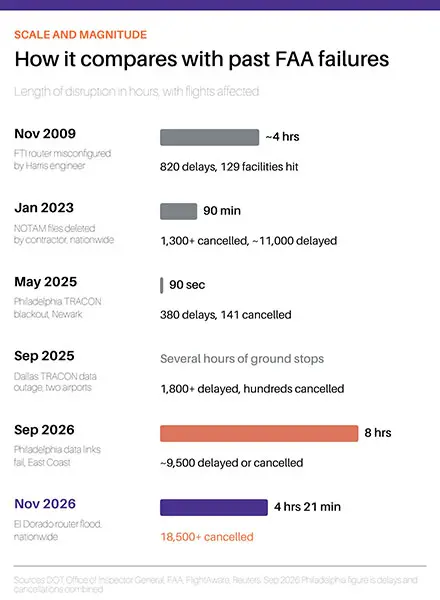
The FAA has been here before, though never on this scale. In November 2009, a router misconfigured by a Harris engineer on the same FTI network blocked about 75% of its routes and cut service to 129 facilities for around four hours. That outage hit flight plan data rather than controller radio and radar, and caused some 820 delays.
 In January 2023, contractors accidentally deleted files in the NOTAM system, which issues safety notices to pilots.
The resulting nationwide ground stop lasted about 90 minutes and led to more than 1,300 cancellations and roughly 11,000 delays. At the time, it was the first nationwide halt since 9/11.
In September 2025, a data outage at the Dallas approach control centre triggered ground stops at both Dallas airports and more than 1,800 delays, with the FAA blaming L3Harris for weak redundancy and L3Harris blaming years of underinvestment.
Then, in September 2026, primary and backup data links failed at Philadelphia, halting East Coast traffic for eight hours and disrupting about 9,500 flights as world leaders arrived for the UN General Assembly.
Set against these, the November 13 event stands apart. It lasted nearly three times as long as the 2023 stop and produced roughly 14 times as many cancellations, and unlike the failures at Newark, Dallas and Philadelphia, it reached every airport in the country.
Only the days-long closure of US airspace after 9/11 was bigger.
What comes next
The uncomfortable irony is that the very upgrade meant to cure the FAA’s fragility appears to have caused its worst failure in a generation.
With about 3,250 routers still to be installed and two years of mixed old and new equipment ahead, the real test is whether the FAA, L3Harris and their suppliers can prove the rollout is safe before it resumes.
Until then, every cutover is a risk, and airlines and passengers will be the ones paying for it.