
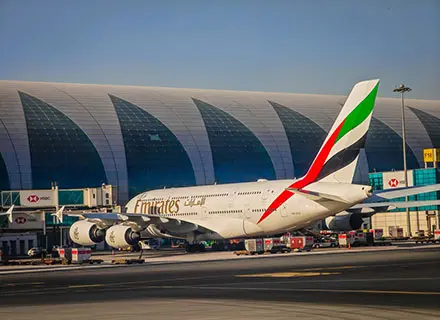

Emirates Airlines reported a 66% fall in first-half net profit to USD 903 million as the conflict in the Gulf disrupted flights, reduced passenger traffic, and sent fuel costs sharply higher, despite resilient demand for premium travel and a strong contribution from its cargo business.
The Dubai-based carrier’s profit after tax was Dh3.3 billion for the six months to September 30, compared with Dh9.6 billion in the same period a year earlier. Revenue fell 13% to Dh56.9 billion (USD 15.5 billion), from Dh65.6 billion, as the airline operated a reduced schedule amid intermittent airspace restrictions and closures.
The results cover the first half of Emirates’ 2026-27 financial year and represent the first full six-month reporting period since military activity across the Gulf disrupted commercial aviation in late February.
Airlines have had to reroute aircraft, cancel services, and adjust schedules, while government travel advisories affected passengers’ choices and travel flows.
Emirates carried 21.8 million passengers between April and September, 22% fewer than a year earlier. Available seat kilometers, a measure of passenger capacity, declined 17%, while revenue passenger kilometers fell 25%. The average passenger seat factor—the proportion of available seats filled—dropped to 72% from 79.5%.
By September 30, the airline had restored operations across 91% of its pre-disruption network, serving 150 airports in 78 countries and territories through its Dubai hub.
Fuel was the biggest pressure on profitability. Emirates said fuel costs before hedging rose 60% from the previous half-year, even though the airline used 12% less fuel because it operated fewer flights. Fuel accounted for 34% of operating expenses.
The airline’s strategy for managing fuel-price risks generated gains of Dh7.1 billion, substantially cushioning the increase. After those gains, the net rise in fuel costs was 13%. Overall operating expenses, including fuel, fell 2%, broadly reflecting the lower level of operations.
Cargo provided an important counterweight to the weakness in passenger traffic. Emirates SkyCargo transported 1.2 million tonnes during the half, a 1% decline year-on-year, but cargo revenue increased by 52%. The airline attributed the rise to reduced airfreight capacity in the region and shippers seeking air transport as maritime routes faced disruption.
Emirates’ profit before tax was Dh3.7 billion, compared with Dh11.4 billion in the corresponding period last year.
The wider Emirates Group, which includes dnata, reported a profit after tax of Dh3.6 billion (USD 1 billion), also down 66%. Group revenue declined 12% to Dh66.2 billion. Dnata’s profit after tax fell 56% to Dh309 million, while revenue slipped 7% to Dh11 billion, reflecting lower volumes in some of its UAE and UK businesses.
The group ended September with cash reserves of Dh54.1 billion, compared with Dh59.6 billion at the end of March. The reduction partly reflected aircraft pre-delivery payments and debt obligations. The group also paid the remaining Dh2 billion of a Dh3.5 billion dividend declared for the 2025-26 financial year to its owner, the Investment Corporation of Dubai.
Despite the pressure on earnings, Emirates continued to invest in its fleet and customer proposition. It took delivery of nine new Airbus A350 aircraft and completed cabin refurbishments on 12 aircraft—nine A380s and three Boeing 777s—during the six months.
Sheikh Ahmed bin Saeed Al Maktoum, chairman and chief executive of Emirates Airlines and Group, stated, “Our business model and our people have once again proven their resilience during these challenging six months.”
He said customer demand had held firm and cargo had made a strong contribution, even as global jet fuel prices doubled compared with the same period last year, affecting costs and profitability.
Sheikh Ahmed credited the UAE government’s response and coordination with enabling air transport to resume safely after military activity across the Gulf. The easing of travel advisories had helped the airline restore operations, he said.
The group entered the second half of its financial year with “measured optimism” while monitoring fuel prices and geopolitical developments. Its strong cash position and established operating base would help it navigate continued volatility, Sheikh Ahmed said.