
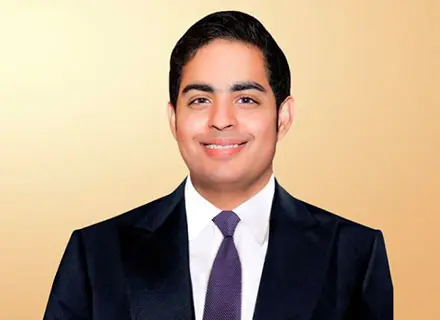

Akash Ambani, who turned 35 on the final day of bidding, walked investors through a business serving 533 million customers and through the profit margins that have made it the crown jewel of Reliance Industries. His twin sister Isha shared the stage.
Their father, Asia’s richest man, stayed away.
Behind Akash, a garlanded portrait of his grandfather Dhirubhai Ambani rested on an easel, while the screen showed black and white photographs of the shareholder meetings that built Reliance’s retail investor base in the 1980s. Three generations, one stage, and a son presented to the market as the face of the family’s most valuable new asset.
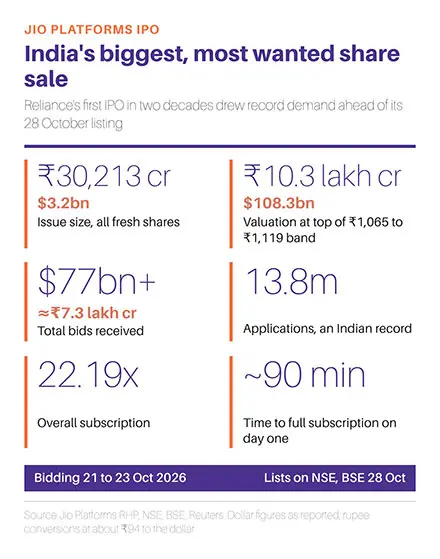
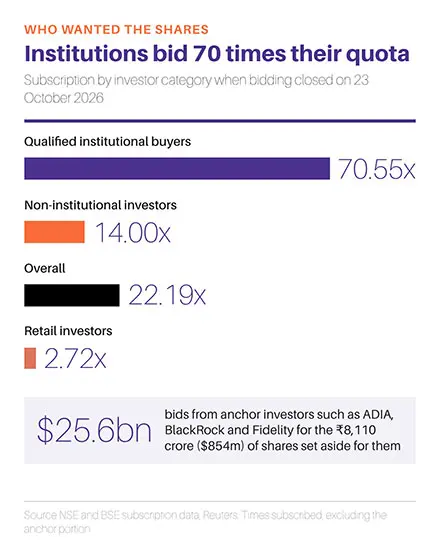
The market responded. The ₹30,213 crore (USD 3.2 billion) issue was fully subscribed within roughly 90 minutes of opening on October 21, a rare feat for an Indian offering of that size.
By the time bidding closed two days later, it had been subscribed 22 times over and had drawn more than USD 77 billion (about ₹7.3 lakh crore) in bids and 13.8 million applications, the most for any Indian IPO.
That overtook the 2008 record held by Reliance Power, part of his uncle Anil Ambani’s group. At the top of its ₹1,065 to ₹1,119 price band, the offer values Jio at up to ₹10.3 lakh crore (USD 108.3 billion). Shares are due to start trading on October 28.
The question now facing investors, rivals and Reliance watchers is whether the listing marks the moment Akash takes charge of most of Jio’s leadership, or simply the moment he becomes its most visible spokesman.
What the prospectus actually says
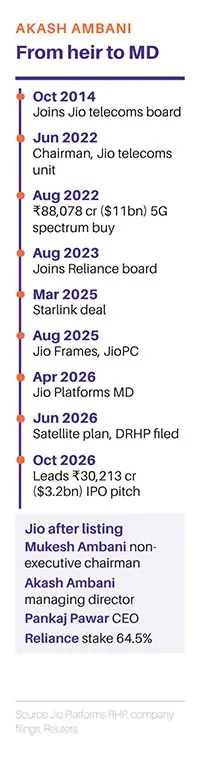
The governance structure set out in Jio’s offer documents gives a measured answer. Akash was appointed managing director of Jio Platforms on 9 April 2026 for a five-year term, with the board’s unanimous approval. He became the first of the three Ambani siblings to hold a managing director title in the group.
 A managing director of an Indian listed company carries statutory executive responsibility, and Akash will be the senior family executive answerable to public shareholders, analysts and the regulator.
Pawar also remains managing director of Reliance Jio Infocomm, the telecoms operating company. Isha and Anant Ambani sit on the ten-member board as non-executive directors, alongside five independent directors.
Reliance Industries will still own about 64.5% of Jio after the issue, down from 66.4%.
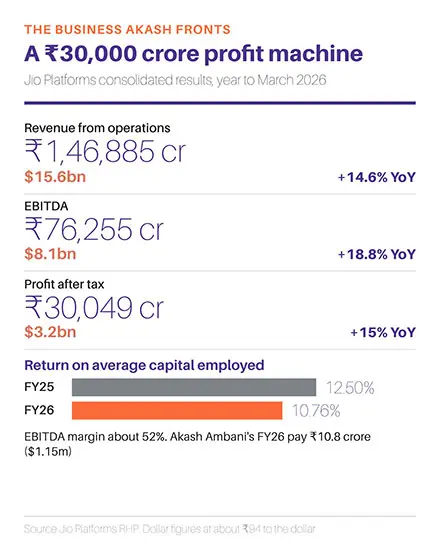
The pay disclosures make the same point. Akash drew ₹10.8 crore (about $1.15 million) for the financial year ended March 2026, modest by the standards of a business that earned ₹30,049 crore (USD 3.2 billion) in profit over the same period.
An executive who worked on the offering told reporters that Akash weighs in on the bigger decisions but stays out of day-to-day management, and that he handles relationships with marquee investors such as Meta, which owns nearly 10% of Jio.
Another industry executive said Akash and his father, both night owls, manage investor relationships separately.
Read together, that sketches a division of labour rather than a transfer of command. Akash owns strategy, technology and the shop window.
Pawar owns operations. Mukesh owns the chair, the controlling shareholder and, for now, the final word.
Four years of preparation
None of this came out of nowhere. Akash joined the board of Reliance Jio Infocomm in October 2014 and was elevated to chairman of the telecoms unit in June 2022, when his father resigned as a director there and Pawar was named its managing director.
Reliance officials credited Akash with personally leading Jio’s digital acquisitions and said he had been closely involved in the 2020 fundraising that brought in ₹1,52,056 crore (USD 20.5 billion) from Meta, Google and other investors.
The move was widely read as the first formal piece of the succession plan, and his first big test followed within weeks.
In the August 2022 spectrum auction, Jio bought 24,740 MHz of airwaves for ₹88,078 crore (about USD 11 billion at the time), nearly half of everything sold, and was the only bidder to win 700 MHz spectrum in all 22 circles.
At that month’s annual meeting Akash introduced JioAirFiber, a plug-and-play device offering gigabit home broadband over 5G. Jio switched on 5G in October 2022 and, using a 5G stack built in-house, covered more than 96% of census towns by mid 2023 and the whole country by the end of that year.
The next push was to reach new customers. In July 2023 Jio launched JioBharat, a 4G phone priced close to a 2G handset and aimed at the hundreds of millions of Indians still on basic phones.
At the August annual meeting Akash presented the commercial version of JioAirFiber, which went on sale on September 19, along with Jio Smart Home services and the Jio True5G Developer Platform for businesses and app makers.
By January 2024 AirFiber had reached more than 4,000 cities and towns, and JioBharat held more than 45% of India’s sub-₹1,000 handset market.
Formal recognition came at that same August 2023 meeting, when Akash, Isha and Anant joined the Reliance Industries board as non-executive directors and their mother Nita stepped down.
Mukesh Ambani said he would mentor the three so they could provide “collective leadership”. That phrase is worth remembering when reading the Jio prospectus.
In 2024 the focus turned to earning more from the network. Jio’s granted patents rose to 331 by March, spanning 5G, 6G, AI and devices, and it added products such as JioSpaceFiber satellite broadband, JioCloudPC and JioTranslate.
It bid in the June spectrum auction and raised tariffs in July.
Since then, Jio’s agenda under Akash has widened into artificial intelligence and space.
In March 2025 Jio signed a deal with Elon Musk’s SpaceX to distribute Starlink satellite internet.
At the August 2025 annual meeting, where Jio passed 500 million customers, he launched Jio Frames, AI-powered smart glasses that work in Indian languages, and JioPC, which turns a television into a cloud computer.
From October 2025 Jio users were offered 18 months of Google’s AI Pro plan free, worth ₹35,100 (about USD 370) each, through Reliance Intelligence, the group’s new AI subsidiary in which Meta holds 30%. By September that year Jio had 234 million 5G users and 9.5 million AirFiber customers.
At the June 19 2026 annual meeting, by then as managing director, Akash reported 524 million subscribers, set out plans to put AI into every call, said Reliance Intelligence had entered its execution phase and laid out a two-track satellite strategy, partnering global providers while evaluating a sovereign low Earth orbit constellation for India.
Jio filed its draft prospectus with SEBI the same day, and the red herring prospectus followed on October 14.
The numbers he inherits
The business he fronts is in strong shape. In the year to March 2026, Jio Platforms reported revenue from operations of ₹1,46,885 crore (USD 15.6 billion), up about 14.6%, and EBITDA of ₹76,255 crore (USD 8.1 billion), up 18.8%.
Profit after tax crossed ₹30,000 crore for the first time.
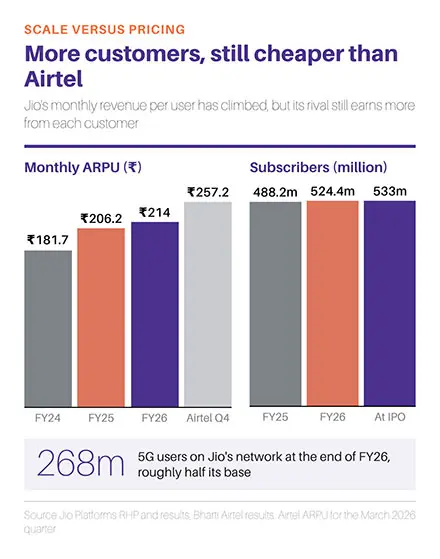
 Average revenue per user rose to ₹214 a month, from ₹181.7 two years earlier, helped by tariff increases in July 2024. The subscriber base reached 524 million by the end of March, making Jio the world’s second largest operator in a single country after China Mobile.
Yet there are pressure points. Return on average capital employed slipped to 10.76% from 12.5% a year earlier, a reminder of how capital hungry 5G, fibre and now AI infrastructure are.
Bharti Airtel still earns more per customer, with average revenue per user of ₹257.20 against Jio’s ₹214 in the March quarter.
At around 33 times FY26 earnings at the top of the price band, the valuation assumes continued pricing power.
 These problems will define Akash’s first years as a listed company executive. Quarterly earnings calls, independent directors and minority shareholders bring a level of scrutiny that an unlisted subsidiary never faced.
Why it is not a clean handover
Three things argue against reading the IPO as Mukesh Ambani stepping aside.
The first is control. Through Reliance’s 64.5% stake and his chairmanship, the elder Ambani retains the levers that matter most, from board composition to capital allocation.
The Ambanis also have reason for caution. The family’s last succession, after Dhirubhai’s death in 2002, ended in a bitter split between Mukesh and Anil.
The deliberate, staged pace of this one reflects that history.
The second is the family model. Mukesh Ambani told shareholders in June that “Isha, Akash and Anant will lead the next phase of Jio”, and said all three were heading the IPO process. Isha’s presence on stage was not incidental.
The plan, as Reliance has described it, is collective leadership across the group’s retail, digital and energy businesses, with each sibling running a vertical while sitting on the others’ boards.
The third is the professional layer. Pawar’s elevation to chief executive, in the same season as Akash’s appointment as managing director, gives Jio a seasoned operator to run the network and the numbers.
That arrangement frees Akash to concentrate on strategy, technology partnerships and investor relations, but it also means a meaningful share of executive authority sits outside the family.
The verdict
So will Akash take over most of Jio’s leadership after the listing? On the dimensions the outside world sees, the answer is largely yes. He is the managing director, the voice of the company to investors, the owner of its technology roadmap and the person Jio’s own prospectus credits with steering the shift from 4G to 5G and now AI.
At the investor event he called himself “a representative of the entire company” and positioned Jio as a technology platform rather than a telco, talking up AI-powered call summaries and transcription in 12 Indian languages.
On the dimensions that decide power, though, the handover remains partial.
Mukesh Ambani still chairs the board, still manages his own investor relationships and still controls the parent.
The operational machine answers to a professional chief executive. And the succession plan is explicitly shared among three siblings.
The more accurate reading is that the IPO turns Akash from heir apparent into an accountable executive. For the first time, his decisions will be priced daily by the market.
If Jio’s shares hold their premium and the AI and satellite bets begin to pay off, the remaining authority is likely to pass to him steadily over his five-year term.
If they stumble, the chairman’s seat gives his father every means to step back in.