
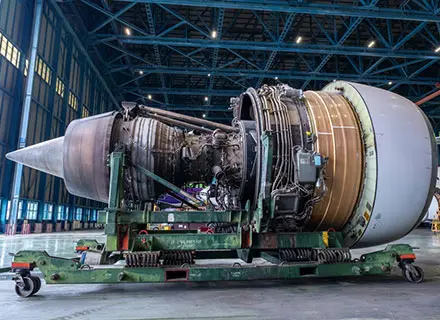

The engines that once flew Boeing 747s across oceans are being rebuilt to power data centres. Gas turbines that sat idle for years in storage yards are being dusted off, shipped across continents and put back to work. Brokers who used to work a quiet corner of the power equipment market now field a steady stream of requests.
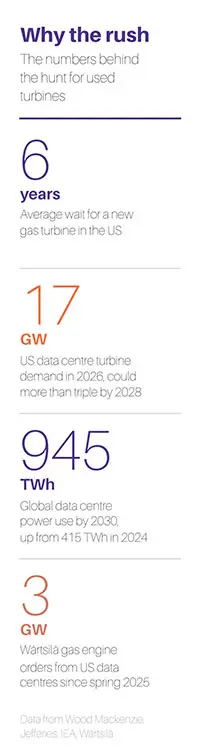
The reason is simple. The companies racing to power artificial intelligence (AI) data centres cannot buy new gas turbines fast enough. A large turbine ordered in the United States today takes about six years on average to arrive, according to Wood Mackenzie, and buyers are already discussing delivery slots in 2030 and 2031.
So utilities, developers and AI infrastructure firms are searching the world for second-hand turbines, reviving mothballed units and converting retired jet engines into power plants, Reuters reported this week after speaking to more than a dozen brokers, service firms and suppliers. The hunt is gathering pace even as investors grow nervous about the AI boom itself.
Sold out for years
Three manufacturers dominate the gas turbine market, GE Vernova, Siemens Energy and Mitsubishi Heavy Industries (MHI). All three say AI demand has pushed orders beyond what their factories can build.
Their order books show it. GE Vernova said on 28 October that its gas power equipment backlog and slot reservations had grown to 122 gigawatts (GW) at the end of September, up from 116 GW three months earlier. It expects at least 130 GW by the end of the year and is now taking reservations for delivery in 2032.
 Siemens Energy ended June with a gas turbine backlog of 69 GW and lead times of more than three years. MHI reported a large-frame backlog of 35 GW in August, up from 23 GW a year earlier.
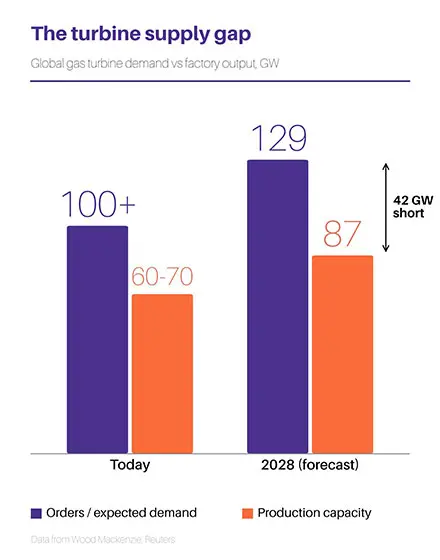
Wood Mackenzie puts global gas turbine orders at more than 100 GW, against annual production capacity of 60 GW to 70 GW. GE Vernova is lifting output from 20 GW a year to 24 GW in 2028 and 30 GW in 2030.
Siemens Energy has raised production of medium-sized turbines from about 50 units a year to about 80. Even so, global capacity is expected to reach only about 87 GW in 2028, well short of the 129 GW of demand forecast for that year.
Data centres account for a growing share of that queue. Jefferies estimates that US data centres alone need close to 17 GW of turbine capacity this year, a figure that could more than triple by 2028.
GE Vernova says data centres now make up about a fifth of its gas turbine demand, with traditional customers accounting for the rest.
Scarcity has pushed prices up as well. GE Vernova said its third-quarter gas equipment pricing was more than 20% higher than in the last quarter of 2025.
The Tennessee Valley Authority, the federally owned US utility, told Reuters that prices for all equipment, whether new, used or refurbished, had risen sharply over the past two years.
A hot secondary market
The used turbine trade has gone from niche to busy. The global turbine market is worth about $25 billion a year, and nobody has a reliable estimate of how much of it the second-hand trade represents.
Ana Amicarella, chief executive of turbine services firm EthosEnergy, called the secondary market “very, very hot” and said asking prices had climbed as more buyers chased the same machines. Darayus Pardivala, US aftermarket head at Sulzer, said he gets a request to find used turbines for a data centre every few weeks.
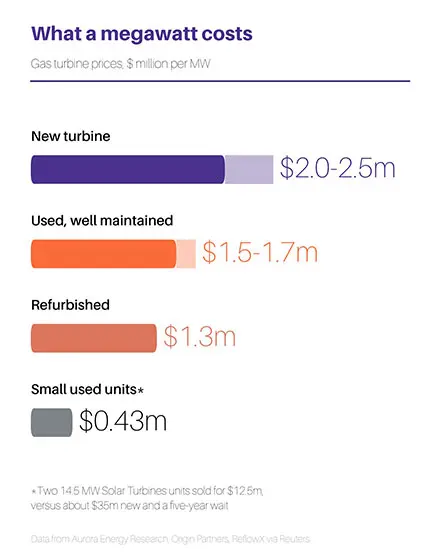
 The appeal is partly about cost and mostly about time. A well-maintained used turbine sells for about USD 1.5 million to USD 1.7 million per megawatt, according to Zach Machuca of Origin Partners, while refurbished units fetch about USD 1.3 million.
Some deals are large. In May, US power producer Hallador Energy agreed to pay USD 350 million for about 460 MW of second-hand Siemens gas turbines, generators and a steam turbine from Energy World Corporation, plus a further USD 100 million to ship and refurbish the equipment, rather than wait in the queue for new kit.
Others piece together power from dozens of small machines. Scott Schreeg of SVI Bremco said some sites now run more than 100 small turbines, often mixing models and brands.
From the runway to the server hall
The most striking workaround involves aircraft engines. Aeroderivative turbines, built from jet engine designs, have long supplied peak power and offshore platforms. Now AI campuses want them.
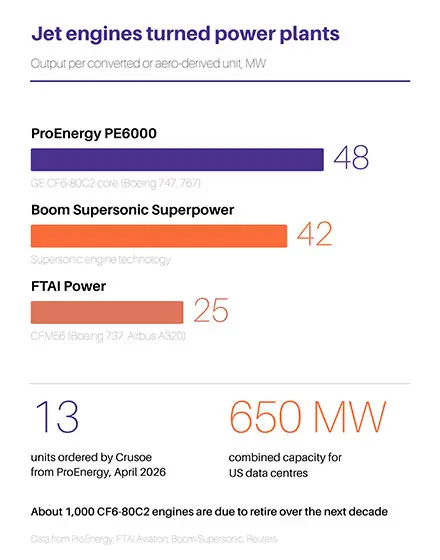
In April, AI infrastructure company Crusoe ordered 13 aeroderivative turbines from Missouri-based ProEnergy, with a combined capacity of 650 MW, for its US data centre projects.
ProEnergy’s PE6000 units are built around the cores of GE’s CF6-80C2 engine, which powered many Boeing 747 and 767 aircraft. Each overhauled core is fitted with newly made parts to produce about 48 MW.
 ProEnergy has said about 1,000 CF6-80C2 engines are due to retire over the next decade, which gives it a steady supply.
Some developers skip turbines altogether. Finland’s Wartsila has booked about 3 GW of orders from US data centres since spring 2025 for power plants that run on large gas engines instead.
Anders Lindberg, president of Wartsila Energy, summed up what was driving the market as “lead times, lead times, lead times”.
 The catch
Second-hand machines come with risks. Overhauled turbines can have patchy maintenance records, limited remaining life and weak long-term servicing support, said Aurora Tenorio, a senior analyst at Wood Mackenzie.
Converted jet engines raise a different question, whether equipment built for flight can run around the clock. Aeroderivative units also burn more fuel for each unit of power than large combined-cycle plants, and noise and emissions limits near towns can slow the permits they need.
For smaller buyers the squeeze is harder still. Jim Matheson, chief executive of the National Rural Electric Cooperative Association, said its members face unprecedented lead times and surging prices and are weighing every option, refurbished turbines included.
Betting against the bubble
The scramble is unfolding at an awkward moment. AI stocks have fallen sharply in recent weeks as investors question whether the hundreds of billions of dollars being spent on data centres will pay off.
On November 5, the Nasdaq Composite fell 5.5%, its steepest daily drop in 19 months, after US midterm results raised fears of tougher rules for the industry.
Yet buyers of power equipment are behaving as if the boom will last.
The International Energy Agency expects global data centre electricity use to more than double from 415 terawatt hours (TWh) in 2024 to about 945 TWh by 2030, roughly what Japan consumes today. It sees gas-fired generation for data centres rising by 175 TWh by 2035, mostly in the US.
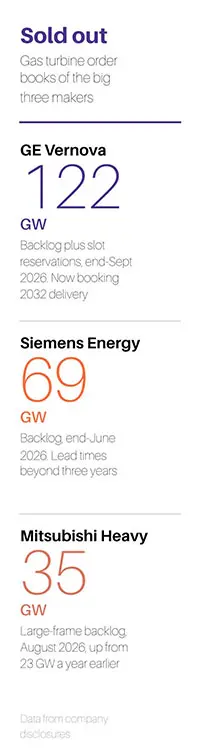 GE Vernova’s total gas capacity under contract rose by just 6 GW in the third quarter, compared with double-digit quarterly gains earlier in the year, and 58 GW of its 122 GW total is still in slot reservations rather than firm orders.
Chief executive Scott Strazik said he expects solid growth in 2027, though not at the pace of the first half of 2026.
Manufacturers have expanded with care, asking customers to fund much of the growth through deposits and reservation fees, which leaves much of the risk with buyers.
A developer paying a premium for a used turbine today is betting that the AI demand behind it will still be there when the machine starts running.
If demand cools, those turbines could flood back onto the market. If it holds, the people holding spare machines will keep naming their price.
For now, buyers are hedging. Many of the jet engine units are being bought as bridging power.
ProEnergy’s first data centre projects were designed to run for five to seven years until a grid connection arrives, after which the machines can serve as backup or be sold on. A turbine can be moved. A data centre that sits dark waiting for power earns nothing.
The rush for second-hand machines shows how far the AI build-out has run ahead of the industrial base behind it.
Data centre shells go up in a year, but the heavy equipment that turns gas into electricity can take most of a decade to arrive.
Until factories catch up, some of the world’s most advanced computing will run on hardware from the age of the jumbo jet.